Home

Review of LIGHTYEAR (Blu-ray combo)

Leave a comment

Grade:  B+
Animation
Rated PG

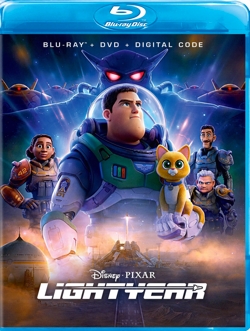
Sometimes you can’t help but hear the buzz about certain films, and I heard two main complaints about Lightyear (2022): that the character wasn’ta toy at all or acting very Buzz-like, and that Disney made a lesbian movie (gasp). And that kind of response slowed down this film at the box office.

Come on, people.  In Toy Story, Buzz Lightyear was an action figure programmed to speak a limited number of sentences, like the old Chatty Cathy dolls. That it came to life when people weren’t around was pure fantasy, and the toy Buzz, upon learning he’s not the real space ranger Buzz Lightyear, spent the rest of the moving dealing with a Pinocchio complex (“I wanna be a real boy”). Meanwhile, Lightyear states its basic premise on a pre-title sequence card that’s onscreen long enough for even slow readers to process:  “In 1995, a boy named Andy got a toy from his favorite movie. This is that movie.”

In other words, this animated Buzz is the living human film character that inspired the action figure seen in the Toy Story movies. People complained, Why isn’t Tim Allen the voice? Uh, because Tim Allen voiced a toy; the real Buzz is a different character, voiced here by Chris Evans—who knows a thing or two about playing a superhero. Later critics who gave Disney credit for the cleverness of the idea complained that Disney settled for making a typical origin story, but that also kind of misses the point. To inspire action figures and all sorts of merch, it takes a by-the-numbers blockbuster, and that’s what we get in Lightyear.
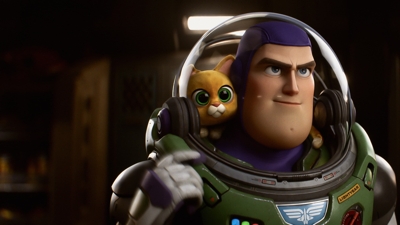
As for the lesbianism, I’m guessing that the people who are now losing their minds over a black mermaid are the same ones who bashed this film because it “exposed” children to gay characters. If you haven’t seen the film, you should know that the sexual orientation of Buzz’s best friend and fellow Space Ranger Alisha Hawthorne (voiced by Uzo Aduba) is introduced in innocent, matter-of-fact fashion. When she tells Buzz she got engaged, Buzz responds with the delight of any best friend and tells her how wonderful it is, adding, “Who is she?” Meaning, he’s already known about her orientation and accepts it as another fact of life, like hair color or temperament. So should moviegoers. And it’s treated so subtly here that many children won’t even notice. There are brief touchstone visuals and references to the married couple later parenting a child, and yes, there’s a kiss—but it’s the same kiss of greeting children receive from relatives of all genders. Same-sex marriage is such a blip on the screen that it’s a shame so many people are talking about that instead of the film.

If people have to rip on something (and finding fault with Disney pictures seems to be a national pastime, like Wordle or Sudoku), I’m surprised they haven’t attacked the logic behind the film’s main situational premise.
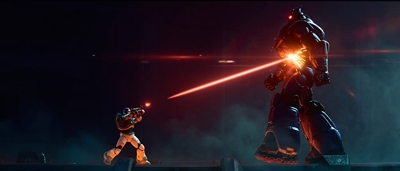
Buzz, best friend Alisha, and a rookie (Bill Hader) carry out an exploration mission on the planet T’Kani Prime. Quickly they (and we) learn the planet is populated by tentacled life forms, and after their ship is destroyed Buzz declares that they’re marooned. But fast-forward a year later and there’s a full-blown space colony with all kinds of people and the capacity to engineer, build, and operate high-tech buildings and vehicles. And they’re still trying to figure out how to repair or replace the hyperspace fuel crystal that will allow them to return home? Meanwhile, the commander and the rest of the colony (where’d they come from?) decide they want to stay on the planet, so they construct a biodome to protect them from hostile indigenous life forms.

Even small children may wonder about the effectiveness of a dome when the tentacled creatures seem to come from underground, but logic and action movies don’t exactly go hand in hand. And Lightyear is an action movie—a slam-bang ride that abandons warp speed only a handful of times so everyone can catch their breaths and also process poignant Up-style montages that explain why Buzz’s new right-hand ranger has to be Alisha’s space-phobic granddaughter, Izzy (Keke Palmer). Lightyear also alludes to and ramps up elements found in previous slower-paced space films as 2001: A Space Odyssey (instead of H.A.L. we get I.V.A.N.) and Interstellar (a fearful space glide especially stands out). Adults have all the allusions, and the kids will hone in on the action (when the bugs start getting zapped, older youths might have Starship Troopers flashbacks) and the characters—young Izzy, especially.

In Disney movies, animal friends aren’t just foils for characters or a source of comic relief. They’re minor characters who have the potential to steal scenes, and that certainly happens with Sox (Peter Sohn), a robotic cat assigned to be Buzz’s “personal companion robot” to ease his emotional transition after he had been on a long solo mission to retrieve a crystal. Also engaging are the ranger trainees that Buzz ends up with after his return:  Izzy, Mo (Taika Waititi), and the gravel-voiced Darby (Dale Soules), who all find themselves facing and fighting a robot invasion coordinated by . . . yep, Zurg (James Brolin), who is shot at times to make viewers think of that late, great space villain Darth Vader.
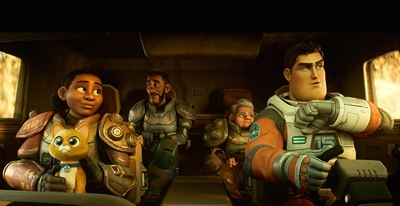
Viewers are either going to love all the Star Wars references and consider them clever allusions, or they’re going to hate them and think they’re lazy or unimaginative rip-offs. But they’re present in force, and you’ve been warned. I personally think they add a referential element that feeds into the whole idea of a space blockbuster and shows that director Angus MacLane and his cast and crew were trying to have some fun with this film. Ultimately, that’s what it is:  a fun animated film that’s nota prequel, not a sequel, and not an origin film. It’s a related film that helps to add depth and breadth to the Toy Story universe. Just don’t expect Woody or any of the other toys to show up.

Lightyear is streaming now on Disney+, but decent bonus features on the Blu-ray and repeat-play potential also make this worth adding to your Disney-Pixar home movie collection so you can play it even after it disappears from the online menus. And you know it will. Disney has that habit of returning titles rather quickly to the “vault.” The 7.1 DTS-HDMA soundtrack also has a commanding presence, and I’m not sure that’s the case with the streamed version.

Entire family:  Yes
Run time:  105 min. Color
Aspect ratio:  2.39:1 widescreen
Featured audio:  DTS-HDMA 7.1
Bonus features:  C+
Includes:  Blu-ray, DVD, Digital Code
Amazon link
Trailer
Rated PG for action and peril

Language:  1/10—Aside from a few euphemistic versions of swearwords that I can’t even recall, this is one squeaky clean galaxy

Sex:  0/10—Nothing at all, unless the mere mention of progeny somehow offends you

Violence:  4/10—Mostly it’s peril, because the violence itself is pretty tame, with the tentacled creatures losing a few here and there; when Zurg’s robot army appears, children who’ve been on the Buzz Lightyear theme park ride will get the same shooting gallery sensation watching this film, even down to the sounds

Adult situations:  2/10—A character has to deal with feelings of loss and displacement

Takeaway:  Disney-Pixar still has a friend in me, as long as they keep producing high-quality films like this one that continue to reflect the studio’s commitment to creativity and excellence


Review of WHERE THE CRAWDADS SING (Blu-ray combo)

Leave a comment

Grade:  B+
Drama
Rated PG-13

Unlike many reviewers of Where the Crawdads Sing (2022), I don’t have an axe to grind or a subject to bludgeon. I never read the first novel by 70-year-old Delia Owens that this Olivia Newman film is based on, and only heard about the hype—a Reese Witherspoon book club selection that sold 12 million copies in four years—and the controversy after watching the film. For some people, Owens’ background makes a difference, so I’ll address it briefly, though even without the backstory there’s plenty enough to get riled up about.

The film, like the novel, tells the story of a girl who is forced to fend for herself in the marshes of North Carolina after her abusive father drives off her mother and older siblings, and later bows out of the picture as well. Shamefully, it doesn’t occur to any of her family to take her with them. They just take off, leaving her alone with him.

The townspeople aren’t much better. They dub her “the marsh girl” and obviously recognize her situation, but only one couple shows her any kindness. And they certainly could have done more for her. Kya attends school barefoot, but is treated so shabbily that she never returns. Later, as a teenager after living in the marsh for years, she draws the attention of two young men: one a rich boy with a penchant for partying and taking what he wants, and the other a college-bound youth who at one point decides to teach Kya how to read. Some think that sweet; others call it condescending and controlling or a perverse sort of  relationship imbalance fetish.

Maybe the razors were sharpened after it was brought to everyone’s attention that Owens, like Kya, was (and is still) a suspect in an unsolved murder. In the film, one of Kya’s suitors ends up dead and she stands trial, with David Straithairn playing the kind of down-home country lawyer with uncommon wisdom and empathy that we saw in Harper Lee’s attorney, Atticus Finch. In real life, Owens and husband Mark were working as biologists and environmentalists in Zambia and were being filmed when a poacher was shot and killed . . . on camera. The couple left the country and was advised not to return because they remain persons of interest, as shown on ABC’s 1996 special Deadly Game: The Mark and Delia Owens Story.

But back to the film. Lucy Alibar (Beasts of the Southern Wild) wrote the screenplay, Witherspoon co-produced, Polly Morgan (The Woman King) was responsible for the gorgeous location cinematography, Taylor Swift co-wrote and sang the theme song (“Carolina”), and Daisy Edgar-Jones (Normal People, Under the Banner of Heaven) headed a talented cast as Kya. Though men also are involved in the project, Where the Crawdads Sing feels very much like a female empowerment story and holds considerable appeal because of that.

More

Review of TWICE TOLD TALES (1963) (Blu-ray)

Leave a comment

Grade:  B-/C+
Drama/Horror
Not Rated (would be PG)

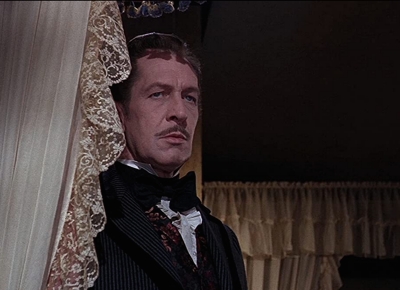
Rewatching Twice Told Tales on the new Kino Lorber Blu-ray, I found myself wondering about the ideal audience for this film adaptation of Nathaniel Hawthorne stories featuring screen legend Vincent Price.

Children old enough to have read the stories in school might be curious to see how the 1963 film treatment was handled, but I’m not sure that they will appreciate a tone that tends toward the melodramatic. Director Sidney Salkow took a break from directing popular TV series like Death Valley Days to churn out seven B-movie genre films: four westerns, a mystery, and two fantasies—one of them being this anthology of Hawthorne tales.

Whether by design or coincidence, the three stories are presented in descending order of appeal. The strongest tale, “Dr. Heidegger’s Experiment,” is a short story that plumbs the depths of human desire for a fountain of youth or immortality. Like the frequently anthologized Edgar Allan Poe story “The Cask of Amontillado,” it involves a friendship that’s solid on the surface but bubbling beneath with hidden emotions. Sebastian Cabot—whose voice children may recognize as the narrator of Disney’s Winnie the Pooh films and the character Bagheera in Disney’s animated Jungle Book—plays Carl Heidegger, who celebrates his 79th birthday with best friend Alex (Price), his only companion since his beloved fiancée Sylvia (Mari Blanchard) died the night before they were to be married 38 years ago. But a “dark and stormy night” causes the door to a crypt in the backyard where her coffin is housed (yep, we’re talking Gothic romance) to open. Carl feels compelled to check on her, and both men are shocked to see that her body appears as it did when she was alive. The rest of the tale follows Dr. Heidegger’s drive to discover what preserved her and maybe even bring her back to life.

The type of horror included in these Price Told Tales is the same sort one would find in a Jaycee’s haunted house: skeletons, dead bodies, creatures dying instantly as if from witchcraft, blood oozing from strange places, etc.—minus the jump scares. It’s pretty tame but still somehow memorable . . . because of the images or concepts, or because of their pairing with old-time melodrama?

More

Review of COSTA BRAVA, LEBANON (Blu-ray)

Leave a comment

Grade:  B-
Drama
Not rated (would be PG-13)

Americans have never been good at thinking about the future. A 2019 Northwestern Mutual poll found that 15 percent of Americans age 40 and older haven’t even put aside a single dollar toward their retirement years. And if the price of gas isn’t too crazy, no one gives a second thought as to whether the oil will run out some day, or whether the polluting side-effects of petroleum consumption will one day become intolerable. Same with the mountains of trash that Americans produce on a daily basis. Does anyone wonder if there will ever come a time when all the refuse becomes too much for the government to handle?

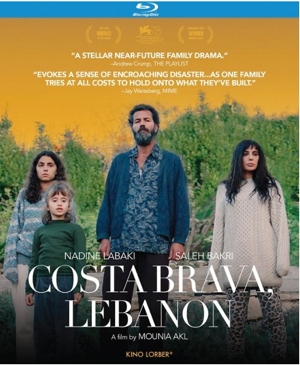
Costa Brava, Lebanon (2021)is an environmentalist fable in Arabic (English subtitles) from Mounia Akl and the Lebanese entry for the Best International Feature Film category at the Oscars. A cautionary tale set in the near future, it has an engaging cast and some powerful moments as it tries to sound the alarm to alert people to an impending crisis of waste management. Except that in some countries it’s not all that impending. It’s already happening. Visitors to Egypt’s pyramids, for example, must first drive past mounds of trash pushed to the sides of roads and freeways. And that could happen anywhere . . . and everywhere.

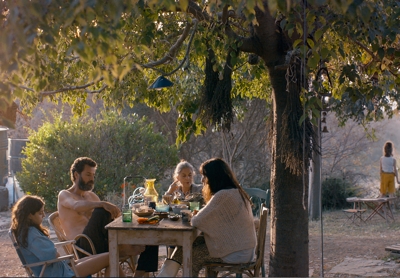
Saleh Bakri and Nadine Labaki star as Walid and Soraya, a couple who eight years earlier decided to leave their Beirut home because of the poor air quality, pollution, and corrupt politics that made life there untenable. Now they live in the mountains with Walid’s aged mother and the couple’s two daughters: a teenager eager for more than the sheltered life her parents provide, and a precocious adolescent. Presumably because of the mother’s previous income from her pre-marriage career as a popular singer, they were able to build a house in the country’s last unspoiled place, an idyllic hillside home that even has the luxury of a small in-ground swimming pool. But it doesn’t take long for this paradise to be lost, and that’s the whole point of the film. Society’s problems are everyone’s problem. There’s no escaping them—even if you try to live off the grid.

You’d think that Walid and Soraya, former activists who met at a protest, would know that. But the impulse to survive and protect loved ones is even stronger than the drive to fight for the change that society needs. Alas, not long after we meet this family, men from the government show up. And like the earth-moving equipment operators from earlier films such as The Emerald Forest or Avatar who displaced forest-dwellers, the workers force the family to make the same hard decision that drove them to the mountains in the first place. On a micro level, Costa Brava, Lebanon could have been about any disaster, because it’s an intimate look—rendered so by Akl’s directorial style—of how one family deals with adversity.

More