Home

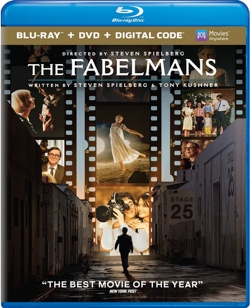
Review: THE FABELMANS (Blu-ray combo)

Leave a comment

Grade:  A-

Drama

Rated PG-13

The Fabelmans was promoted as a “semi-autobiographical story loosely based on Spielberg’s adolescence,” but after Steven Spielberg’s November 2022 New York Times interview, the term “biopic” seems more appropriate. As it turns out, all of the major and memorable events happened pretty much as they were depicted in this 2022 film, which earned seven Oscar nominations. That includes a memorable scene where a timed young aspiring filmmaker meets the great, gruff John Ford in his office.

Even without labeling, audiences would have picked up on at least one similarity between the boy in the film and the famous director’s work:  a scene with boy scouts reminiscent of a sequence from the third Indiana Jones film. In fact, Spielberg recreated exactly the first short films that he made, including one he made with his boy scout troop to earn his photography merit badge.

The Fabelmans (fable-man’s) are an eccentric Jewish family that’s split down the middle of their collective brain. The mother, Mitzi (Best Actress nominee Michelle Williams), is a creative right-brained talent ruled by passion and imagination. A concert pianist, she’s also a free spirit who loves life, loves to laugh, and loves to play-act. The father, Burt (Paul Dano), is a left-brained tech genius who does his best to go with the flow, despite wanting his son to make useful things, as he does does. In their own way, both parents are  creative, so it’s no wonder that Spielberg turned out to be a creative genius. The fun of this film comes from seeing how that genius was nurtured in his adolescent and teen years.
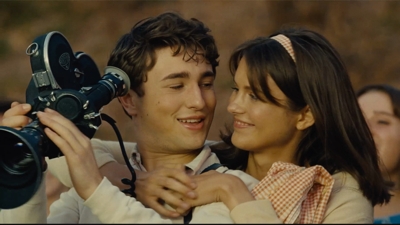
As one of Sammy Fabelman’s three younger sisters (Keeley Karsten, Julia Butters, Sophia Kopera) observes, the youth is most like his mother.

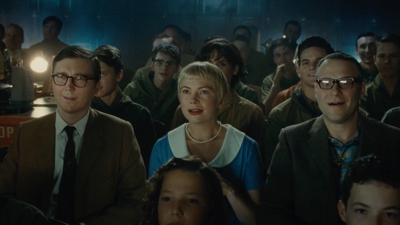
Sammy (Gabriel LaBelle) is immediately drawn to filmmaking after his parents take him to see Cecil B. DeMille’s The Greatest Show on Earth—alternately mesmerized and traumatized by the film’s storytelling and realistic depiction of a train crash.

Mitzi is drawn to her husband’s partner and best friend, Bennie (Seth Rogen), who does everything with the family except spend the night in the same house. Bennie is silly and a bit of a free spirit himself. Early on the audience can detect that their mutual attraction is a train wreck in the making.

What results is a fascinating coming-of-age film with a twist:  as Sammy teaches himself how to make movies, the audience learns all the ingenious things that young Spielberg did with a little budget and big ambitions. His special effects and utilization were a marvel, and he learns early that the power that a film can have—especially when it captures people in a way that can be missed or overlooked in daily life. Film can be a means of expression, it can evoke emotions in the audience, and it can reveal truths—some of them painful.

Michelle Yeoh deserved to win the Best Actress Oscar, but so, frankly, did Michelle Williams, who captivates the audience as much as she does her family . . . and Bennie. She brings life to the film in every frame she’s in. Gabriel LaBelle is also convincing as the young hero who copes with anti-Semitic taunts, bullying, parents who are drifting apart, an uncle (Judd Hirsch) who tells him he was meant to pursue his art at the expense of his family, and a first crush that ends up being a Pray-the-Jew-Away comedy in two acts.
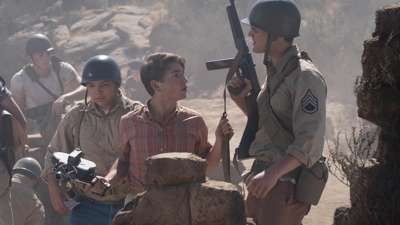
Hirsch leans a little too close to familiar stereotypes in his performance as Uncle Boris, a former actor and circus performer, but the rest of the cast blends seamlessly into the landscapes of ‘50s and ‘60s Arizona and California. They were no doubt helped considerably by watching the home movies that Spielberg showed them and the recollections he shared so they could get a handle on how to play them. As Paul Dano said, “For somebody like Steven to share that much of himself with us—with the audience too—it was really a profound experience.

Knowing that this is the life story of one of the great directors of all time—the man who gave us Jaws, Close Encounters of the Third Kind, Raiders of the Lost Ark, E.T. the Extra-Terrestrial, The Color Purple, Jurassic Park, Schindler’s List, Saving Private Ryan, War Horse, Lincoln, The Post, and West Side Story—makes an already compelling film even more so. The average viewers will make connections to many of their favorite Spielberg films, and appreciate them (and this biopic—there, I said it) all the more.

The late Roger Ebert once said, “No good film is too long,” and that almost applies to The Fabelmans, a 2.5 hour film that might prompt many people to head for the snack counter or restrooms or just stretch their legs. Some of the scenes might go on a bit long, but it’s an interesting, episodic story that covers a lot of ground: the breakup of a marriage, prejudice, a painful relocation, a first love, and, most of all, the development of a filmmaker. In the end, you’re apt to forgive Spielberg his one excess:  trying to make a biopic that does justice to his own interesting life and amazing career.

Entire family:  No (junior high age and older)

Run time:  251 min. Color
Aspect ratio:  1.85:1 anamorphic widescreen

Featured audio:  Dolby TrueHD 7.1

Bonus features:  B

Includes:  Blu-ray, DVD, Digital Code

Amazon link

Trailer

Rated PG-13 for some strong language, thematic elements, brief violence and drug use

Language: 5/10—1 f-bomb plus a peck of lesser swearwords

Sex:  3/10—Just the start of a teen make-out session, an embrace and hand-holding as signs of an affair, plus Sammy’s mom dances nude in a see-through dress (though all the audience sees is the outline of her shape)

Violence: 3/10—A character is pushed and punched in the face (nose bloodied), and an adult slaps a teen across the face; it hardly counts, but the young director films a war movie with realistic blood and gore from his high school “actors” not that severe because we see the secret behind the screen magician’s tricks

Adult situations:  3/10—Social drinking and smoking, plus the sadness of anti-Semitic bullying and a marriage on the rocks

Takeaway:  Spielberg said he almost abandoned his dream of being a filmmaker after seeing Lawrence of Arabia, thinking he could never reach the heights that David Lean did in that film. But he has done so a number of times, even if he fell just shy of perfection with this one
Review of NEVER SAY DIE (1939) (Blu-ray)

Leave a comment

Grade:  B/B-

Comedy

Not rated (would be PG)

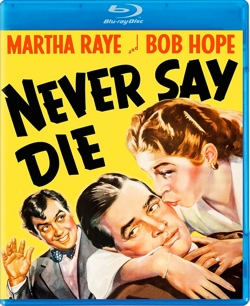
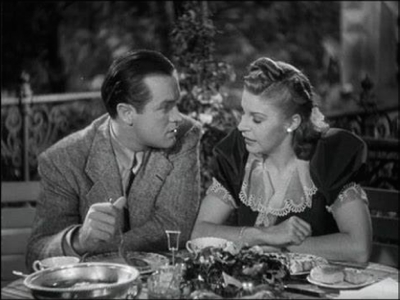
Bob Hope comedies have been entertaining families for generations, perhaps because Hope’s onscreen persona is a likable, somewhat bumbling and cowardly, non-threatening kid version of an adult. Before Hope took his vaudeville shtick on the road with Dorothy Lamour and Bing Crosby, he was paired with “Big Mouth” Martha Raye in a pair of screwball comedies. They had the leading roles in Give Me a Sailor (1938) and Never Say Die (1939), both of which involved multiple possible couples in a comedy where romance for the leads happened unexpectedly.

Never Say Die, which was based on a long-running Broadway play, is the better of the two. The writing is crisper and Raye and Hope (they were billed in that order) relate to each other so wholesomely and with a certain amount of naiveté that you begin to realize Universal might have been hoping they’d become the studio’s version of Judy Garland and Mickey Rooney. They’re not—probably because Raye and Hope don’t quite have the chemistry that Garland and Rooney did. But Never Say Die is still a fairly solid early comedy for both of them.

It’s a tale of two fortunes (and two fortune hunters), as wealthy hypochondriac John Kidley (Hope) gets a diagnosis intended for a dog and thinks he has only a month to live. He decides to put his fiancée, Juno (Gale Sondergaard) on hold while he runs off to the fabled spa of Bad Gaswasser, half hoping for a miracle but more practically wanting to go out in style.

Meanwhile, Texas heiress Mickey Hawkins (Raye) has her own problems. She’s in love with a bumpkin bus driver from home (Andy Devine) and wants nothing to do with Prince Smirnov (Alan Mowbray), to whom she’s been betrothed. Turns out the Prince, like Juno, is also a golddigger.

Screwball comedies from the late thirties and early forties often involved class clashes, disguises and mistaken identities, fast-clipped dialogue, romantic mix-ups, and farcical rotations of characters. This one works as well as it does partly because it was based on a successful play by William H. Post and William Collier Sr.— but also because one of the screenplay writers was none other than Preston Sturges, who elevated the screwball comedy to a sub-genre with his intelligent writing.

Never Say Die never reaches the same heights as the Sturges-directed The Lady Eve or The Palm Beach Story, though, because it doesn’t have the same level of sophistication. It’s a screwball comedy for the masses, without the subtly withering embedded commentary on the upper classes. While it’s also not quite as madcap as another Sturges comedy for the masses—the WWII-era The Miracle of Morgan’s CreekNever Say Die does manage to do a lot with the cliché that “three’s a crowd.”

Never Say Die is directed by Elliott Nugent, whose best film might just be Nothing But the Truth (1941), another one in which he directed Hope, that time opposite Paulette Goddard. Nugent is a storyteller first and a satirist second, and that’s evident in Never Say Die. Though the film isn’t one of the great screwball comedies, it’s still fun enough and wholesome enough for the entire family to watch—if the kids are so inclined.

More

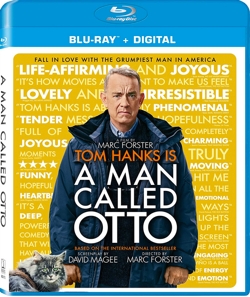
Review of A MAN CALLED OTTO (Blu-ray)

Leave a comment

Grade:  B-

Drama-Comedy

Rated PG-13

A Man Called Otto (2022) offers another serving of a Hollywood trope we’ve seen many times over: the grumpy widower whose life is brightened somehow by a younger person.

In Finding Forrester the old man was a Salinger-like recluse dogged by a young wannabe writer. In Gran Torino it was a crusty racist war veteran softened by a teenage Lao Hmong refugee. In About Schmidt it was a still-numb and rudderless old coot that found some sense of purpose by corresponding with a Tanzanian boy through a Plan USA program. In Murphy’s Romance it was a widowed druggist who found an unlikely romance with a young single mom. And in Disney’s animated Up it was a gruff old codger with a cane who became stuck with an overly talkative boy scout insisting he help the elderly man in order to earn a merit badge.

There are many more examples to cite, but this Tom Hanks film tweaks the trope to make it both schmaltzier and darker. Otto (“O-T-T-O”) is so lost and depressed after losing his beloved wife to cancer that he tries to take his life onscreen—multiple times, and by multiple means. If this were a Taika Waititi film, those attempts would have been rendered more comically. But director Marc Forster (Finding Neverland, The Kite Runner) goes for a deadpan blend of dark humor and pathos that doesn’t quite scream “Don’t try this at home,” the way broader humor might have done.

A Man Called Otto is a bit of a Hanks family affair, with Hanks’ wife, Rita Wilson, sharing a producing credit and son Truman playing a younger Otto in flashbacks. In the early going those flashbacks with Sonya (Rachel Keller) keep the film from being a total downer, like a film version of “Bolero” that plays over and over again because Forster tends to overstate Otto’s grumpiness, anger, and unexplained Barney Fife-like mission of guarding a gated cul-de-sac block of row houses in the Pittsburgh, Pa. area. The average viewer will, at some point, think, Okay, I get it. He’s an angry old bird. Move on. The film runs six minutes past two hours, so it could certainly have used a heavier hand in the editing room.

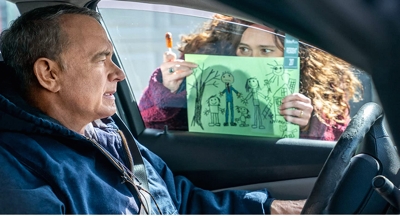
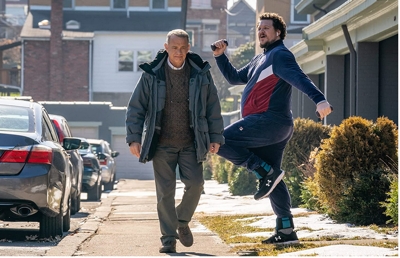
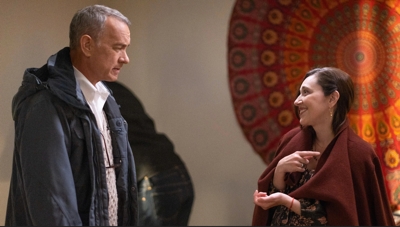
Though Hanks—like Sean Connery, Clint Eastwood, Jack Nicholson, James Garner, and Ed Asner before him—is the focal character and the one who grows and changes, the heart of the film belongs to a pregnant Mexican woman named Marisol (Mariana Treviño), her two young daughters, and her bumbling husband (Manuel Garcia-Rulfo). Without this family, Otto is a dead man, and without Treviño the film is a train wreck. Treviño has been acting for 10 years, but A Man Called Otto has to be considered her breakout role for U.S. audiences. She received no nominations for her performance, but Marisol’s exhuberance, honesty, and literal foot-in-the-door no-nonsense approach to life and relationships model the kind of virtues and values that parents might hope their children could attain. And her onscreen daughters Abbie (Alessandra Perez) and Luna (Christiana Montoya) get the assist. Scenes with them and Otto can seem cloying at times because they’re so purposefully intended to show Otto beginning to soften, but the young actresses channel their screen mother’s knowing enthusiasm along with their own characters’ innocence and naiveté to make those scenes funny.

Is it manipulative? Heck yeah. You’ll find yourself near tears one minute and laughing the next, and you know it’s because most of the scenes seem shot with the sole purpose of moving the audience. Some viewers will resent that, while others will appreciate a roller coaster ride that dips down for much of the first half and climbs throughout most of the second.

But if you give it any thought, Otto’s depression and anger would have been plenty to pull at audience’s heartstrings without the filmmakers adding a seemingly tacked-on side plot about a friendship that dissolved over automobile makes and a parallel sad medical situation. All of that feels like unnecessary piling on. The film would have been helped by fewer downer subplots, fewer trips to the cemetery, and more diverse characters like Malcolm (a transgender kid who had Otto’s wife for a teacher) and Jimmy (a neighbor whose fitness walking style will crack you up). There’s no happy ending here, only a happy transformation.

Is it family fare?  Perhaps, for families with tweens and older children. I’m a film critic, not a mental health professional, but a UCLA study reported that suicide is the second-leading cause of death among people age 15-24, with nearly 20 percent of high school students admitting that they’ve had serious thoughts of suicide. That’s a crazy statistic. Would it help them to watch a depressed and angry man who thinks he has nothing to live for find his way? Parents who know their children might have the answer. I don’t. I do know this: a film isn’t a substitute for professional evaluation and treatment, but it could very well be a starting point for a discussion that could lead to seeking outside help.

Entire family:  No

Run time:  126 min. Color

Studio/Distributor:  Columbia/Sony

Aspect ratio:  1.85:1

Featured audio:  DTS-HDMA 5.1

Bonus features:  C

Includes:  Blu-ray, Digital Copy

Amazon link

Trailer

Rated PG-13 for mature thematic material involving suicide and language

Language:  7/10—Some audience members seem to bristle at the mere mention of “transgender,” and that word is spoken, along with an f-bomb, a few profane God damns, shits, hell, SOB, etc.; turns out that angry old men have a potty mouth

Sex:  1/10—Nothing here, even in flashbacks, which are intended to be tender; just a few kisses

Violence:  3/10— Otto loses it with a honking driver, physically manhandling the guy and threatening him, and there are lesser examples of physicality

Adult situations:  7/10—Aside from the multiple suicide attempts, two of which have him experiencing a near-death vision of his wife, there’s some alcohol and smoking, and one death

Takeaway:  A Man Called Otto is based on a best-selling novel by German writer Fredrik Backman, so given the number of aging male actors in Hollywood I would say there’s a pretty big incentive for future novelists to keep feeding this trope

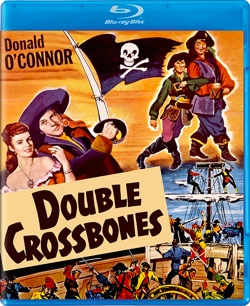
Review of DOUBLE CROSSBONES (Blu-ray)

Leave a comment

Grade:  B-/C+

Adventure Comedy

Not Rated (would be PG)

Today’s audiences know Donald O’Connor mostly as the third wheel in the 1952 Gene Kelly and Debbie Reynolds musical romance Singin’ in the Rain—you know, the “Make ‘Em Laugh” guy?

But O’Connor, a former vaudevillian, also had his share of top billings, starting with 1938’s Tom Sawyer, Detective and continuing with a series of romantic leads and Francis the Talking Mule pictures. Typecast as a mild-mannered nice guy / funny man, he became Universal’s version of Bob Hope. 

Hope made a Western comedy-musical in 1950 (Fancy Pants), and so did O’Connor (Curtain Call at Cactus Creek). Double Crossbones, which followed a year later,is Universal’s answer to the Hope comedy The Princess and the Pirate, in which a bumbling non-pirate finds himself at sea pretending to be one.

While the Hope film is a classic comedy that was frequently televised and released for home video, Double Crossbones got buried somehow—a forgotten little treasure that was recently dug up by Kino Lorber and released for the first time on Blu-ray for family home theaters. Like many films from the ‘50s, it’s a fun costumed romp that’s heavy on light entertainment, with a plot that’s just complicated enough to keep it interesting.

O’Connor is engaging as always, but surprisingly up to the task of shivering a few timbers and slitting a few gullets—far less cowardly than Hope’s characters. He plays shopkeeper’s apprentice Davy Crandall, whose boss turns out to have been selling stolen merchandise bought from pirates. When he’s wrongfully accused of being one of the pirates, Davy ironically takes to the high seas with his newfound sidekick (Will Geer) and bumbles his way across the Spanish Main to the top of the brotherhood (and sisterhood—pirate Anne Bonny makes an appearance).

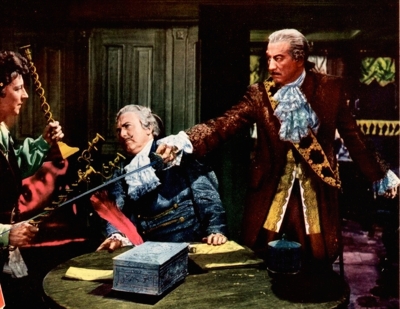
Double Crossbones is directed by Charles Barton, who would later direct Disney’s The Shaggy Dog (1959), and in both films the comedy is mostly situational. Fans of classic TV will recognize Geer as the grandpa from The Waltons and Hayden Rorke as the suspicious Dr. Bellows from I Dream of Jeannie. And if the actor playing Captain Kidd looks familiar, it’s because Alan Napier would go on to play Bruce Wayne’s butler, Alfred, in the campy sixties Batman series.

There’s action, but the violence is minimal compared to films today.

There’s comedy, but the jokes aren’t as clever or in-your-face as in films today.

There’s drama, but not the melodrama of most films of the era or the anxiety-driven films of today.

As I said, Double Crossbones is light entertainment, but fun and watchable light entertainment that manages to sneak in a comic dance routine from O’Connor . . . who indeed makes his cutlass-and-pistol-wielding audience laugh.

Will he have the same effect on audiences today? Probably not. Hope’s The Princess and the Pirate (1944) is still the better movie of the two, and The Crimson Pirate, Treasure Island, and Against All Flags are the best of the pirate movies that Hollywood made in the fifties. Everything else falls somewhere in the 2-2 ½ star range out of 4, and Double Crossbones lands near the higher end of those colorful genre films. It’s guilty pleasure pirate booty that still makes for an entertaining family movie . . . perhaps as the warm-up for one of Disney’s Pirates of the Caribbean movies?

Entire family:  Yes

Run time:  76 minutes Color

Studio/Distributor:  Universal / Kino Lorber

Aspect ratio:  1.37:1

Featured audio:  DTS 2.0

Bonus features:  C

Amazon link

Trailer

Not rated (would be PG for some violence)

Language:  1/10—Squeaky clean, but I might have missed something

Sex:  0/10—Tepid, not torrid, love interest, with an occasional embrace

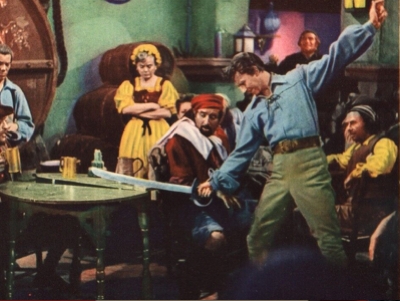
Violence:  3/10—There are swordfights (uh, “Pirate!”) and brawls, but nothing cringeworthy

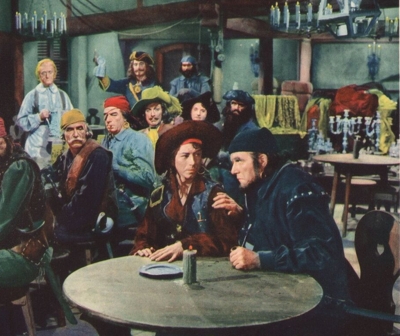
Adult situations:  2/10—Pirates hang out in pubs in Tortuga, and so there’s drinking and smoking in such scenes

Takeaway:  Disney’s Treasure Island sparked several dozen pirate movies in the fifties, more than were made in the previous decades, and Double Cross is an artifact of that era

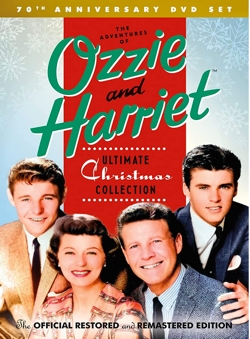
Review of THE ADVENTURES OF OZZIE AND HARRIET ULTIMATE CHRISTMAS COLLECTION (DVD)

Leave a comment

Grade:  B-

TV sitcom

Not rated (would be G)

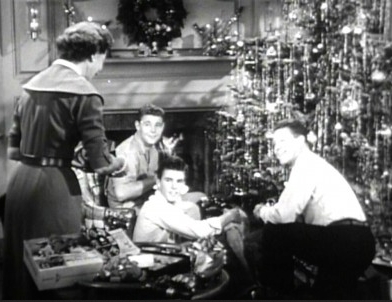
Some Christmas movies are best seen as a run-up to the holiday, while a few special ones become part of our family holiday traditions. Others, like The Adventures of Ozzie and Harriet Ultimate Christmas Collection, are best seen after the letdown of Christmas, when everyone is feeling slightly sad that the extended family that gathered has gone back to their own separate, hectic lives. This two-disc 70th anniversary DVD set is guaranteed to spark nostalgic feelings and thoughts, especially if you’re a fan of classic TV, old enough to remember television before streaming, or feeling nostalgic already about Christmases past.

For 14 years, Americans tuned in to watch The Adventures of Ozzie and Harriet, a sitcom featuring former bandleader Ozzie Nelson, his singer-turned-wife Harriet, and their two boys, David and Ricky. It wasn’t exactly reality TV, but it wasn’t a straight fictional sitcom, either. Their TV house on 822 Sycamore Road was built to look like an exact replica of the Nelsons’ Hollywood home, and the episodes were mostly inspired by the Nelsons’ real lives, especially young Ricky’s, who had a propensity for lowering his head and driving full speed ahead, no matter what was involved.

Like today’s reality shows, the Nelsons played themselves and ad-libbed a certain amount, but there were still scripts that shaped each episode and you always suspected that when the cameras stopped rolling there was a side to this TV family that you never saw. I mean, name two siblings in America other than David and Ricky that never really fought! These guys were as polite to each other as they were to their teachers or parents, whom they addressed as “ma’am” or “sir.” As in “No, ma’am,” or “Yes, sir.” But I can’t think of a better way to get a feel for the Fifties than by watching The Adventures of Ozzie and Harriet, and this Christmas collection will get more play and appeal to a wider audience than the regular episodes because of people’s natural curiosity about how families celebrated Christmas in earlier decades.

Ozzie and Harriet remained pretty much the same throughout this squeaky clean-cut series. Ozzie was the ever-smiling, often bumbling or hapless father who had a good relationship with his wife and sons, and who never raised his voice or got angry.  There seemed to be no secrets with this group, and no topic that was too small or too taboo to bring up. Ozzie always seemed to talk on a level that would have made him a great kiddie show host, especially when he wore those cardigan sweaters that Mr. Rogers later would discover. Harriet, meanwhile, was the always perfectly coiffed and poised matron who was the quiet voice of reason and the apron-wearing expert on social graces.

It’s the boys who did all the changing, Ricky especially. Viewers first saw him as a milder, 11-year-old version of Dennis the Menace–that twinkle-in-the-eye mischief-maker who was basically a good kid but had some pretty definite ideas about how to have fun.  Then, before you knew it, Ricky was caught up in the brand new rock ‘n’ roll craze and dressed like Elvis Presley for one Halloween episode. The pre-teens went nuts. The family had always been musical, with the boys playing multiple instruments, so it was a no-brainer for Ozzie to figure out how to incorporate Ricky’s playing into the show. His first musical outing aired on April 10, 1957, with “Ricky the Drummer.” Quickly, Ricky Nelson became a teen idol, and his father, who had the same sort of control over this show as Lucille Ball and Desi Arnaz had over theirs, found ways to incorporate every single song somehow in the episodes. If there wasn’t a way to work in the song during the show, then it was tacked on at the end, like an epilogue or a bonus scene.

More

Newer Entries