

Grade: B
Drama
Not rated (would be PG)
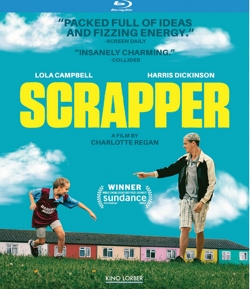
After watching Scrapper a second time, I found myself scratching my head that British director Charlotte Regan was able to craft such a likable feature film her first time doing something more than music videos and short films. It confirmed for me that the “flaws” I perceived initially were really just stepping stones for this director’s different sort of journey. I liked it despite:
—a gentle tone that comes dangerously close to meh territory,
—a quirkiness that’s understated even by indie standards,
—a narrative that has conflicts you’d also have to call gentle or understated,
—a crisis point that’s relatively calm in a story with no real antagonist, and
—emotional content that’s so understated (there’s that word again) it borders on matter-of-factness or apathy.
Altogether, it adds up to a different kind of daddy-daughter story—one that’s endearing in a non-cloying way and that tells a story of human interaction without relying on standard tropes and audience manipulations.
Amazon link
Scrapper might work just as well as a play, because it revolves around two flawed characters who learn to put up with each other and peacefully coexist. They’re their own antagonists, as we watch them take baby steps toward an understanding that both of them seem to want, deep inside. Except their outsides don’t know it yet, and so they resist or fall short of full commitment.
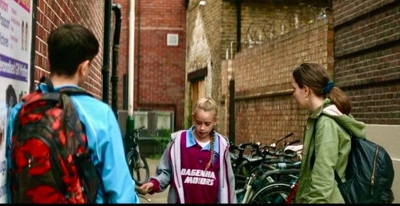
Here’s how simple the plot is: Georgie’s mum died, and while aren’t supposed to question the logistics of why she wasn’t taken away when the body was, we see her fending for herself in the flat. She pays the rent by stealing bicycles with her best (and only) friend Ali (Alin Uzun) and selling them to a fence. One day she looks out the window and a strange man is hopping her fence. It turns out that he’s her dad, returned from a carefree life in Ibiza. He heard her mum passed away and decided to see how she was doing. Though Georgie isn’t about to let any stranger who calls himself “dad” in her house, he blackmails her by telling her he’ll phone social services.
Once he’s in, she sends him on an errand and then changes the lock. Again, pretty swift work, unless a locksmith owes her a favor or she just happens to have a new lock ready to install right there at the apartment. But he doesn’t get angry—no one, really, expresses feelings that run high on the Emotion Meter—and they continue to tolerate each other. Small things happen in small ways to help them get to a point where they’re ready to accept each other. That’s the film in a nutshell: subtle, and far from the kind of heartstring tugging that a director could have opted for with a daddy-daughter-reunion-‘cause-mommy’s-dead story. Except that they’re really more like older brother and younger sister as they try to negotiate a relationship from scratch.
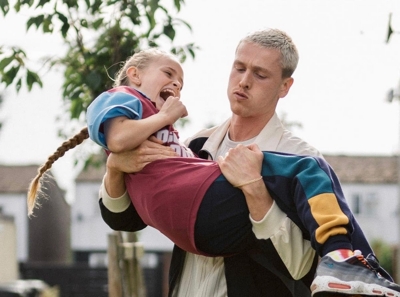
In retrospect, that’s kind of refreshing. The wildest or most expressive elements in the film seem to be leftover ideas from Regan’s music video days—a few visual tricks and modern sitcom-style “interviews” to impart quirkiness in a different kind of way. To me, though, they didn’t add to the film, and, overdone, detracted from it.
But the tentative relationship between Georgie (Lola Campbell) and her dad, Jason (Harris Dickinson) is strong enough to weather the stylistic storm. Overall, this film really has a gentle vibe—no tantrums, no shouting, no swearing, and no “go to your room”s. But it was strong enough to win the Grand Jury Prize in the World Cinema Dramatic Competition at Sundance.
Entire family: No (Age 10 and older?)
Run time: 84 min., Color
Studio/Distributor: BBC Film / Kino Lorber
Aspect ratio: 2.39:1
Featured audio: DTS 5.1 Surround
Bonus features: C
Not rated (would be PG for petty theft and adult situations)
Language: 1/10—Nothing verbalized that I caught, but there was one prominent middle finger
Sex: 0/10—Nothing, other than Ali’s concern for his friend sleeping in the house with a strange man roaming about
Violence: 2/10—One incident involving one child giving another a black eye
Adult situations: 2/10—A child steals bicycles and “dad” advises her to file off the serial numbers before painting it—there are no role models here, only characters trying to figure things out
Takeaway: Scrapper sticks with you because of the casting of the two main characters, the understated direction, and the way those two make you believe you’re watching life as it’s really lived
 Family Home Theater
Leave a comment