Home

IN THE DEEP (DVD)

1 Comment

IntheDeepcoverGrade: C
Entire family: No
2016, 89 min., Color
Dimension Films / Anchor Bay Entertainment
Not Rated (would be PG for drinking and frightening situations)
Aspect ratio: anamorphic widescreen
Featured audio: Dolby Digital 5.1
Bonus features: n/a
Trailer
Amazon link

Two woman vs. shark movies were released this past year, and neither of them comes close to the sheer terror of that first toothy blockbuster, Jaws. Of the two, The Shallows is slightly superior, but they both fail to achieve the same simmering first act as Spielberg’s original, and the pay-off is equally slight by comparison.

In the Deep’s big claim to fame is that the majority of the film was shot underwater—the first full-length feature to accomplish that feat. The underwater filming does give this direct-to-video film a sense of authenticity that’s a welcome antidote to a cliché-filled opening that couldn’t be any slower moving if the cameraman had only focused on the sea lapping against the sand. Two sisters are on vacation in Mexico, one is less adventurous, they talk, they kill time, we all kill time until those sisters, Lisa (Mandy Moore, Red Band Society) and Kate (Claire Holt, The Originals), find themselves trapped at the bottom of the sea when a cable breaks and their shark-cage adventure goes awry.

IntheDeepscreen1Originally titled 47 Meters Down, it’s 127 Hours without the backstory and Cast Away underwater without the volleyball—which is to say that with the focus solely on two trapped characters and the narrative arena minimalized, the burden falls on the writers and the actors’ abilities to carry the film. They try, but director Johannes Roberts seems to specialize in modern-day B movies and made-for-TV films, and this one feels like something you’d see on television (it seems to have aired on Starz). The opening is so slow and mindless that can’t wait for them to get in the water. Once that happens you get POV filming that makes you feel as if you’re right there in the cage with them—so much so that it might make some viewers claustrophobic. The filmmakers also manage a credible tension.

IntheDeepscreen2But one big problem with the all-underwater filming is that once the cage hits bottom, the visibility isn’t the greatest. Pictured left is the cage in open water, but down below it’s dark, it’s murky, and there are too many scenes where all you can see are shapes and different brightly colored lights. If you watch this with kids they may complain, “I can’t see, was that the shark?” Oh, there are frightening moments when you DO see the shark and plainly enough, but too much of this underwater drama is obscured—though it helps if you watch it at night and turn off all the lights.

Matthew Modine also appears aboard ship, but unlike the minor characters in Jaws, he and the rest of the supporting cast seem to exist as necessary plot devices and nothing more. There are implied relationships and also a slight sexual tension that borders on the lecherous, but none of it is developed or seems to matter. As I said, In the Deep is all about what happens underwater.

The two sisters have less than an hour of oxygen in their tanks to figure a way to get to the surface, past the Great White Sharks that are on the prowl. Some viewers will be fine with the murky darkness. After all, horror films are predicated on a simple premise: keep people from seeing the whole monster until the “money shot.” Lovers of the genre will hang on, hoping for a big payoff. Others will feel caged themselves and want out.

If you want to watch this one, I recommend that you rent or buy the Blu-ray rather than the DVD. You’ll need and appreciate all the visual sharpness you can get.

Language: A few very mild curse words and that’s it
Sex: Just implied lechery and flirtations
Violence: Nothing here that older children can’t see
Adult situations: Drinking, flirtation, and underwater peril
Takeaway: Hardcore lovers of shark films may like this, but I’m guessing more casual viewers will be turned off by the slow opening and the underwater murkiness
EDDIE THE EAGLE (Blu-ray combo)

Leave a comment

EddietheEaglecoverGrade: B+/A-
Entire family: No, but . . . .
2016, 106 min., Color
20th Century Fox
Rated PG-13 for some suggestive elements, partial nudity, and smoking
Aspect ratio: 2.39:1
Featured audio: DTS-HDMA 7.1
Bonus features: B
Includes: Blu-ray, DVD, Digital HD
Trailer
Amazon link

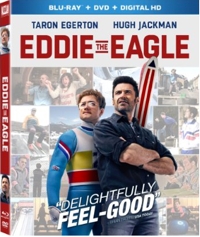
Most of the time you can’t trust the glowing blurbs on Blu-ray and DVD boxes, but USA Today’s description of Eddie the Eagle as “delightfully feel-good” pretty much sums it up. And you don’t have to be a sports nut to enjoy this 2016 comedy-drama.

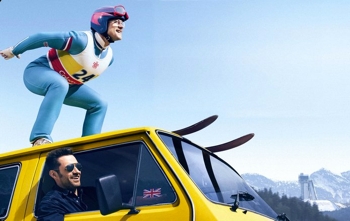
Eddie the Eagle is the latest sports biopic to celebrate the underdog who wins despite losing. It’s a movie that will remind you a lot of Cool Runnings, which told the story of a group of Jamaicans determined to enter the Olympic bobsled competition with the help of a has-been coach. In fact, it wouldn’t surprise me if writer Simon Kelton and director Dexter Fletcher had that 1993 Disney biopic in mind when they added a disgraced flask-carrying coach to the otherwise mostly true story of Eddie “The Eagle” Edwards, the Brit who was determined to represent his country in the Olympics no matter what sport, and who first took up ski jumping in his early ‘20s. Most competitors had been training since the age of six, so how is that possible? Because Great Britain hadn’t had an Olympic ski jumper since 1929, and all Eddie had to do to qualify for the 1988 Winter Olympics in Calgary was to make a single minimum jump.

If it sounds like a sports film with no competition (and therefore, no interest), far from it. Eddie has plenty of obstacles to overcome. He may have boundless energy, enthusiasm, and dedication, but his athletic ability is
EddietheEaglescreenslightly above average, at best. Mostly, he’s competing against his own limitations, but there are subplots as well. After trying unsuccessfully to make the British Olympic downhill ski team, he thought he found the perfect loophole to allow him to fulfill his dream of competing in the Olympics. But the British Olympic Committee had ideas of their own. Then Eddie thought the battle would end after he was accepted as an Olympic participant, but next came a wave of negative reactions from “legitimate” ski jumpers. Even when he made it to Calgary, there was still the reaction from his unsupportive father to contend with.

Taking a page out of Billy Elliot, the filmmakers concoct a parallel conflict with a disapproving dad who wants his son to face facts and get a legitimate, respectable, paying job. Like Billy, whose dream was to dance rather than box, Eddie is obviously hurt by the lack of support, but undeterred. What makes Eddie such a likeable hero is that he just keeps going, eyes on the prize. While others around him drink, his beverage of choice is milk. While others have full social lives, Eddie has only a fellow outcast—the coach (Hugh Jackman) who is at first reluctant to take him on.

The real Eddie the Eagle was called “Mr. Magoo” by some journalists, and the way that Taron Egerton plays him you can’t tell whether Eddie is in some way disabled or if he’s just a simple man whose I.Q. isn’t the highest. He’s like the kid with glasses who was always picked on at school, or the mutt you rescue rather than entering him in a dog show. But in a world where winning is narrowly defined and you have people like Dance Moms’ Abby Lee Miller complaining that second place is the first loser, Eddie Edwards is a refreshing example of pursuing a dream that’s scaled down. He doesn’t dream of winning the Olympics. He dreams of participating at that level, and in following that dream he’s as inspiring as this biopic is entertaining.

The film may be rated PG-13, but I think children as young as 10 would enjoy this film, since the adult elements are understated. And the 7.1 soundtrack and glorious HD make you feel as if you’re experiencing it right there.

Language: A few mild swearwords and that’s it
Sex: The coach uses a lovemaking analogy to get his pupil to understand that at the moment of liftoff it’s corresponds to orgasm; very brief glimpse of male backside
Violence: Real footage of wicked wipe-outs are shown
Adult situations: Some smoking and drinking, with one instance where the other jumpers get Eddie intoxicated
Takeaway: Like Hoosiers and Cool Runnings, this is one underdog story that should get a lot of replay because the writing is crisp, the performances are engaging, and there are some good messages for youngsters

THEY WERE EXPENDABLE (Blu-ray)

Leave a comment

TheyWereExpendablecoverGrade: B+/B
Entire family: No
1945, 135 min., Black-and-white
Warner Archive Collection
Not rated (would be PG for war action and adult situations)
Aspect ratio: 1.37:1
Featured audio: DTS-HDMA 2.0
Bonus features: n/a
Trailer
Amazon link

War movies probably have more permutations than any other genre, but the most fascinating and family-friendly ones are probably those that were made during WWII when the Office of War Information had to approve content. Most of them were patriotic films aimed at boosting recruitment or morale back home, and as a result probably fewer than a dozen are good enough to entertain today. Some of the best? Wake Island (1942), Action in the North Atlantic, Bataan, Destination Tokyo, Guadalcanal Diary, and So Proudly We Hail! (1943), as well as Thirty Seconds over Tokyo (1944), Objective, Burma!, Pride of the Marines, and They Were Expendable (1945).

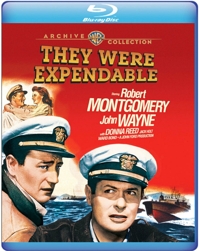
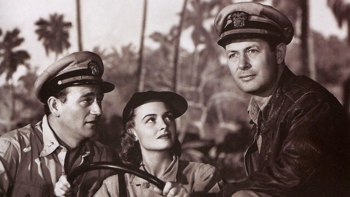
The latter—a black-and-white John Ford tribute to the men who served on America’s flimsy plywood PT-Boats in the Pacific—stars Robert Montgomery, John Wayne, and Donna Reed in a film that tries to capture not just the heroism of the men who fight, but also the boredom and frustration. What makes They Were Expendable doubly interesting is that it details the mostly true story of two officers who were trying to prove the worth of these Motor Torpedo Boat Squadrons, as they were initially called, when they were still an experimental dream like the 1807 steamboat people called “Fulton’s Folly.”

TheyWereExpendablescreen1There are battles in these wartime films, but the violence is dimmed while the spotlight is on service and the day-to-day life of soldiers, sailors, airmen, and nurses. People back home knew their loved ones were at war and that they probably saw action. Did they want to see graphic killing? No, but they did want to get some sense of what life in the military was like and what their loved ones were going through so far from homes, families, and sweethearts. And Ford’s tribute is one of the most authentic from the era.

The stars are fine in their roles, but really it’s the story that holds our attention—though it’s a long one (135 min.). The action picks up in the Philippines, where the military learns that Pearl Harbor has just been attacked. Everyone is given orders to do their part to stop the advance of the Japanese fleet, except for the Motor Torpedo Boat Squadron, which is given the token assignment of messenger and transport duty. The Navy brass can’t see value in the boats, though that doesn’t stop Lt. John Brickley (Montgomery) and Lt. Rusty Ryan (Wayne) from pushing. But even as the Japanese keep taking over more territory, it’s a fight for the Motor Torpedo Boat Squadrons just to get into the fight.

TheyWereExpendablescreen2PT-Boats became famous because of former Pres. John F. Kennedy, whose story is told in the movie PT-109 starring Cliff Robertson and Robert Culp. Watch this black-and-white movie first and then the color 1963 film for a decent double feature. In They Were Expendable Ford is careful to add plenty of detail about life on the small, fast plywood boats that were equipped with machine guns to battle aircraft and torpedoes to launch from the deck at heavier ships. We see the crew patching it up, dealing with boring assignments, and yes, mixing it up with the enemy. Eventually the boats’ value was proven: their small size made them a small target, and their speed and maneuverability enabled them to get in close enough to launch torpedoes and then get to safety.

War or not, the core story is one that everyone—even children—can identify with. Children’s books are full of characters who are disregarded because they’re too small, too insignificant, or too something to succeed. In the nautical vein, there’s Tuffy the Tugboat, the children’s book hero who is scoffed at by the boats who have bigger and more important jobs to do, until one day Tuffy is the only one with the skill set to save the day. That archetype is at work here too, while Reed provides a romantic interest that’s wholesome as can be and secondary to her own heroics as a nurse stationed at Manila and Bataan hospitals. The weepy-eyed sentimentality that creeps into Ford films is here too, but thankfully it’s limited. Still, young viewers not familiar with history might raise their eyebrows when “The Battle Hymn of the Republic” is sung while we glimpse an actor meant to be Gen. Douglas MacArthur. And if they don’t know about his famous “I shall return” promise made to the people of the Philippines as he himself fled to safety, that’s the period of history encompassed by Ford’s mostly fascinating and sometimes stirring film.

Language: Mild swearwords occasionally used
Sex: Nothing at all, wholesome as can be
Violence: No blood or gore or glorifying violence, but boats are blown up and battles are waged
Adult situations: Some drinking and smoking
Takeaway: War movies like Inglorious Basterds and Fury try to be edgy and shocking and rattle viewers out of their complacency; war movies like They Were Expendable look to tell a story that will enlighten and inspire as much as the biopics that came out of the ‘40s and ‘50s, and They Were Expendable is among the best of that type

ROOTS (1977) (Blu-ray)

Leave a comment

RootscoverGrade: A-
Entire family: No
1977, 587 min. (8 episodes), Color
Warner Bros.
Not rated (would be TV-14 for nudity, adult themes, and violence)
Aspect ratio: 1.78:1
Featured audio: Dolby Digital 2.0
Bonus features: B+
Trailer
Amazon link

Snoop Dogg recently slammed Oscar-winning Best Picture 12 Years a Slave and the 2016 remake of the iconic miniseries Roots because “they just want to keep showing the abuse that we took hundreds and hundreds of years ago. But, guess what? We taking the same abuse. Think about that part.”

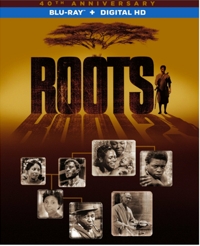
The “they” the rapper is talking about—12 Years a Slave director Steve McQueen and Alex Haley, the author of Roots—just happen to be black, though, and they’re coming at it from a different, “lest we forget” angle. The four-episode remake of Roots has gotten all the attention, but for my money the original 1977 series is still the best. As the box of the 25th anniversary edition proclaimed, “200 years to unfold. 12 years of research to discover. 2 years to create. 8 nights to make television history.” And that’s not hype.

When the final installment of Roots aired in January 1977, some 130 million viewers—then, roughly half the entire population of the U.S.—gathered around their TV sets to watch. Even the Las Vegas gaming tables slowed when it aired. Adapted from Haley’s novel about his search to unearth information about his African ancestors, the groundbreaking mini-series remains the most-watched dramatic show in television history. Everyone everywhere seemed to be talking about it, and the series was such a phenomenon that People’s Choice Awards were presented to every individual cast member, while Haley received a special citation Pulitzer (of which only nine have ever been awarded). Roots was the first mini-series to be aired on consecutive nights rather than a single episode per week, and at a time when there were few black actors in serious prime-time offerings, it featured a virtual Who’s Who of African-American actors.

The show pulled down nine Emmys, including Best Limited Series, acting awards for Louis Gossett, Jr., Olivia Cole, and Edward Asner, and awards for editing, writing, and directing. It also won the Golden Globe that year for Best Drama Series and top honors in the same category at the Television Critics Circle Awards. Hard as it is to imagine, few Americans thought much about their ancestors prior to Roots, and the show sparked a national interest in genealogy that continues to this day. But the show also generated controversy–and not because of the National Geographic-style bare breasts in early episodes, or because of the frequent use of the inflammatory word “nigger” that television viewers weren’t accustomed to hearing.

It was the white-on-black enslaving, rape, and mutilation scenes that caused all the fuss, and the rerelease of Roots has already rekindled those same heated debates about race and what Haley called his “faction” (a blend of fact and fiction). When it first aired in 1977, ABC executives feared it might incite race riots or that southern stations might refuse to broadcast the show. But there was just one mild incident at a single school, and the series was broadcast not just on every ABC affiliate in America, but in every country that syndicated American shows—including South Africa. Despite the “faction,” the series remains as powerful now as it was then, which is why John Amos and other African American cast members think it should be shown in every school in America, ad infinitum.

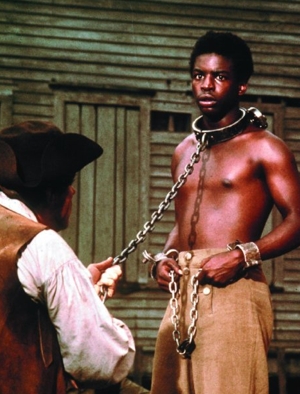
Rootsscreen1The mini-series tells the story of four generations of a single family, beginning with the birth of Kunta Kinte (LeVar Burton, who produced the remake), son of Omoro (Thalmus Rasulala) and Binta (Cicely Tyson), on the West Coast of Africa near the river Gambia. Just as Haley’s search for his roots began with the words “Kunta Kinte” and “gambi balongo” that he heard from his aunts, and the story they told him about Kunta’s enslavement, Episode 1 chronicles Kunta’s capture while he was seeking a log suitable for making into a drum. Viewers follow Kunta’s odyssey across the Atlantic in the holds of a slave ship captained by a Christian first-time slaver (Edward Asner) and his sadistic and seasoned mate (Ralph Waite). If it’s strange seeing Asner and Waite in those roles now, it was even stranger when the series first aired and The Mary Tyler Moore Show and The Waltons were still on prime time TV. Roots was an amazing production that still holds up today, but it’s even more amazing if you consider that back then miniseries were like variety shows in that recognizable TV actors from other shows were often cast. And in this one you saw a bunch of familiar faces, both black and white.

More

THE SUM OF US (Blu-ray)

Leave a comment

SumofUscoverGrade: B
Entire family: No
1994, 100 min., Color
Olive Films
Rated R for language, sex talk and sexual situations
Aspect ratio:  1.85:1
Featured audio:  DTS 2.0
Bonus features: n/a
Trailer
Amazon link

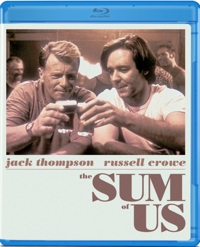
Russell Crowe’s first appearances in feature films came in 1990, when the New Zealander began working in the Australian film industry. Just two years later Crowe would be cast to star as a tough skinhead in Romper Stomper, while in 1994 he would show his sensitive side playing a dutiful gay son in The Sum of Us—the last Australian film he would make before taking his talents to Hollywood.

For that reason alone, The Sum of Us will be of interest to movie-lovers—though it would be an unusual and unlikely choice for family viewing, unless the family wanted to face issues like sexual orientation and elder care head-on. David Stevens adapted his own play for the screen, and he and directors Geoff Burton and Kevin Dowling are absolutely clear about what message they want audiences to take away from the film: Life is short; love people for who they are, as they are not an aberration, but the sum of family members who passed on their DNA or helped shape them in other ways.

The Sum of Us is a study in contrasts. Widower Harry Mitchell (Jack Thompson, The Man from Snowy River) lives with his adult gay son, Jeff (Crowe), and Harry is the poster child for unconditional parental love. He not only accepts his son for who SumofUsscreenhe is, but he tries to understand what it means to be gay—yes, that includes going to clubs with his son—and he encourages his son to talk openly about his relationships. However, when Jeff brings his latest boyfriend-to-be home, Greg (John Polson) is shocked by Harry’s openness. Greg’s parents don’t even know he’s gay, and when they find out, the father wants nothing more to do with his son and the mother is so shocked into dumb silence that she can’t stop the father from kicking the young man out of the house. It’s clear which way is right, if for no other reason than Harry himself is a likeable, blunt force of nature. He loves life and makes it clear how much he loves his son and accepts him and everything he does. The film’s other main contrast comes from a woman that Harry meets through a dating service. Joyce (Deborah Kennedy) got divorced after her husband left her and she’s ready for love again. With Harry, she seems to have found it. But like Greg’s parents, she has a hard time dealing with homosexuality. Will it get in the way of her happiness and Harry’s? Will Greg and Jeff get together despite Greg’s discomfort over Harry’s full knowledge of what they do in the sack?

More

RICH KIDS (1979) (Blu-ray)

Leave a comment

RichKidscoverGrade: C+/B-
Entire family: No
1979, 97 min., Color
Olive Films
Rated PG for mild language and sexual situations
Aspect ratio:  1.85:1
Featured audio:  DTS 2.0
Bonus features: n/a
Clip
Amazon link

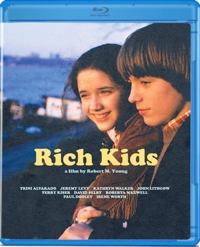
Though it’s decades old, Rich Kids ought to be the kind of film that would interest families with adolescent children. It stars two engaging young actors (Trini Alvarado, Jeremy Levy) who play upper-crust offspring of Upper West Side parents who are either divorced or in the process of divorcing. It’s a kids’ point-of-view film with very few scenes that don’t feature the young characters. And the focus—an opposite gender friendship that leads to some innocent experimentation—would seem to be timeless.

Unfortunately, the pacing of ‘70s films is a liability for many of today’s young viewers, who will also find this character-driven coming-of-age drama relatively plotless compared to today’s movies. Your not-so-rich kids might reach for their cell phones or hand-held gaming systems to “multitask” during this one.

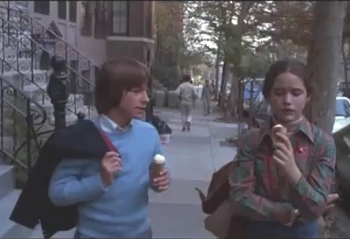
RichKidsscreen1That’s too bad, because the acting is superb, and older viewers will delight in seeing a very young-looking 34-year-old John Lithgow as the father of 12-year-old Franny, who knows her father sneaks home at 5 a.m. every day to hide that he spends the night elsewhere. Precocious and left on her own a lot, Franny has somehow picked up a copy of The Joy of Sex, which she studies and keeps hidden behind her childhood books. Her mother (Kathryn Walker) has her own preoccupations, and because that includes another man we suspect that Franny’s racy reading isn’t just the result of sexual curiosity, but perhaps self-guided “homework” to try to understand what’s happening to her parents and their family unit.

At school Franny has bonded with Jamie, whose parents are already divorced and caught up in their new lives, leaving him on the periphery or bouncing back and forth between houses. The plot is simple, though it stretches the limits of belief. Franny wants to have a sleepover with Jamie and asks her workaholic mother when she’s half asleep. Later, when Mom learns that Jamie is a boy, she and her husband still allow her daughter to go to Jamie’s house because “she said it was okay.” Meanwhile, Jamie’s dad leaves the kids alone in his bachelor pad while he goes off in his sports car with his latest conquest, despite assuring Franny’s parents that the kids would be supervised. That’s the plot in a nutshell, and the illogical and irresponsible parental behavior that puts the two rich kids in a position to experiment may bother older viewers as much as the plotless narrative might turn off the kids. Still, the performances are worth watching, and if young viewers are warned in advance that Rich Kids is a slower-moving character-driven film they might be able to enjoy them and the read-between-the-lines nuances of the film.

Language: Some mild swearwords
Sex: Two children in a bubble bath, perhaps innocent, perhaps not; two children in pajamas play wrestling with each other and sexual tension
Violence: None
Adult situations: None, apart from talk of affairs and that bachelor pad
Takeaway: Wes Anderson did a better job of exploring similar territory in Moonrise Kingdom (2012), a PG-13 rated adventure-comedy-drama.

CREED (Blu-ray combo)

Leave a comment

CreedcoverGrade: B+
Entire family: No
2015, 133 min., Color
Warner Bros./MGM
Rated PG-13 for violence, language, and some sensuality
Aspect ratio: 2.40:1
Featured audio: DTS-HDMA 7.1
Bonus features: C+
Includes: Blu-ray, DVD, Digital HD
Amazon link
Trailer

You’ve heard the jokes about Rocky XX and so on. After the popular film franchise, which began with Rocky in 1976, came out with Rocky II (1979), III (1982), IV (1985), and V (1990) in what seemed like rapid succession, entertainment writers started tossing off one-liners about the series continuing down the road with Sylvester Stallone eventually mixing it up with residents at a rest home from his wheelchair.

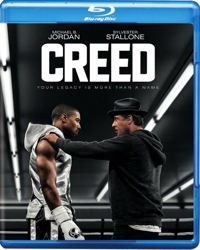
Well, who’s laughing now? Not only did Stallone prove he still had it with Rocky Balboa (2006), but with Creed he shows that he can effortlessly shift from the Rocky role into the role of boxing trainer—a part that Burgess Meredith made famous, and for which Meredith earned an Oscar nomination.

CreedscreenStallone earned an Oscar nomination for his initial role as Rocky, and he earned his second acting Oscar nomination for playing Rocky Balboa the trainer in this 2015 sport drama. What that means, all you jokers, is that Rocky CAN go on for many more years, though now the title shifts to Creed. And Creed II, III, or whatever. It’s no longer dependent upon Stallone’s ability to give or take a punch.

Stallone is as engaging as Meredith’s crusty seen-it-all trainer, and his performance anchors the film, both as a presence and as a plot point that’s central to the screenplay. The son of Apollo Creed fighting for the championship with boxing legend Rocky Balboa, “The Italian Stallion,” in his corner? It’s a dream-come-true for boxing promoters, and just as dreamy for filmmakers wanting to inject this storied but stalled franchise with a new shot of adrenalin.

As Adonis Johnson, the illegitimate son of Rocky’s deceased foe-and-friend who has a rap sheet as long as his juvenile hall stays, Michael B. Jordan comes to the film buff and ready to go the full 12 rounds. As Creed’s widow, Phylicia Rashad (The Cosby Show, Do No Harm) isn’t nearly the tough-love foster parent young Donnie needs, but that only goes to show that he’s more boxer-at-heart than he is criminal-at-heart. As he trains we see him go down the same streets and marketplaces as Rocky once did, and also climbing those famous Philadelphia Museum of Art steps that are commemorated by a statue of Rocky that’s also shown in the film. Though it’s not intrusively nostalgic or formulaic, fans will still notice quite a few similarities between Rocky and Creed. Both are headstrong and self-taught lumps of coal that need a little compressed discipline and training to be come diamonds, both get a shot at the championship well before they’re ready, both find a skull-cap wearing trainer, and both find a woman that motivates them. It’s Rocky all over again, but shifting characters makes it feel like a double-layered film rather than a formulaic exercise.

Creedscreen1The first four Rocky films and Rocky Balboa were rated PG, but Creed follows in the footsteps of Rocky V, with a PG-13 rating for violence, language, and some sensuality. But Creed is more violent and intense than any of the previous Rocky films, and there’s an implied sex scene and more language (including the F-word). So it’s every bit a PG-13 film. It’s also an entertaining film because the characters are likable, they grow and have good chemistry together (including Jordan and Tessa Thompson, who plays love-interest Bianca, a singer going permanently deaf), and the plot framework itself is a proven winner. Creed is Rocky for a new generation, with realistically choreographed boxing sequences, plenty of attitude, and just as much punch. And a sparkling transfer to Blu-ray and DTS-HDMA 7.1 really brings it all to vivid life.

Language: Typical range of PG-13 swear words, with at least one f-bomb tossed
Sex: Nothing graphic or too revealing, but there is naked skin and implied coupling, plus plenty of kissing
Violence: More violence both inside and outside the ring than in previous Rocky movies; people get beat, people get hurt
Adult situations: There’s not so much in the way of drinking as there was in previous Rocky movies
Takeaways: If you’re going to continue a series of films and not be worrying about your star’s physical capabilities, this reboot is certainly a good way to solve the problem, and Stallone is just as engaging as a trainer in a supporting role as he was the boxer and star

EVEREST (3D Blu-ray/Blu-ray combo)

1 Comment

EverestcoverGrade: B+
Entire family: No
2015, 121 min., Color
Rated PG-13 for intense peril and disturbing images
Universal
Aspect ratio: 2.40:1
Featured audio: Atmos Dolby True HD
Bonus features: B/B+
Includes: 3D Blu-ray, 2D Blu-ray, DVD, Digital HD
Trailer
Amazon link

“Because it’s there.”

That’s the reason George Mallory gave in 1924 when asked why he would risk his life to reach the summit of Mt. Everest—Earth’s highest point and the tallest of 14 mountains in Pakistan, Nepal, and China that are more than 8,000 meters (five miles) high. For dedicated climbers and adventurers, that’s reason enough.

Everest is a 2015 adventure-drama based on a 1996 climb when a blizzard took the lives of eight people, several of which are dramatized here. Reaching the summit takes more than courage and experience. It also takes $65,000 to join one of the commercial outfits leading expeditions each year. Because there’s only a small window of opportunity, based on the weather conditions, the mountain can get crowded. Thirty-four climbers were trying to reach the summit on the same day that year. That’s one of the points made in the movie, which focuses on Rob Hall (Jason Clarke), leader of Adventure Consultants, and his six clients, but also peripherally on Scott Fischer (Jake Gyllenhaal), the Mountain Madness guide that Hall recruits to cooperate with each other.

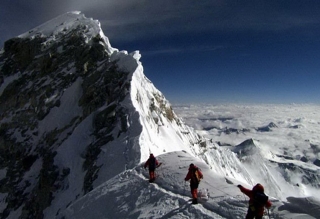
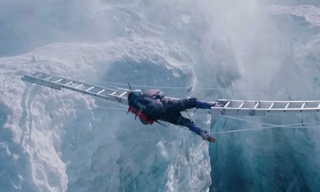
Everestscreen1Hall lays it all out for his climbers and viewers at the beginning. This will be a survival challenge. “Human beings are not designed to function at the cruising altitude of a 747. Your bodies will be literally dying.” Like Quint in Jaws, he pulls off his shoe and sock to show them his scars—a foot with no toes on it—and reminds them that one out of four climbers who attempt the summit will die.

Those odds don’t seem to bother the climbers, but one wonders about the film crews. The IMAX documentary Everest (1998) was being filmed at the time of this 1996 climb, and when disaster struck, the crew joined the search and rescue. That’s not highlighted here, though some of the stock footage from that earlier documentary does find its way into the film. Ironically in April 2014, when this fictionalized drama was being shot, filming was postponed because a sudden storm killed 16 people, most of them Sherpas, at a base camp.

That’s the true-story backdrop to this harrowing drama, which begins like an adventure and quickly starts to feel like a slow-march-to-disaster movie. Although we spend a lot of time with the characters, we don’t get to know too much about them because the focus is on preparation for the climb and the climb itself. But we know enough to care when some of them die, reach or fall short of their dreams, or barely make it down the mountain. It’s impossible not to be moved, especially by Rob Hall and his Texas client Beck Weathers (Josh Brolin), the latter of whom had “forgotten” to tell his wife and children that he was attempting Everest.

Everestscreen2This fictional treatment has more power than the documentaries, and on 3D Blu-ray the film looks spectacular—especially those long shots of Everest and the views from the mountain. Depth of field is superb, but don’t look for things to break the viewing plane. The film is nearly as remarkable looking on standard 2D Blu-ray, with solid detail even when snowstorms come. That clarity really brings this experience to life, and the acting and cinematography are as convincing as a script that only briefly flirts with melodrama as we watch wives (Robin Wright as Peach Weathers, Keira Knightley as Jan Hall) come to terms with the situation as it unfolds. If you’ve ever dreamed of doing the impossible—like the Washington mailman who hoped to inspire the schoolchildren of his town who raised the money so he could climb—Everest is a powerful, if unsettling, film.

Language: Nothing much. They’re bundled up and wearing oxygen masks much of the movie
Sex: n/a
Violence: Deaths are shown
Adult situations: Drinking but no drunkenness; frostbitten flesh is shown, along with frozen dead bodies and plenty of moments of peril
Takeaway: As much as you admire the climbers that inspired this movie, you also have to admire anyone who would risk their lives to film such an adventure-drama

A.D.: THE BIBLE CONTINUES (Blu-ray)

Leave a comment

ADcoverGrade: B+/B
Entire family: No
2015, 12 episodes (600 min.), Color
Unrated (would be PG-13 for graphic violence)
MGM
Aspect ratio: 1.78:1
Featured audio: English DTS-HDMA 5.1
Bonus features: C+
Trailer
Amazon link

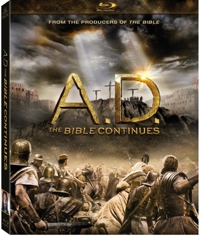
The New Testament gets the TV miniseries treatment in A.D.: The Bible Continues, a less sprawling 2015 sequel to the gap-filled 2013 miniseries, The Bible.

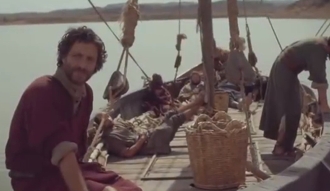
What immediately impresses is that A.D. presents a believable ancient-world reality, despite slightly modernized language and direction that includes all sorts of contemporary techniques. It’s really well made, with great production values. While previous biblical movies and miniseries stayed with unobtrusive camerawork and an overly respectful treatment of the material often handcuffed directors, the five (Ciaran Donnelly, Tony Mitchell, Brian Kelly, Rob Evans, Paul Wilmshurst) who direct these 12 one-hour episodes use such devices as quick cuts, extreme close-ups, character flashbacks, walk-and-talks, and cross-cut scenes so that A.D. feels contemporary but still looks convincingly ancient. Filmed in Morocco using CGI to enhance the illusion, A.D. also features some gorgeous cinematography (it looks terrific in HD).

What’s more, you never find yourself thinking that these are actors wearing costumes, and for that you can credit the casting department. For the most part A.D. is constructed like a contemporary dramatic miniseries and only infrequently lapses into the kind of heavens-open-and-angels-sing schlock-and-awe that characterized the old-school biblical epics. Also missing (and thankfully so) is the gratuitous sex and violence that now seems requisite for “edgy” TV miniseries. A.D. only includes violence that seems necessary to the storytelling and manages to find its edge without going any further. Some, for example, might think it edgy that Mary Magdalene (Chipo Chung) is ethnic in this production, that the humanity of Jesus (Juan Pablo Di Pace) is emphasized, or that the political machinations involving the Roman governor Pilate (Vincent Regan), the Hebrew high priest Caiaphas (Richard Coyle), and various emperors are worthy of House of Cards episode.

ADscreenDespite a complicated plot in later episodes, A.D. flows well—much better than The Bible—starting with Jesus’ crucifixion (yes, the filmmakers assume a certain knowledge of subject matter on the part of the audience) and continuing with the backlash and the early activities of Jesus’ disciples, as told in the Book of Acts.    More

THE SECOND BEST EXOTIC MARIGOLD HOTEL (Blu-ray)

Leave a comment

SecondBestExoticcoverGrade: B-/C+
Entire family: Yes, but….
2015, 122 min., Color
Rated PG for some language and suggestive comments
20th Century Fox
Aspect ratio:
Featured audio:
Includes: Blu-ray, Digital HD
Bonus features: C+
Trailer
Amazon link

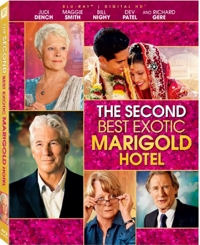
The Best Exotic Marigold Hotel (2012) was a surprise hit because it hit home with its basic messages. A group of older British retirees traveled to India because of a brochure that glamorized The Best Exotic Marigold Hotel and made it look like the ideal place to retire, to find a replacement husband, or to stay there while getting a hip operation. Unknown to each other, they discovered things in common; foreign to India and some of them suspicious or awkward, they found an appreciation for a different culture and a level of comfort; and feeling a little tired and depressed by their late stage of life, they found some measure of renewal by their association with the hotel’s optimistic and energetic young owner. It was a feel-good movie about growing old, and there aren’t many of those around.

But The Second Best Exotic Marigold Hotel (2015) is a sequel that really didn’t need to be made. Missing is the charm and freshness of the first film, replaced by a formulaic plot and a paucity of humor, with a running gag that’s a 180-degree turn from the positive attitude toward aging that we encountered in the first film. In the original, one of the residents died, but what kind of tone does it set when in the sequel the proprietor, Sonny (Dev Patel), begins each morning with a roll call so the residents can answer . . . and let him know they’re still alive?

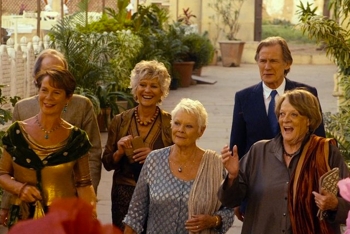
Two standard plot devices that we’ve seen before drive the narrative: a wedding and an anonymous visiting inspector who will decide whether Sonny can create a second hotel. Sonny is finally marrying the love of his life, Sunaina (Tina Desai), and there are some song-and-dance numbers SecondBestExoticscreenthat liven up the film. As with the first, each character has a subplot. Evelyn and Douglas (Judi Dench, Bill Nighy) are now working and fully immersed in local culture and finding occasional times to date each other. Carol and Norman (Diana Hardcastle, Ronald Pickup) are learning how to be exclusive to each other, while Madge (Celie Imrie) still plays the field and juggles two wealthy suitors. Somewhat lost in the shuffle is Muriel (Maggie Smith), who has been named co-manager of the hotel and seems to exist only as a confidante for everyone else. Meanwhile, there are two new arrivals (Richard Gere, Tamsin Greig) and only one nice room, and of course one of them is thought to be the inspector. Another sideplot about a business rival seems thrown in for good measure.

More than in the first, the screenplay feels like a paint-by-numbers affair, but the acting and the characters remain strengths. Patel is as energetic as a stand-up comic, and his onscreen mother (Lillete Dubey) gets something fresh to do as the object of Gere’s attentions. As with the first film, India itself is really the most colorful draw, and if you want to make a pilgrimage you can visit the Pearl Palace Heritage Guesthouse in Jaipur, where Second Best was filmed. But the movie truly is “second best,” which is not an uncommon thing for sequels. I was charmed by the first film, yet as much as I wanted to like this one I found it slightly dull. So did my family.

Language: some mild swear words
Sex: n/a
Adult situations: n/really
Takeaway: No matter what your age, after watching this film or the first you’ll dream of going to India.

Older Entries Newer Entries