Home

THE LONGEST RIDE (Blu-ray)

Leave a comment

LongestRidecoverGrade: B-
Entire family: No
2015, 139 min., Color
Rated PG-13 for some sexuality, partial nudity, and some war and sports action
20th Century Fox
Aspect ratio: 2.40:1
Featured audio: DTS HD-MA 7.1
Includes: Blu-ray, Digital HD
Bonus features: B
Trailer
Amazon link

This could have been the shortest review I’ve written. All I had to do was say that The Longest Ride is based on a novel by romance writer Nicholas Sparks, and everyone would get the picture.

Sparks’ audience is and has always been primarily women, and the movie adaptations of his books have fallen into the category of “chick flicks.” That’s not bad, mind you, but the reality-check is that families with adolescent and teenage girls are more likely to fall for this opposites-attract love story than families with boys. That’s just the way it is, and it’s not a slam. Sparks has written 18 romance novels, and 11 of them (including Message in a Bottle, The Notebook, and Dear John) have been turned into films. They’re tremendously popular.

This one falls right in the middle, in terms of worldwide gross, but it’s decent enough entertainment if you’re into romance. The plot is a two-strand weave that involves two couples.
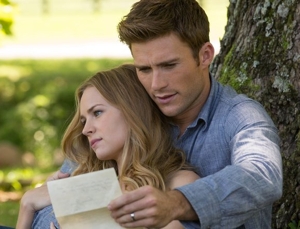
LongestRidescreenRomantic comedies always have a “meet cute,” and though this isn’t a comedy, that’s how it works. Wake Forest college student Sophia Danko (Britt Robertson) is coerced by her sorority sisters into donning cowboy boots and going to a rodeo to check out the “beef.” When Luke—who was seriously injured a year earlier and is still mentally and emotionally scarred as a result—falls off a bull right in front of her and loses his hat, she tosses it to him . . . and he tosses it back. “Keep it,” he says. Eye contact. Later they meet at a party where she’s just about to accept a drink with him but has to cut the evening short because of a friend who drank too much. Yep, there’s drinking and implied sex in this film, though the nudity we see is full-body without full reveal, hence the PG-13 rating.

They start to see each other, but an otherwise ordinary love story is given another layer when they come across an accident. Luke (Scott Eastwood—Clint’s youngest son) pulls the man out, while Sophia goes back at the man’s request to retrieve a box. Sparks has never been bashful about using plot devices, and this one’s a doozy. With a curious Sophia reading the love letters contained in the box, Sparks sets up a double love story—one in the past, with the woman (Oona Chaplin) deceased and the man (Alan Alda) on life support, and the other a young couple just trying to find someone. Sparks and director George Tillman, Jr. (Soul Food, Barbershop) do a nice job of pacing the reveals and relationship development, and a surprise-but-inevitable ending ties that neat bow that romance lovers have come to expect on every package.

In between there are some exciting and wonderfully filmed bull riding sequences, and the stars are plenty likable—which is really important in a formulaic romance, so that we care about their characters and their outcomes. It also looks great in HD, with a bundle of bonus features that should appeal to fans.

Language: Surprisingly little. Maybe a few s-words but that’s about it
Sex: A number of sex scenes, with one brief breast shot and a brief men’s top half of a butt shown. Also plenty of talk about sex.
Violence: Not much. Really just the bull riding sequences and the car crash
Adult situations: Drinking, smoking, partying, etc.
Takeaway: You’re doomed to repeat the past, unless you can learn from someone else’s past. Oh, and love is timeless.
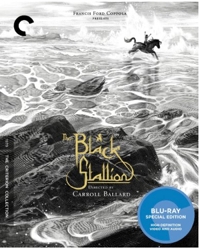
THE BLACK STALLION (Criterion) (Blu-ray)

Leave a comment

BlackStallioncoverGrade: B+
Entire family: Yes, but . . .
1979, 117 min., Color
Rated G
Criterion Collection
Aspect ratio: 1.85:1
Featured audio: DTS-HD MA 2.0 Surround
Includes: 17×11 color poster, five short films by Ballard
Bonus features:  B-/C+
Amazon link

The Black Stallion—at least the 1979 adaptation that Francis Ford Coppola “presents”—is an interesting hybrid. It’s part family movie and part indie/art house film. Director Carroll Ballard takes the 1941 book for young readers and infuses the story of a boy and a wild horse who “save” each other with indie film sensibilities and art-house cinematography.

The result is a film that’s obviously made for adults but suitable for children. There are a few less warm fuzzies and sappy moments in this hybrid (a good thing!), though the pacing in the first act might seem a bit too leisurely for the youngest viewers. There’s not much you can do for them except to assure them that the action picks up, but older children who squirm can be shown the luxurious cinematography from Caleb Deschanel (Zooey Deschanel’s father), with breathlessly original shots and angles and the space for those shots to breathe and expand in our consciousness.

BlackStallionscreen1Ballard isn’t quite as lavish with his plotting and narrative. Some directors like to show rather than tell; Ballard likes to suggest rather than show. We see a young boy and his father on a steamer off the coast of North Africa, where Dad (Hoyt Axton) is gambling with dangerous-looking people, and the boy, Alec (Kelly Reno), has the run of the ship. The boy glimpses a wild black stallion roped and whipped by Arab trainers and forced into one of the ship’s holds. Feeling sorry for the horse, Alec returns with sugar cubes he swiped but is caught and treated almost as roughly by the Arab. Shortly thereafter, his father shares with him a trinket from his poker winnings: a small statuette of Alexander the Great’s horse. We hear the story of how the horse was so wild the king was going to put him down, but conceded that the boy Alexander could keep him if he could ride him. Of course, that tiny statuette and story become a controlling metaphor for the narrative of The Black Stallion, for soon afterwards a violent storm kicks up, the boy releases the horse so he won’t go down with the ship, and after watching him leap into the sea the boy is thrown overboard and calls for help.

So begins a relationship between the boy and the horse that develops on the island until he’s rescued by a group of men who also take the animal that Alec refuses to leave behind. And yet, what Alec does leave behind is any apparent feeling for his father. We really don’t know what happened to the man, nor did we see any emotional reaction in Alec after he awakens on the beach of a desert island. He’s as concerned about what happened to his father as he is about finding fresh drinking water (a detail that’s never addressed). We aren’t told, as readers of the book were, that the two of them had been visiting an uncle in India, so viewers really have no idea why the pair was on a ship so far from his home somewhere in the states where horses are raced. Even after Alec returns home to his mother (Terri Garr), we aren’t given much in the way of information.

BlackStallionscreen2But this is an impressionistic film, one that is more image-driven and scene-driven than it is dependent on plot, especially in the early going. For a while, it’s like Cast Away, but with a horse instead of a volleyball. Then turns into National Velvet, but with a teenage boy instead of a teenage girl, and a thoroughbred horse race rather than steeplechase. Perhaps not coincidentally, just as actor Mickey Rooney played the role of the former jockey and mentor in National Velvet who helps young Velvet train for the steeplechase, he’s a former jockey and mentor here too, helping Alec to learn what it takes to harness all that wild energy and race Black, as he’s simply called.

The payoff will ultimately satisfy young viewers if they can make it through the slower parts. But frankly, it wouldn’t hurt today’s children to learn how to appreciate those slow-down moments in life—especially when they’re so beautifully filmed.

If you’re building a Blu-ray collection, by all means, add this title. But the master had a lot of grain that carries over onto the HD release, so this title would probably look just as good on DVD. As for the bonus features, they’re geared for adults—though older, curious young filmmakers-in-waiting might be drawn to several of the five short films by Ballard, especially one on the “Rodeo” and another in which Ballard interviewed centenarians talking about what L.A. was like a hundred years ago . . . juxtaposed against the chaos of images that flood 1971 Los Angeles. What he does will inspire young filmmakers, who will find a way to take the best of what he does and speed it up for the current time and generation.

Language: Clean as can be
Sex: Same here
Violence: That brief boat beat-down, a violent storm, and a cobra incident
Adult situations: Loss of the father
Takeaway: It IS possible to have it both ways, to craft a film that’s aesthetically pleasing out of a story intended for a young audience.

BIG EYES (Blu-ray)

1 Comment

BigEyescoverGrade: B+
Entire family: No
2014, 105 min., Color
Rated PG-13 for thematic elements and brief strong language
Anchor Bay
Aspect ratio: 1.78:1
Featured audio: English DTS-HD MA 5.1
Includes: Blu-ray, Digital HD
Bonus features: C-
Trailer/Amazon link

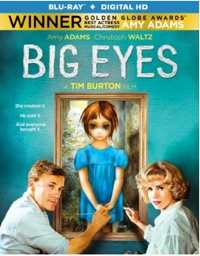
Big Eyes isn’t your usual Tim Burton film. Though there’s a twisted aspect to the relationship between painter Margaret Keane and her controlling husband Walter—along with a vibe that’s faintly reminiscent of Edward Scissorhands—it’s still a pretty straightforward biopic. But don’t be misled by the box blurb announcing that Amy Adams won the Golden Globe for Best Actress in a Musical/Comedy. Big Eyes is neither. It’s a drama made fascinating by Adams’ flawless performance, with occasional comedic moments provided by Christoph Waltz’s brilliant-but-delusional P.T. Barnum-like antics as Walter Keane.

Walter manipulates the art world and the buying public as much as he does his wife, whose paintings he takes credit for—first, to make a sale, then, because it feeds his ego. Throughout the Sixties they continue this charade, with Walter rising as a public figure and Margaret shrinking to even smaller dimensions than when they first met and she was overwhelmed by his personality.

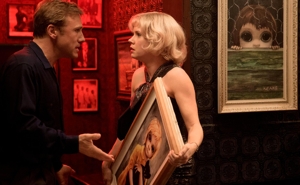
You forget that it’s a Tim Burton film until Margaret goes grocery shopping and has hallucinations of all the other shoppers looking at her with the trademark “big eyes” that she featured on all of her paintings of children. That’s the one creepy moment in the film that feels Burtonesque. But you can see why the director was drawn to Margaret’s story. Like Edward Scissorhands, she’s forced to live in isolation and spends much of her time in an attic, working away. Like Scissorhands, she’s timid and naive and easily manipulated. And the big eyes she paints? It’s those paintings of big-eyed, dark-eyed, sad-looking waifs that come closest to what we expect from Burton.

BigEyesscreenBig Eyes tells Margaret’s story, beginning with her flight in 1958 from her first husband and her meeting Walter Keane at a San Francisco art fair, where they both were trying to sell their works. It’s rated PG-13 for thematic elements and brief strong language, but I’d have to say that it’s pretty understated, with far less language and violence than most PG-13 movies, and no sex. It wouldn’t hurt young teens to see that an abusive relationship doesn’t have to involve physical violence. There’s no hitting in their marriage, only intimidation and manipulation, with Margaret being an unwitting enabler because of her timidity. Yes, there’s one scene where Walter gets drunk and menaces his wife and stepdaughter, but young girls might benefit from seeing a film like this, and how easily things can snowball in a controlling relationship. While Big Eyes is the story of a twisted relationship, the focus remains on the art, the phenomenon that this “kitsch” art became, and what art and those children mean to Margaret. In that respect, it’s quirkier and more upbeat than your typical sour relationship story.   More

50 to 1 (DVD)

1 Comment

50to1coverGrade: B
Entire family: No, but ….
2014, 111 min., Color
Rated PG-13 for some suggestive material and a bar brawl
Sony Pictures
Aspect ratio: 1.78:1 anamorphic widescreen
Featured audio: Dolby Digital 5.1 Surround
Bonus features: C
Trailer/Amazon link

50 to 1 just about describes the odds of a low-budget, small-studio movie with mostly B-list talent and a writer-director of former box-office disappointments being able to compete with slicker big-studio horse racing titles.

But I’ll tell you right now, like Mine That Bird, the subject of this 2014 sport drama with comedic moments, 50 to 1 beats the odds. I liked it as much as Seabiscuit (2003) and Secretariat (2010).

Notice I said “liked it as much” rather than “as good as.” The budgets for Seabiscuit and Secretariat were respectively 8.7 and 3.5 times larger and the production values sometimes show it. The script for 50 to 1 also is more uneven, with character development that falls a little short. William Devane is the most recognizable name actor onboard, and while the acting won’t win any awards, the cast does a good job of making you believe their characters.

50to1screen1Everybody loves an underdog story, and 50 to 1 is a doozy. The horse, a smaller-than-usual gelding with a strange walk, has been running as slow as can be and gets no respect. Neither does the rag-tag group of New Mexico cowboys and their families who own him, train him, ride him, invest in him, and, most importantly, believe in him. They’re not wealthy dabblers who race horses as a hobby. They need one good horse to help them keep their stables in business, and with creditors knocking at the door they’re as much of an underdog as Mine That Bird. Even if you’re an urbanite, it’s tough not to appreciate this rough-around-the-edges group and the joy they take in the small things in life. They’re not phony posers, they’re real people, so when the snobs in racing circles treat them as if they were the Clampetts from The Beverly Hillbillies, it’s hard not to secretly (or not so secretly) pull for them to show those bluebloods a thing or two.   More

EMPIRE RECORDS (Blu-ray)

1 Comment

EmpireRecordscoverGrade: B
Entire family: No
1995, 90 min., Color
Rated PG-13 for sexual situations, language and drug use
Warner Bros.
Aspect ratio: 2.40:1 widescreen
Featured audio: English DTS-HD MA 5.1
Bonus features: D
Trailer/Amazon link

Sometimes you’d swear that critics and audiences seem to be watching two different movies. Empire Records was liked by only 24 percent of the Rotten Tomatoes critics, whereas 84 percent of the audience liked it. But I can see where a person’s reaction could go either way.

Empire Records (1995) is deliberately quirky, with a cast of teens whose quirkiness and iCarly-style random dancing will make you either smile . . . or roll your eyes. It’s the kind of movie you’d get if you crossed a mainstream teen dramedy like The Breakfast Club with an indie film that, like so many indie flicks, seems to operate by the philosophy that the weirder the better. And if you’re familiar with the classic chick-flick Mystic Pizza (1988), which featured Conchata Ferrell as the lone adult presiding over a small business overrun by teens and their problems, you’ll see plenty of similarities, starting with the basic premise and structure.

Mystic Pizza featured a young Julia Roberts, and the attraction here is a young Liv Tyler and Renée Zellweger.

Like Mystic Pizza, Empire Records is a coming-of-age story in which a wholesome character (Tyler) is looking to lose her virginity, a young man (Johnny Whitworth) wants to overcome his shyness and tell a girl he loves her, one girl wrestles with the “promiscuous” label (Zellweger), and another (Robin Tunney) is feeling so down on herself and life that she’s tried to cut herself as a cry for help. And a running contrast between promiscuity and wholesome behavior blurs at some point.

EmpireRecordsscreenThe business itself is facing a make-or-break moment, though it almost seems incidental compared to the personal problems of the employees that take center stage—or rather, center aisle. Empire Records is an independent store that feeds off the energy of its young and crazy employees, who like to play loud music and rock out in the store with customers of all ages. At times, you’d think you were in an Elvis movie, the whole place is so up and random dancing. Even the benevolent boss, Joe (Anthony LaPaglia) gets into the act by locking himself in his office and playing a drum set he keeps there for stress relief. He’s a father-figure to this group, the “cool dad” before cool dads became a thing. He doesn’t even get overly mad when a young employee (Rory Cochrane) entrusted to close and deposit the day’s receipts has an Uncle Billy moment, and he’s just as tolerant with a space cadet employee who wants to be in a band (Ethan Embry), a young shoplifter (Brendan Sexton III) whose attitude is 50 shades of obnoxious, or a boyfriend (Coyote Shivers) that hangs around too much.   More

THE BREAKFAST CLUB 30TH ANNIVERSARY EDITION (Blu-ray)

1 Comment

BreakfastClubcoverGrade: B+
Entire family: No
1985, 97 min., Color
Universal
Rated R for language and sex talk
Aspect ratio: 1.85:1 widescreen
Featured audio: English DTS-HD MA 5.1
Includes: Blu-ray, Digital HD
Bonus features: B+
Trailer

In high school, which one were (or are) you? One of the popular kids, a jock, a disturbed misfit, a hood/criminal, or a nerdy brain? These days there are a few more sub-categories, but writer-director John Hughes pretty much nailed the stereotypes back in 1985. And though they’re stereotypes, as one cast member stressed they’re not caricatures. That’s a big reason why The Breakfast Club became such an instant classic film about teenagers and their problems. The other reason is that Hughes captured the way teens talk, and he made sure that his script worked by allowing his young actors to ad lib.

Hughes’ “Brat Pack”—Emilio Estevez, Molly Ringwald, Anthony Michael Hall, Ally Sheedy, and Judd Nelson—did a lot of that, as you’ll discover if you choose to watch the digitally remastered and fully restored (from hi-res 35mm original film elements) 30th Anniversary Blu-ray with pop-up trivia cards. It’s a great way to experience a film that looks terrific with the new transfer, even if the cards linger on the screen a little long (have reading levels dropped that much since 1985?).

Entertainment Weekly called The Breakfast Club “the best high school movie of all time,” and the R rating—for language (including F-bombs), sex talk, and marijuana use—hasn’t stopped generations of teens from watching it. Let’s be honest. Parents know that kids talk this way, or else they hear kids talking this way every day at school. And Hughes captures that part of the culture where everything revolves around the teen and his or her standing among peers. So let your teens watch, if they want. It’s nothing they haven’t seen before.   More

THE WONDER YEARS: SEASON 2 (DVD)

Leave a comment

WonderYears2coverGrade: A-
Entire family: No. Age 10 and older.
1988-89, 520 min., Color
Time Life/StarVista Entertainment
Not rated (would be PG because of mild language, content)
Aspect ratio: 1.37:1
Featured audio: Dolby Digital 2.0
Bonus features: B

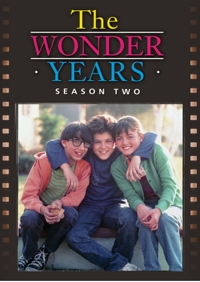
As I wrote in my review of The Wonder Years: Complete Series, this coming-of-age TV comedy-drama gets it right. Lots of things can shape a person, and just as WWII defined a generation, so did the Sixties—which historians date from John F. Kennedy’s 1963 assassination to Richard M. Nixon’s 1972 resignation. The Wonder Years managed to capture the perfect storm of events that were always in a family’s consciousness—even as the father tried to put food on the table, siblings fought and sought to find their place in the world, and the mother tried to hold them all together.

Like Leave It to Beaver, the series’ episodes were seen from the point of view of an adolescent, and you knew you were in for an interesting ride when this 1988-93 series shunned a laugh track and introduced the kind of voiceover narrator that we got in A Christmas Story—an adult version of the main character. And you knew that the series would meet the ‘60s head-on when the pilot called for the girl-next-door’s older brother to be killed in Vietnam, and for our hero to comfort her in a scene that would culminate in a first kiss for each of them—both as characters, and as actors.

Kids Kevin Arnold’s age were too young to worry about a draft number, but too old to ignore the events that were shaping history and the lives of Americans—things like the Martin Luther King, Jr. and Robert F. Kennedy assassinations, the moon landing, Woodstock, the Apollo 13 crisis, and events that were an outgrowth of Civil Rights, women’s liberation, and the increasingly violent anti-war protests. The result is a series that combines the innocence of childhood—of who likes whom, and passing notes—with a world that’s pushing them to grow up more quickly.   More

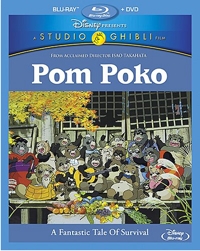
POM POKO (Blu-ray combo)

Leave a comment

PomPokocoverGrade: B
Entire family: No
1994, 119 min., Color
Rated PG for violence, scary images and thematic elements
Disney/Studio Ghibli
Aspect ratio: 1.85:1
Featured audio: English dubbed 2.0 DTS-HDMA
Includes: Blu-ray, DVD
Bonus features: C-
Trailer

Based on an idea by legendary Japanese filmmaker Hayao Miyazaki, Pom Poko is the story of a community of shape-shifting raccoons who struggle against developers that tear down forests and natural habitats to build stacks upon stacks of new subdivisions.

It’s a solid film from director Isao Takahata (Grave of the Fireflies, The Tale of The Princess Kaguya)—one that may strike Western viewers as having at least four “endings” where the film felt neatly wrapped up but then kept going, and in another direction. The runtime is only 119 minutes, but it frankly felt longer because of those false endings, which can also make the film seem like an episodic patchwork.

Once you buy into the premise—that raccoons (called raccoon dogs in the original Japanese version) have the power to transform into anything they want, including humans (watch for someone whose rings under the eyes look just a little TOO dark)—the film has its own kind of magic. While the plot itself doesn’t move all that fast or far, what holds our interest is the artwork and animation, and the various, often mischievous transformations that these animals engage in—first as a kind of training, then as a revolutionary tactic, and finally as a way to adapt. Call them a Far Eastern version of the trickster characters that North American audiences might be more familiar with. But if you watch this with younger children, be prepared to explain the prominent testicles that are visible even when these tricksters, known as “tanuki,” are seated.   More

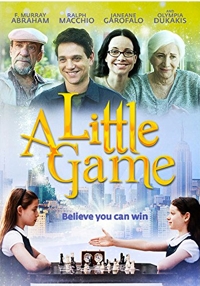
A LITTLE GAME (DVD)

Leave a comment

LittleGamecoverGrade: B
Entire family: Yes
2014, 91 min., Color
Rated PG for mild language and thematic elements
Arc Entertainment
Aspect ratio: 16×9 widescreen
Featured audio: Dolby Digital 5.1
Bonus features: C+
Trailer

There’s always something a little hokey about movies made for children to watch with their parents—kind of like Norman Rockwell paintings that depict life, but also simplify and idealize it. There’s a cheery afterschool special tone to them that resists any comparison to reality as we know it.

Then again, when something in that facile genre gets an infusion of talent and its heart is in the right place, it’s tough to find fault.

That’s how I felt watching A Little Game, which struck me as Karate Kid plays chess instead of learning martial arts. It struck co-star Ralph Macchio the same way, only in this 2014 film from Arc Entertainment he plays the dad rather than the kid in this coming-of-age story. In a bonus feature that mixes interview clips with behind-the-scenes NYC shooting footage, Macchio admits it’s just like the Karate Kid. And playing the Mister Miyagi role brilliantly is F. Murray Abraham as an irascible chess master who spends his time in Washington Park playing pick-up chess games for money. He has a background that we assume is impressive, though it’s never really stated. Like Pat Morita in Karate Kid, he also has a roundabout way of instruction that teaches his pupil as much about life as about the game itself. And as in Karate Kid, his pupil is bullied and feeling lonely and ostracized. Chess becomes a focal point that changes everything.

I know what you’re thinking. Chess??? That slow-moving Rook-to-A-3 strategy game of intellectuals that’s been around since the 6th century? Yep. Part of the fascination comes from the way that chess master Norman Wallach teaches—insisting, in true “wax on, wax off” fashion, that his pupil learn step by step and discover things in the city that will help her to understand the moves on the chess board, and part of the fun comes from Norman’s cranky personality and feisty exchanges with a precocious 10 year old whose parents let her ride the subway by herself.

I wouldn’t say that newcomer Makenna Ballard carries the film, but she co-carries it with Abraham. Without them, there’s really no interest, despite a smarter-than-usual screenplay. Without them, the minor characters stand out as stock types who function in ways we’ve seen at least a thousand times. But Ballard and Abraham’s characters are both so darned likeable and their relationship so deliciously testy that you really don’t need much else.   More

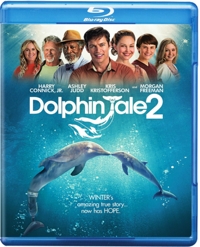
DOLPHIN TALE 2 (Blu-ray combo)

Leave a comment

DolphinTale2coverGrade: B
Entire family: Yes
2014, 107 min., Color
Rated PG for some mild thematic elements
Warner Bros.
Aspect ratio: 1.85:1
Featured audio: DTS-HD MA 7.1
Bonus features: C+
Includes: Blu-ray, DVD, Digital HD Copy
Trailer

When you do the right thing, you don’t have to do it perfectly in order to make a difference. So I’m going to pick up a pocketknife and cut this film some slack, the way that its main characters have had to cut fishing line and nets off of trapped and disabled marine life.

Dolphin Tale was based on a true story and used a combination of CGI, animatronics, and real dolphins to tell the tale of Winter, a rescued animal that was fitted with a prosthetic tail and became a beacon of inspiration for physically challenged people everywhere. So many of them came to the Clearwater Marine Hospital to see her that the place not only survived its own bout with possible extinction, but also expanded to a full-blown aquarium to accommodate all the new interest. People who made this film thought it was a one-and-done, with no plans for a sequel. But when they realized that the story about the subsequent acquisition of a very young dolphin named Hope was just as interesting and actually intersected with Winter’s story, Dolphin Tale 2 was born.

The same cast returns, with singer Harry Connick, Jr. playing Dr. Clay Haskett, the amiable head of Clearwater Marine Hospital. Kris Kristofferson is his retired father who lives in a houseboat next to the hospital, while Morgan Freeman reprises his role as prosthetics expert Dr. Cameron McCarthy, and Ashley Judd returns as the mother of Sawyer, a young boy who formed a bond with Winter in the first film.

In the sequel, the boy and Dr. Haskett’s daughter, Hazel, have risen to positions of importance at the aquarium, and the three-year gap between the 2011 original and this film is especially evident when you look at the young actors. Nathan Gamble (Marley & Me) was 13 when Dolphin Tale was released, and his co-star Cozi Zuehlsdorff was younger still. Now they’re more poised and self-assured teens, and if the rule of thumb holds true for young actors—that they tend to appeal to an audience younger, not older than they are—it only means that the audience for Dolphin Tale 2 has grown right along with them.   More

Older Entries Newer Entries