Home

Review of BEAST FROM HAUNTED CAVE Special Edition (Blu-ray)

Leave a comment

Grade:  C-

Horror/Drama

Not rated (would be PG)
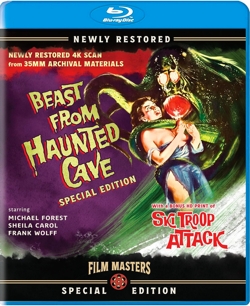
Just in time for Halloween, Film Masters has released a B-movie trick or treat (you decide):  a newly restored 4K scan from 35mm archival materials of the Gene and Roger Corman-produced Beast from Haunted Cave Special Edition. What makes it a special edition is bonus B movie from the King of B Movies, director Roger Corman: his WWII drama Ski Troop Attack, with both films released in 1959.

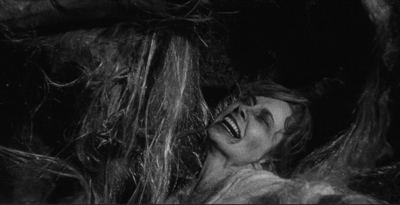
The Corman brothers were ahead of his time, because their films are perfect for today’s young adult film-watching parties, where the goal is to offer snarky running commentaries. It will be a “treat” for this crowd to savor and skewer—especially the “beast,” who has to be a contender for worst looking bargain-basement movie monster ever. You’ve got to see this. Really.

The “trick,” of course, is that the film got a 4.3 rating out of 10 at IMDB.com, and that’s not inaccurate. But a little context:

As someone who grew up in the late fifties and early sixties, I’ve sat through my share of B movies when going to the theater meant a double feature: the heavily advertised A movie that you went there to see, and a B movie that was shot on the cheap and thrown in as a bonus. Most of them were genre films and some of them were just bad. Sad bad—the kind that made you squirm in your seat or think to go to the restroom yet again, because you had a limited amount of money for movie snacks and could only make so many trips to the lobby counter. Then there were Hammer films and Roger Corman films, who embraced the fact that they were making movies, not films, on the cheap, so why not do it tongue in cheek? These were the campy films, the so-bad-they’re-good ones that left you wondering whether they were intentionally or unintentionally goofy. Somehow, despite being bad and having abrupt endings that made you wonder if they stopped filming when the money ran out, they were still fun to watch.
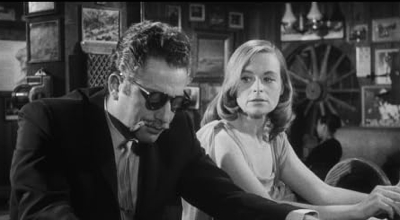
That’s what we’re dealing with here. Beast from Haunted Cave combines two genres—the heist film and the horror film—and it ends so suddenly that—wait, what?—you’ll probably want to rewind a bit. The plot is straightforward, as B movies typically are, but with better-than-B-average dialogue. A group of men and one woman plan on robbing a ski lodge, and decide to blow up an old mine/cave for a distraction. There’s more talk than action, but there are some interesting moments, many of them provided when Sheila Carol is on camera. Trivia fans might also look for Frank Sinatra’s nephew, who does a decent job with his role.

The heist team in this film is probably the most generic and benign cast of characters ever assembled, though the writing and their acting is just good enough to hold your attention until the next sighting of a creature that sometimes looks like a hairy tentacle operated by a Muppetteer and sometimes looks like a thinner, gauzy, spidery rendition of Pizza the Hutt. Like I said, you’ve got to see this movie monster to believe it. Beast from Haunted Cave is one of those B movies that’s fun make fun of.

Ski Troop Attackis surprisingly okay for a B movie, which is to say it’s almost good. Like Beast, it holds your attention while you wait for something to happen, but instead of hokey laughable moments there are just logical lapses that make you think, really? Like, why is it that it takes five ski troopers behind enemy lines to take out a bridge that we’re told can’t be attacked by the air, when A movies like 633 Squadron and The Bridges at Toko-Ri established that pretty much any target can be hit through the air?
Both films are halfway decent for B movies, and the transfers look great. Of the two, Beast remains the most fun to watch because of that campy monster. Ski Troop Attack, also filmed in Deadwood and the Black Hills of South Dakota, doesn’t lend itself as much to wisecracks—maybe because a historical war is the central subject. As I said, it’s surprisingly okay, but logically uneven. One final note:  like Alfred Hitchcock, Roger Corman liked to insert himself into his films. Look for “German Soldier Entering Cabin” in this one. The films and bonus features are on two separate discs in this release.

Entire family:  No (Age 10 and older)

Run times:  65 and 72 min., Black & White

Studio/Distributor:  Film Masters

Aspect ratios: 1.85:1 and 1.33:1

Featured audios:  Dolby Digital and DTS 2.0 Mono

Bonus features:  B-/C+

Trailer

Amazon link

Not rated (would be PG for adult subjects and frightening images)

Language:  2/10—Beast is squeaky clean, and Ski Troop isn’t much worse

Sex:  1/10—Other than a single bathtub scene where nothing can be seen, there isn’t anything here

Violence:  3/10—Neither film is particularly violent, either

Adult situations: 4/10—Some smoking and drinking and wartime action

Takeaway:  This is an interesting pairing of a Corman brothers’ produced B movie and a Roger Corman directed movie

Review of FINAL CUT (2022) Blu-ray

Leave a comment

Grade:  B-/C+

Horror comedy

Not rated (would be PG-13)

Final Cut is an onion of sorts, a 2022 French film with English subtitles that will vary in its appeal based on how much viewers know about (and appreciate) low-budget filmmaking, how much they like the tongue-in-cheek zombie subgenre of horror, and how many of the film’s subtle gags they happen to catch or find funny.

It’s entertaining in a heady sort of way—more clever than silly, and more silly than laugh-out-loud funny. For me, the gold standard for horror comedy remains the quirky Tucker and Dale vs. Evil, a hilarious parody of slasher films and all their familiar tropes. That one is both clever and laugh-out-loud funny. Final Cut is perhaps even cleverer, but funny in a way that makes you smile.

Final Cut, which opened for general release the same day it screened at the Cannes Film Festival, is part of a burgeoning subgenre of films in which the audience watches both a movie plot that unfolds as well as the behind-the-scenes action—a postmodern self-consciousness that directs the viewers’ attention to the process of filmmaking or theater production and the relationship between process and product. Think Charlie Kaufman’s Adaptation or Synecdoche, New York, or Alejandro González Iñárritu’s Birdman or (The Unexpected Virtue of Ignorance).

Like I said, heady stuff that will nonetheless appeal to fans of the subgenre because it parts the curtain on low-budget guerilla filmmaking, and that can be more fascinating than the movie that they’re filming.

Directed by Michel Hazanavicius (The Artist), Final Cut is a remake/adaptation of a 2017 Japanese horror-comedy One Cut of the Dead, but you don’t have to have seen that film to appreciate this one. It just adds another layer to peel away and savor.

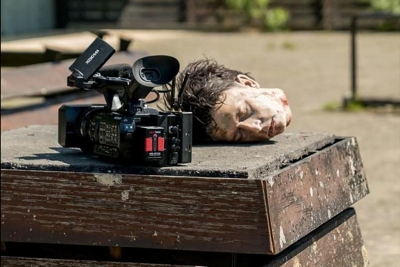
Hazanavicius said he wouldn’t have been surprised if some people at the Cannes screening “whistle or boo after 20 minutes.”  That’s because what we think we see for the first 20 minutes or so seems like a generically bad low-budget B-movie that’s chaotic, poorly cast, and shot on the cheap. I say “poorly cast” because the characters have Japanese names though they’re clearly European and speaking French.

There’s an explanation for that and everything else we see in those first 20 minutes, but I won’t spoil it by saying anything more. As I said, it’s a clever onion of a film that can be appreciated as an onion, but much more so if more of the layers can be perceived. I’ll give you one right now:  Yoshiro Takehara, who plays a producer that’s funding the film and has her own ideas about what her money should buy, had the same role in the 2017 original that this film partly spoofs and partly remakes.

In Final Cut, Romain Duris plays a passionate and slightly crazy director who normally directs infomercials and small documentaries and seems out-of-his-league making a film about cast and crew members that, one-by-one, turn into zombies. The character mix seems familiar enough: two daughters who have their own opinions about how the film  should be shot,  an egocentric prima donna of an actor, a crew member who drinks too much . . . on the job, and a bevy of producers to keep happy. As far as the audience goes, Final Cut will keep viewers happy as long as they appreciate the cleverness, but patience is definitely a virtue, for there are many lackluster stretches where you have to give Hazanavicius the benefit of the doubt and wait to see where he’s going with it all.

This gleefully gory, meta film with scatological humor might be played tongue-in-cheek, but even at that it’s only suitable for older teens and adults. In the end, I thought it was above-average, but couldn’t touch Tucker and Dale—even with its satisfying ending. Tucker and Dale grabs you from the very beginning, while Final Cut seems to start slow and gradually build momentum and interest. But as with Tucker and Dale you’ll find yourself thinking about the film later and realizing how clever it actually was. And young filmmaker wannabes will get the same sort of inspiration as they may have gotten from The Fabelmans.

In case you’re wondering, Final Cut didn’t make the cut for awards at Cannes, but it did win Best Motion Picture Score at the Fantasia Film Festival and Hazanavicius earned a Best Adapted Screenplay nomination for a César, the French equivalent of the Oscars.

Entire family:  No (Age 10 and older)

Run time:  111 min., Color

Studio/Distributor:  Kino Lorber

Aspect ratio:  2.39:1

Featured audio:  French 5.1 DTS with English subtitles

Bonus features:  C

Trailer

Amazon link

Not rated (would be PG-13 for bloody violence and gore and brief nudity and scatological humor)

Language:  7/10—F-bombs and other language galore, but the act of reading subtitles while processing visual information somehow makes it seem less impactful

Sex:  3/10—One scene that’s fairly tame and nothing else major that I can remember; rather, anything sexual is mostly talk and allusions

Violence:  7/10—The violence here is intended to be gory and shocking in a campy sort of way; a head gets lopped off, another character takes an axe to the head, an arm gets ripped off, there’s projectile vomiting, but again, all in a campy sort of way

Adult situations:  5/10—One main character is an alcoholic, and there’s drinking and some smoking I think (hard to say because your focus is elsewhere)

Takeaway:  I can see why the director thought audiences might boo around the 20-minute mark, but that’s because of structural decisions the director made; filming it in another sequence or way ultimately wouldn’t have been as effective

Review of TWICE TOLD TALES (1963) (Blu-ray)

Leave a comment

Grade:  B-/C+
Drama/Horror
Not Rated (would be PG)

Rewatching Twice Told Tales on the new Kino Lorber Blu-ray, I found myself wondering about the ideal audience for this film adaptation of Nathaniel Hawthorne stories featuring screen legend Vincent Price.

Children old enough to have read the stories in school might be curious to see how the 1963 film treatment was handled, but I’m not sure that they will appreciate a tone that tends toward the melodramatic. Director Sidney Salkow took a break from directing popular TV series like Death Valley Days to churn out seven B-movie genre films: four westerns, a mystery, and two fantasies—one of them being this anthology of Hawthorne tales.

Whether by design or coincidence, the three stories are presented in descending order of appeal. The strongest tale, “Dr. Heidegger’s Experiment,” is a short story that plumbs the depths of human desire for a fountain of youth or immortality. Like the frequently anthologized Edgar Allan Poe story “The Cask of Amontillado,” it involves a friendship that’s solid on the surface but bubbling beneath with hidden emotions. Sebastian Cabot—whose voice children may recognize as the narrator of Disney’s Winnie the Pooh films and the character Bagheera in Disney’s animated Jungle Book—plays Carl Heidegger, who celebrates his 79th birthday with best friend Alex (Price), his only companion since his beloved fiancée Sylvia (Mari Blanchard) died the night before they were to be married 38 years ago. But a “dark and stormy night” causes the door to a crypt in the backyard where her coffin is housed (yep, we’re talking Gothic romance) to open. Carl feels compelled to check on her, and both men are shocked to see that her body appears as it did when she was alive. The rest of the tale follows Dr. Heidegger’s drive to discover what preserved her and maybe even bring her back to life.

The type of horror included in these Price Told Tales is the same sort one would find in a Jaycee’s haunted house: skeletons, dead bodies, creatures dying instantly as if from witchcraft, blood oozing from strange places, etc.—minus the jump scares. It’s pretty tame but still somehow memorable . . . because of the images or concepts, or because of their pairing with old-time melodrama?

More

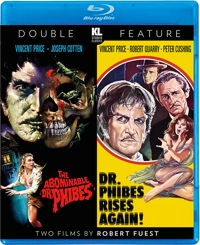
Review of THE ABOMINABLE DR. PHIBES / DR. PHIBES RISES AGAIN! DOUBLE FEATURE (Blu-ray)

1 Comment

Grade:  C+
Mystery-Horror
Rated PG-13

The Abominable Dr. Phibes (1971) and its sequel, Dr. Phibes Rises Again (1972), are cult films—but that doesn’t automatically mean they’re not suitable for family viewing. In the case of this double feature—available now on Blu-ray from Kino Lorber—there’s far less violence, sex, and jump-scares than in contemporary horror films (see the trailer). But these are definitely cult classics, which is to say that they’re not mainstream popular.

For me, a cult classic is defined by a string of “usuallys”:  Usually it’s a low-budget B-movie, one that courts in-your-face difference and has an air of scandal or controversy about it, often with acting and a script that make you wonder if it’s unintentionally bad or bad for the purpose of being campy. Rarely is a cult film deadly serious, but most of the time there’s a “weird” factor. In part they’re also defined by their audiences, who celebrate “getting” the film when others don’t, and whose embrace can be exuberant, if not obsessive.

When it was first released, Dr. Phibes nudged viewers toward a cult film mindset just by featuring Vincent Price, who had built up a following as the star of campy director Roger Corman’s B-movie adaptations of Edgar Allan Poe horror stories. Price’s silky villainous voice and stage-actor mannerisms in those films had already earned him cult status—something that would continue throughout his career, whether he was featured in The Brady Bunch Hawaii episodes and the beach-party film Dr. Goldfoot and the Bikini Machine, embraced by Tim Burton for two films (Vincent and Edward Scissorhands), enlisted by Michael Jackson (“Thriller” song/video) and Alice Cooper for musical gigs, celebrated in song by Deep Purple and ZZ Top,or parodied on The Simpsons and SNL.

More

Review of CURSE OF THE UNDEAD (Blu-ray)

Leave a comment

Grade: C+/B-
Western-horror
Not rated (would be PG)

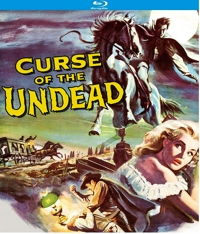
A week ago, if you had asked me to name a Western that bridged genres and included vampires, I would have said, “I know, I know: Billy the Kid vs. Dracula!” That 1966 movie is famous for being so absolutely awful that it’s not even laughably bad—an insipid film that’s only known for the blending of genres that everyone thought unique. But a few days ago I became aware of another vampire Western—Curse of the Undead—and it turns out that this black-and-white 1959 film was really the first vampire Western.

What’s more—and here’s the shocker—it’s not a silly movie that takes itself seriously, thereby setting itself up for an audience that likes campy films, films that are wink-wink so bad that they’re kinda good. You need to know this, so you won’t look at the cover art and think, Oh, we’re going to have so much fun making fun of this rotten film. It’s not rotten and it’s not campy. Writer-director Edward Dein, who would go on to direct Robert Conrad in three TV series (Hawaiian Eye, The Wild Wild West, The Black Sheep Squadron), plays this absolutely straight. It’s a surprisingly good drama that treats vampires a little less like Universal monsters and more like what legend says they were. If it were shorter, it might pass for an episode of The Twilight Zone, and tonally it’s very much like the classic monster movies that Universal cranked out in previous decades.

To make the Western aspect work, it helps that one of the stars is Eric Fleming, who played Gil Favor on the highly respected Rawhide (think Blues Brothers!) TV series and also appeared in several episodes of Bonanza, that other long-running TV Western. In this vampire Western, Fleming plays Preacher Dan. Somebody has to have a cross, right?

One of the other stars is John Hoyt, who appeared in such TV Westerns as The Virginian, The Big Valley, Laredo, Wagon Train, Have Gun – Will Travel, Maverick, Laramie, The Rifleman, Death Valley Days, and Union Pacific. All of those Westerns were popular because they were aimed at adults. They were serious dramas and not just Saturday morning formulaic shoot-‘em-ups.

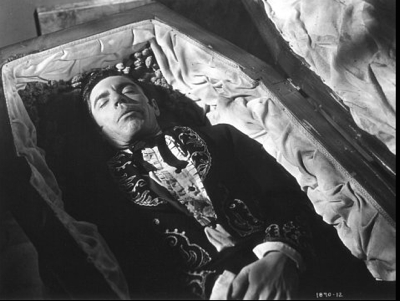
In this film, even the vampire—Michael Pate—worked in TV Westerns that were played for drama, not laughs, including shows like Zane Grey Theater, Maverick, Wanted: Dead or Alive, Sugarfoot, and Broken Arrow. These guys knew how to play cowboys, and it’s both surprising and refreshing that the vampire in Curse of the Undead doesn’t transform into a bat, doesn’t say “I vant to suck your blood,” and doesn’t behave like he just got in from Transylvania. He looks and acts like the kind of gunslinger you’d encounter in the Old West: dark and menacing as a coiled rattlesnake ready to strike.

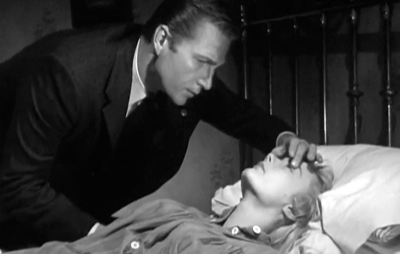
There’s always a ranch or town boss in a Western who’s the villain, but when there’s a vampire gunman in town any villain is going to seem soft by comparison—even someone like Bruce Gordon, who played Frank Nitti in the old Untouchables TV series and also appeared with Vincent Price in Tower of London. And there’s always a damsel in distress, a delectable morsel-in-waiting in every vampire movie. Here, the part is played by Kathleen Crowley, who was in her fair share of B movies and Westerns, including The Rebel Set, Target Earth, Female Jungle, and Maverick. More

Review of THE CAT AND THE CANARY (1939) (Blu-ray)

Leave a comment

Grade: B+
Comedy-Horror-Mystery
Not rated (would be PG)

If your family enjoyed Knives Out, you also might be entertained by an early entry in the self-conscious light mystery genre.

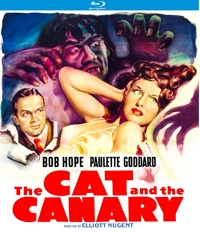
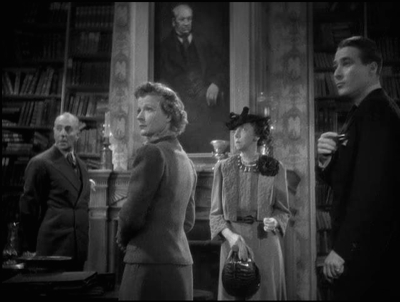
In The Cat and the Canary (1939)—based on a 1921 stage play by the same name—comedian Bob Hope plays it mostly straight, an actor without the ham in this tongue-in-cheek whodunit with a dash of horror. A year later, hitting the road with Bing Crosby and Dorothy Lamour, Hope would develop his famous persona as a bumbling coward of a second banana to Crosby’s straight man, but in this one he’s less goofy and more believable as a love interest for Paulette Goddard. Hope is a considerably more suave and in control than later characters he’ll play, and as a result viewers find themselves focused more on the atmosphere and plot.

The Cat and the Canary was so popular that Hope and Goddard would team up for a second haunted house picture in 1940—The Ghost Breakers, which isn’t recommended for family viewing because of offensive outdated cultural stereotypes. The sets and gimmicks from both films would provide the inspiration for Disney’s popular Haunted Mansion theme park attraction.

There are revolving bookcases, secret panels, and a Louisiana bayou mansion that wasn’t exactly prime real estate even before it fell into decrepit disrepair. Why would anyone visit now, especially when you have to be paddled there by various canoeists? As it turns out, all are relatives and named parties to attend the ceremonial reading of the will, according to instructions left by a reclusive millionaire who died 10 years ago. The deceased specified that his will must be read exactly at midnight, of course. One more thing: worried that insanity might run in the family, the eccentric recluse specified that the one bearing his surname (Norman) will inherit everything. But there’s a catch. If the named heir, Joyce Norman (Goddard), goes crazy before 30 days have passed, then a second replacement heir will be read from a second sealed envelope.

Kind of makes you want to run the other direction, right? Except that the canoe paddlers don’t operate late at night (they must have a strong union). But how else can you ensure that everyone has to spend the night in this spooky place? More

Review of BLOOD QUANTUM (Blu-ray)

Leave a comment

Grade: B-
Horror-thriller
Not rated (would be R)

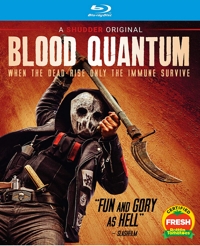
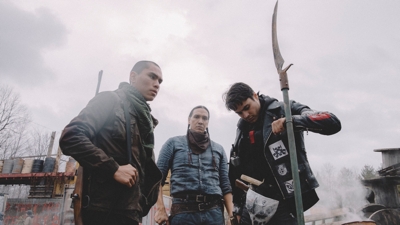
Blood Quantum isn’t a title that screams “family friendly”—just plain screams, is more like it, considering that this 2019 horror film finds a few inventive new ways to kill zombies. There’s blood and gore and f-bombs galore, but if we’re being honest it’s the kind of film that appeals to older teens and families that enjoy a good frightfest every now and then.

Plus, Blood Quantum deserves a shout-out because this 2019 Canadian film from Jeff Barnaby is that rare horror film made by a First Nations director. Barnaby, a Mi’gmaq, shot much of the film on the same reserve in Listuguj, Quebec where he was born and he spotlights a large cast of First Nations actors. The history of indigenous people in North America is a history of segregation and forced relocation, but this film gets its own symbolic revenge (a theme suggested by two animated segments) by having the reserve be a place where all of the whites now want to go. The film’s key concept is that indigenous people are immune to the zombie plague. While they can be killed, they can’t be turned into zombies themselves. That is, they are immune to whatever zombie virus is being transmitted through zombie bites. As a result, the reserve, ironically, has become the only safe haven in the world.

The title itself is also ironic, because “blood quantum” or “Indian blood” laws were enacted by the U.S. government as a way of legally defining racial groups—too often a first step toward isolation and persecution. Here, blood quantum is a saving grace, and the political statement that Barnaby makes in his second full-length feature (the politically charged Rhymes for Young Ghouls was his first) is unmistakable. More

Review of ANNABELLE COMES HOME (Blu-ray combo)

Leave a comment

Grade: B-/C+
Entire family: No (way)
Horror, thriller
2019, 106 min., Color
Rated R for horror violence and terror
Warner Bros.
Aspect ratio: 2.40:1
Featured audio: Dolby Atmos TrueHD
Bonus features: C+/B-
Includes: Blu-ray, DVD, Digital Code
Trailer
Amazon link

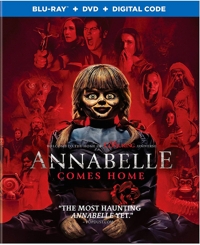
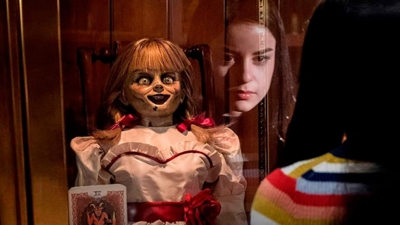
First there was The Conjuring (2013), then Annabelle (2014), The Conjuring 2 (2016), Annabelle: Creation (2017), The Nun (2018), The Curse of La Llorona (2019), and now Annabelle Comes Home (2019). The Conjuring Universe continues to expand, but this latest film isn’t as much of a big bang as it is a slow evolution from dark potentiality to a third act burst of relatively predictable action. That’s because it’s a Pandora’s box film, and even if you know nothing about Greek mythology you probably have heard that Pandora opened a box (well, jar, actually) and unwittingly unleashed sickness, plagues, death, and all manner of evils on humankind. With a Pandora’s box film, you know the plot will be about trying to re-contain those evils, and the protagonists either will succeed or not. You have a 50/50 chance of guessing the outcome.

That’s one thing that makes Annabelle Comes Home less energetic or surprising than some of the previous entries. Fans have been through this before and know what to expect. There aren’t as many scares as in previous films, but the ones that are here are high octane, and their intensity is boosted by the fact that much of the action takes place within the confines of the home. More

Review of US (Blu-ray combo)

Leave a comment

Grade: B
Entire family: Heck no!
2019, 116 min., Color
Thriller-Horror
Universal
Rated R for violence, terror and language
Aspect ratio: 2.39:1 anamorphic widescreen
Featured audio: Dolby Atmos
Bonus features: B+
Includes: Blu-ray, DVD, Digital
Trailer
Amazon link

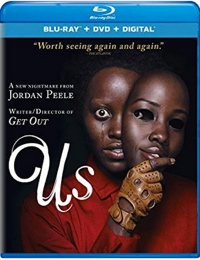
We need to talk. I’m not sure how I feel about Us.

I mean, a part of me feels that it’s another tense thriller from Jordan Peele, who first indulged his non-comedic side by writing and directing Get Out. But—and you might call this follow-up Just Try to Get Out—there’s a part of me, maybe my doppelganger, that thinks this latest “horror” film doesn’t make enough sense.

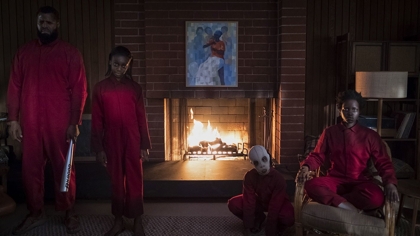
Then again, horror genre writers and directors have never excelled in logic. It was their worst subject in school. For them it’s all about putting the characters quickly in peril and keeping them there for 90 minutes. And Peele does that, right up until the big-twist ending that would have tied Chubby Checker into a pretzel, all the while leaning more in the direction of “thriller” than “horror” for much of the way.

We’re told in an epigraph that there are a bazillion tunnels under the continental U.S., suggesting that whatever horrors we’ll meet in this film will be subterranean denizens—hard to miss, especially since there are also images of rabbits, which evoke Alice’s plunge into Wonderland.

The action begins with a family’s 1986 trip to Santa Cruz beach and boardwalk, where a young girl named Adelaide wanders off from her dad and is drawn to a “Find Yourself” fun-house of mirrors on the beach. Before she enters she passes a guy who’s a cross between a creepy carney and a doomsayer with the sign that reads “Jeremiah 11:11”— which quickly became a popular Internet search. I’ll save you the trouble: “Behold, I will bring evil upon them, which they shall not be able to escape; and though they shall cry unto Me, I will not hearken unto them.” Yeah, well, she sees her double inside and whatever else happened when she’s recovered by her parents she’s so traumatized she can’t even tell them (or the audience) what happened.

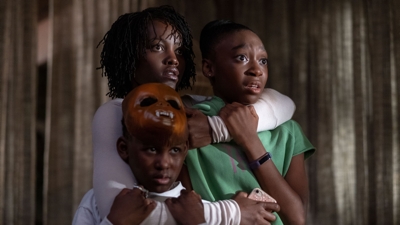
Flash forward to the present and we see an adult Adelaide (Lupita Nyong’o) reluctantly agreeing to return to Santa Cruz for a family outing with her husband (Gabe Wilson) and their two children: Zora (Shahadi Wright Joseph), whom her father thinks could be an Olympic track star if she applied herself, and Jason (Evan Alex), an odd withdrawn kid who tends to wear a mask up on his head like flip-up sunglasses, ready to put it over his face whenever he wants anonymity. If you’re thinking of Friday the 13th’s Jason and his lake antics, that’s what Peele wants. Throughout the film there are numerous allusions to classic campy horror films, which, of course, means that the hope was for Us to be seen as equally classic and campy. More

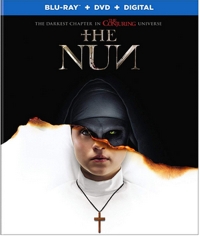
Review of THE NUN (Blu-ray combo)

Leave a comment

Grade: B-
Entire family: No
2018, 96 min., Color
Horror
Warner Bros.
Rated R for terror, violence, and disturbing/bloody images
Aspect ratio: 2.40:1
Featured audio: Dolby Atmos TrueHD
Bonus features: C+
Includes: Blu-ray, DVD, Digital Code
Trailer
Amazon link

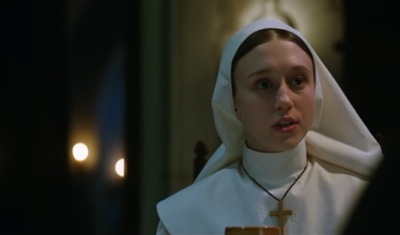
The Nun ends right before The Conjuring begins, but you don’t have to have seen that film, The Conjuring 2, or the related Anabelle and Anabelle: Creation to understand what’s going on. This horror prequel is a stand-alone film set decades before the hauntings from the other films in the popular franchise.

Eighty percent of the scenes in The Nun are dark and/or dreary, and location filming in Romanian Transylvania castles and manors adds to the atmosphere, creating a look and feel that will remind horrorphiles of the old Hammer gothic horror flicks from the late ‘50s and 1960’s. In those B movies, atmosphere was everything, and the mood was so thick you could cut it with a scream. Light on plot and characterization, those old films were also dependent upon the occasional jump-scare—a trick that Nun director Corin Hardy relies on a bit too much. It’s like walking through a Jaycees Haunted House and having something pop out at you every 10 minutes. But that’s what appeals to young horror fans today, and it’s also why my teenage daughter gave this one a higher grade than I did. She gave it a B; I gave it a C+, with B- the compromise grade. More

Older Entries