Home

Review of DOUBLE TROUBLE (1967) (Blu-ray)

Leave a comment

Grade:  C

Comedy-Musical

Not rated (would be PG)
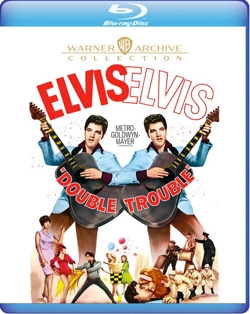
Elvis Presley made 31 movies between 1956-69, and 16 of them are currently available on Blu-ray from U.S. or European distributors (the latter via eBay).

Of those films currently on Blu-ray, King Creole has been broadly acclaimed as the best of the bunch, followed by Follow That Dream. After that there’s disagreement, but I would rank the rest currently available in this order: Jailhouse Rock, Viva Las Vegas, Blue Hawaii, Flaming Star, Love Me Tender, Kid Galahad, Spinout, Clambake, Charro!, Tickle Me, It Happened at the World’s Fair, Change of Habit, and Frankie and Johnny. The best films yet to be released in high definition are The Trouble with Girls, Girl Happy, Girls! Girls! Girls!, Loving You, Wild in the Country, G.I. Blues, Roustabout, Fun in Acapulco, and Live a Little Love a Little.

You may have noticed that Double Trouble hasn’t been mentioned yet. That’s because along with Easy Come Easy Go, Kissin’ Cousins, Harum Scarum, and Stay Away Joe, this 1967 film ranks as one of the worst that Elvis made. It’s for hardcore fans only. And even those fans might feel a little uneasy watching it.
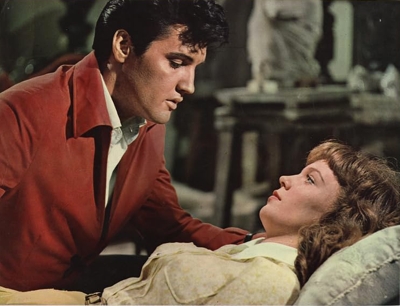
Double Trouble is about an American performer in London who dates a girl who he thought was “legal” but is actually still months shy of her 18th birthday. He goes to Brussels and she pursues him. He doesn’t put up much of a fight, instead vacillating between rejecting this “little girl” and embracing her. It’s not just the groupie thing. Further discomfort comes from knowing Elvis’s own story. Double Trouble was released in April 1967, just one month before Elvis married Priscilla Beaulieu—whom he was drawn to and dated intermittently (albeit with chaperones) since meeting her at a party at his rented house in Germany. He was 24; she was 14.
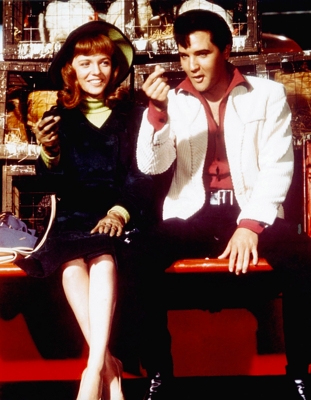
So yeah, while it’s a little creepy watching Elvis romance a fictional underage girl, it’s even more unsettling when you know the story of his relationship with Priscilla. Yes, it was chaperoned . . . but still.

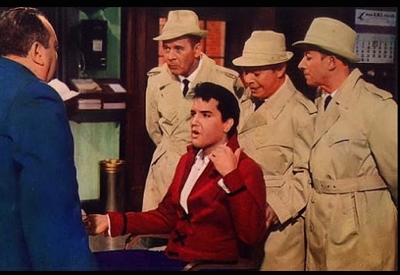
Even if the character played by 19-year-old Annette Day were 18, Double Trouble would still be one of the worst Presley films. Though it’s helmed by frequent Elvis formula pic director Norman Taurog, the screenplay itself is a bomb. The writing is sillier and the gags are cornier than usual. Scenes with three bumbling policemen—echoes of The Three Stooges—are even painful to watch.

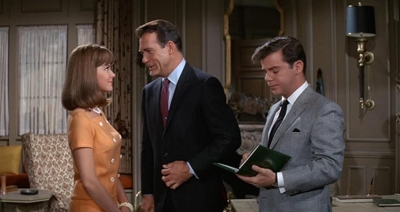
Elvis plays Guy Lambert, a small-time touring musician playing London who is dating a young woman named Jill (Day) and pursued by an older, more sophisticated woman (Claire Dunham). While the opening credits visually announce that Elvis is in Austin Powers Land and while many of the characters dress the Carnaby Street part, Elvis sports the same hair and look that he’s had in all his films set in contemporary times. In short order we learn that Jill, who continues to pusue Guy, is not only underage, but she comes from a wealthy family. Her uncle forbids her to see Guy, and thinks he’s solved the problem by sending her away to Brussels. Unbeknownst to him (but knownst to us), that’s exactly where Guy’s next gig is. But someone keeps trying to kill one of them, with Bond-era spy types lurking and the police also involved . . . somehow.
As for the songs, it doesn’t help the underage thing to have Elvis sing “Old MacDonald” to Jill as they ride on the back of a hay wagon—the kind of song parents everywhere sing with their children to get them to make different animal sounds. It also doesn’t help that they ruin a perfectly good song—“I Love Only One Girl”—by dragging it out and having Elvis prance around a festival singing to costumed women from different countries. That leaves “Long Legged Girl (With The Short Dress On)” and the title song as the upbeat songs worth mentioning.

Entire family:  No (though theoretically, yes)

Studio/Distributor:  Warner Bros.

Aspect ratio:  2.35:1 widescreen, Color

Featured audio:  DTS-HDMA 2.0 Mono

Bonus features:  two cartoons and a trailer

Trailer

Amazon link

Not rated (would be PG for some peril and adult situations)

Language:  1/10—Maybe something slipped past me, but I doubt it; Elvis flicks are pretty clean-cut affairs

Sex:  2/10—As always, nothing explicit or even highly suggestive; here, it’s just the awkwardness of a 17-year-old groupie in pursuit of an older man who doesn’t really fight her off

Violence:  2/10—Everything is done with a certain level of campiness, not unlike the pianos that would be dropped on cartoon characters

Adult situations:  2/10—Some smoking and drinking in club settings, and the 17-year-old thing

Takeaway:  You have to wonder what goes into a decision to release an Elvis flick on Blu-ray, and how a stinker like this got to the front of the line when more entertaining films are still only available on DVD; Girl Happy or The Trouble with Girls ought to be next up
Review: SPINOUT (1966) (Blu-ray)

Leave a comment

Grade:  C+/C

Comedy-musical

Not rated (would be PG)

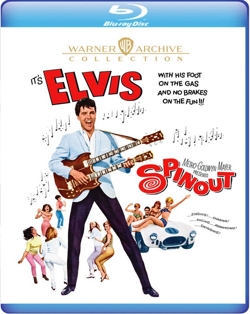
The “formula” Elvis Presley picture was a thinly plotted, quickly filmed excuse to string a few new equally slapdash songs together so audiences hungry for All Things Elvis could get their fix at a time when “The King” wasn’t touring. Elvis movies were a phenomenon in the sixties—a part of the cultural milieu before Vietnam and Civil Rights demonstrations rocked the American landscape so much that wholesome light and fluffy escapist fare like these instantly became extinct.

But back in the day, rare were the teens that didn’t go to movie theaters to see Elvis, although (or perhaps because) they knew what they were going to see:  a number of songs (some good, some not so good), at least two pretty women pursuing Elvis, lots of silly-to-watch-now dancing, and a light tone that was an important part of the formula.

Elvis made 31 movies between 1956 and 1969, with the first “formula” picture coming in 1960 with G.I. Blues. Spinout was released in 1966, when the Elvis films were already steering toward self-parody, with more silliness, overused running gags, and minor characters leaning closer to caricatures.

Spinout was the second of three movies that Presley made opposite former teen star Shelley Fabares, who played daughter Mary on the popular TV series The Donna Reed Show and scored a #1 hit in 1962 with her song “Johnny Angel.” Fabares actually plays well off Presley, so it’s easy to see why producer Joe Pasternak went to that well more than once. Onscreen she has a wholesome perkiness tempered by impertinence. In this one she plays a spoiled rich girl who flat-out tells racecar driver Mike McCoy (Elvis) that she always gets what she wants, and she’s set her sights on him. So has an older woman (Una Merkel, in her last film) who does undercover research for how-to tell-all books about understanding American males. And he’s the intended subject of her next book.

Fans of Westerns will recognize the former star of Sugarfoot, Will Hutchins, who plays a cop with a food fetish and also turns up in a more major role in Clambake in a Prince and the Pauper variation as a rich Texan who trades places with poor water skiing instructor Presley.

The formula had been getting so old and obvious that the filmmakers felt compelled to throw in a third love interest:  the band’s tomboy drummer Les (Deborah Walley, of Gidget Goes Hawaiian fame). Figuratively speaking there’s even a fourth person who’s  after Mike:  the rich girl’s father (played by Fabares’ TV dad from Donna Reed) who wants him to drive the racecar he designed in an upcoming race—with nary a seatbelt that I could see.  

It didn’t matter how much they tried to freshen up the formula. Despite moments when Fabares and a couple of Presley songs brighten things up, Spinout isn’t in the same class as the best of the Fabares-Presley films, Girl Happy (1965), and isn’t even as good as Clambake (1967), a film that provoked mixed reactions. Maybe fans need to clamor a bit for Girl Happy, because MGM does seem to be listening. With this release they added a song index where fans can watch all the songs being performed, without having to try to guess the scene selection chapters.

Auto racing fans should enjoy seeing a Cobra, Cheetah, and McLaren Elva being put through their paces before CGI, and Elvis fans might relish seeing him play a twin-necked guitar. But Presley’s best racing film is Viva Las Vegas

Entire family: Yes (see below)

Studio/Distributor:  Warner Bros.

Aspect ratio:  2.35:1

Featured audio:  DTS-HDMA 2.0 Mono

Bonus features:  C

Trailer

Amazon link

Not rated (would be PG for implied adult themes)

Language:  1/10—Euphemistic swearwords if anything; Elvis movies were pretty clean and wholesome

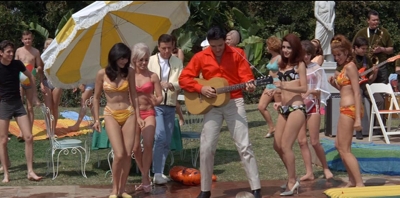
Sex:  2/10—Elvis kisses a number of women and it’s implied that he spent each night with a different woman apart from the three who are after him in the film; there’s also a pool scene with lots of skin and bikinis and briefs

Violence:  0/10—Usually there was a fist fight in the typical Elvis picture, but not this one; just a few cars run off the road

Adult situations:  1/10—Some characters have champagne, and the whole idea of women scheming to marry Elvis is adult, though the situation now is dated and sexist

Takeaway:  Come on, Warner Bros. Put Girl Happy in your Elvis queue, and Girls! Girls! Girls!—both of which are more entertaining formula flicks than this one

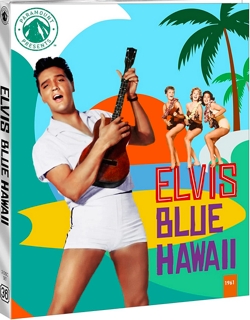
Review of BLUE HAWAII (4K) (1961)

Leave a comment

Grade:  B-
Musical comedy
Rated PG

How do you explain the Elvis Presley phenomenon?  You start with the music. Until Elvis, rock and roll was an evolving synthesis of blues, gospel, jazz, boogie woogie, and western swing. As a type of music that was deliberately dance-oriented, it hooked America’s youths. But Elvis and his “rockabilly” variation made the new music sexy, with hip-swiveling gyrations that caused girls to scream and faint. In no time at all, he became the biggest rock-and-roll star of them all and is still recognized by Guinness as the best-selling solo musical artist of all time, with more than 500 million records sold worldwide.

If you saw Baz Luhrmann’s Elvis you learned that Col. Tom Parker, Elvis’s manager, was exploitive as a promoter. The big money was in movies, so he pushed Elvis away from giving concerts (some of which were banned or caused riots) and instead pointed him in the direction of Hollywood. From 1956-69, Elvis starred in 30 films. Since Elvis wasn’t doing concerts anymore, his movies were the only way fans could actually seehim perform, and they turned out in droves. As a result, Hal Wallis remarked, “A Presley picture is the only sure thing in Hollywood.”

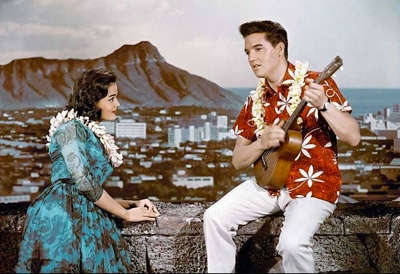
Variety called Blue Hawaii a “handsome, picture-postcard production,” and that’s what it was. With Hawaii becoming the 50th state on August 21, 1959, Americans wanted to see and learn more, and location filming added to the film’s interest—along with a tagline that promised “Ecstatic romance…Exotic dances…Exciting music in the World’s Lushest Paradise of Song.”

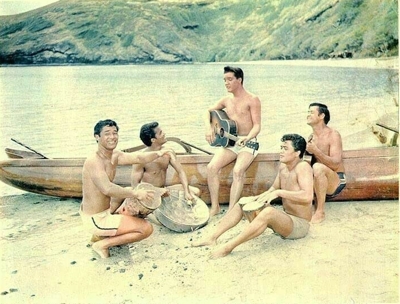
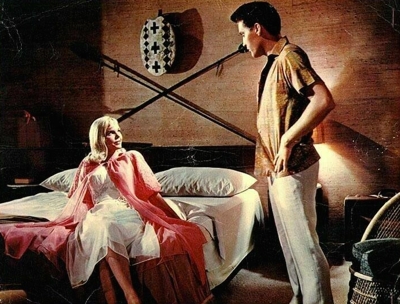
Elvis plays Chad Gates, the son of a wealthy pineapple plantation owner (Roland Winters) and a doting, suffocating mother (Angela Lansbury). Chad dreads seeing his parents after returning from military service and instead goes straight to his beach house to hang with his girlfriend (Joan Blackman as Maile) and local musicians. The premise was genius, since Elvis himself had only recently returned stateside after a stint in the Army. Blue Hawaii was his third post-service film, following Flaming Star and Wild in the Country. Not wanting to work at the family business, Chad instead proposes to start a tourist guide business with Maile. But their first client proves that Chad’s charm is both an asset and a liability as he is tasked with showing a schoolteacher and her four teenage charges a good time.

On a four-star scale, all Elvis movies fall in the 2-to-3 star range, but Blue Hawaii makes everyone’s Elvis Top 10 movie list because of the music. Some of the movies skimped on songs, but this one has 15 of them, including “Can’t Help Falling in Love,” which sold a million copies as a single release. The soundtrack album spent 20 weeks at the top of the Billboard Pop Albums chart. Some of the songs are throwaways, but there are some solid ones here too, like “Almost Always True” (though it’s a bit mind-boggling that Maile would smile and groove along with him as he fudges, in song, the question of whether he was faithful to her). Other upbeat songs that work as something more than soundtrack music include “Rock-a-Hula Baby,” “Beach Boy Blues,” and possibly “Slicin’ Sand,” while Elvis’s renditions of “Hawaiian Wedding Song,” “Aloha Oe,” and “Blue Hawaii” are serviceable enough.

Blue Hawaii finished as the 10th top-grossing film of 1961—so successful that it would provide the formula for many of the Elvis films that followed. The image that these films cultivated was an Elvis meant to be everything to women. A nice guy and a perfect gentleman yet handy with his fists if need be, he also had a slight bad boy or rebellious streak. He was also good with kids and respectful of elders—the kind of guy that, despite the attitude, you could still bring home to meet Mom and Dad. The formula called for Elvis to have at least two women interested in him, at least one cutesy scene with children, one scene with elders, and one scene where he comes to the defense of a woman. And as much as the formula Elvis movie is ridiculed—Top Secret! offers a pretty wicked spoof!—it was still what fans seemed to want. Year after year.

Do the Elvis films still work? Probably not, unless you’re wanting to put yourself in the mindset of young people from the time period, or unless you’re an Elvis fan. If you are, this still ranks in the top third of his films.

This Paramount release contains a superior 4K feature and a Blu-ray version with special features that’s a little grainier.

Entire family:  Yes (pretty wholesome, overall)
Run time:  101 min. Color
Studio/Distributor:  Paramount
Aspect ratio:  2.35:1 widescreen
Featured audio:  Dolby TrueHD 5.1
Bonus features:  C
Includes: 4K Blu-ray, Blu-ray, Digital Copy
Amazon link
Trailer
Rated PG for mild sensuality

Language:  1/10—I didn’t catch anything

Sex:  3/10—Women come on to Elvis, and a girl who’s supposed to be 17 throws herself at him and flirts with others; a woman loses her top in the ocean but nothing is shown and nothing is sexualized

Violence:  2/10—Just a brief restaurant-bar fight

Adult situations:  3/10—One young woman acts up and ostensibly tries to drown herself and is subsequently “spanked” in a rather outdated sequence; flirting and suspicions of cheating

Takeaway:  It’s dizzying reading all of the movies, studio recordings, benefits, and other things that Elvis did, and you can’t help but wonder if he wasn’t so overworked if his personal outcome might have been different

Review of A CONNECTICUT YANKEE IN KING ARTHUR’S COURT (1949) (Blu-ray)

Leave a comment

Grade:  C+/B-
Fantasy musical comedy romance
Not rated (would be G)

Disney didn’t invent family movies. As early as the 1930s, studios were adapting literary classics by Stevenson, Verne, Kipling, Dickens, and Twain with the intent that they might appeal to whole families. Disney’s philosophy was to make films for children that adults could also enjoy; those early family films were made for adults, but with content that might also keep children entertained. So many of these films were pleasant entertainment, which is to say a kind of middle-of-the-road offering meant to please a lot of people a little.

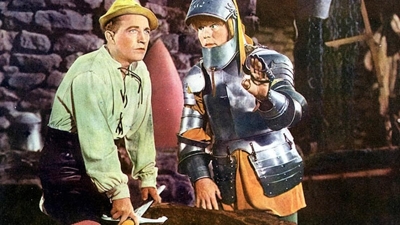
When The New York Times’ Bosley Crowther reviewed A Connecticut Yankee in King Arthur’s Court(1949), he called it “that good time to be had by all.” Like many costumed adventures the studio system produced, this Twain adaptation featured a fantasy common to children (being transported to another time and place) and musical numbers that were a staple back then. While the adults were enjoying the romance and music, children were engaged by the escapist adventure and comedy, with everyone appreciating crooner Bing Crosby (The Bells of St. Mary’s, Going My Way, Holiday Inn) as Hank Martin, an easy-going blacksmith/mechanic from 1912 who awakens from a bonk on the head to find himself in medieval England, where he falls for King Arthur’s niece (Rhonda Fleming), becomes a knight, and has to out-wizard Merlin (Murvyn Vye) in order to survive.    

But that was then, and this is now. Despite the engaging premise, A Connecticut Yankee doesn’t have quite the same crackling energy and spitfire gags as Bob Hope’s costumed pirate romp The Princess and the Pirate (1944), nor does it have the intricacy of plot and memorable scenes that still make Danny Kaye’s The Court Jester (1955) a great film. Both of those costumed adventures are stronger than A Connecticut Yankee in King Arthur’s Court, which may have been more restrained because director Tay Garnett had a better track record with dramas and war movies than he did musicals or comedies. In fact, his last comedy prior to this one was seven years earlier: the bomb My Favorite Spy, with Kay Kyser. Everything in A Connecticut Yankee seems as mellow as Crosby’s character, when a more accomplished comedic director might have varied the pacing and contrasted Crosby’s mellowness with more madcap situations or manic characters.

More

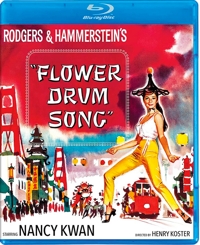
Review of FLOWER DRUM SONG (Blu-ray)

Leave a comment

Grade:  B-
Musical
Not rated (would be PG)

I am not Asian or Asian American, so I’m not in a position to comment on what has lately been called “outdated cultural stereotypes” or “depictions.” But I can spot a song in this overlooked Rodgers & Hammerstein musical that feels more like it came out of South Pacific than San Francisco’s Chinatown, where this film version of the Broadway play is set. And I can look up who’s singing and see that, surprise, it’s the same woman who played Pacific Islander Bloody Mary in that earlier R&H musical. And that actress was of African and Irish American descent—not Asian American. 

Hollywood has a history of casting white. Marlon Brando as Japanese? That’s what audiences were supposed to believe when he played one of the leads in The Teahouse of the August Moon (1956). From 1957-58, TV’s The New Adventures of Charlie Chan featured Irish American actor J. Carrol Naish as the Chinese American detective. Of the 12 billed actors in The World of Suzy Wong (1960), only five in that “world” were Asian. In 1965, a remake of Genghis Khan replaced the laughably cast John Wayne from an earlier film with Omar Sharif in the title role—but Sharif was Egyptian. Even as late as 1980, British actor Peter Sellers starred as Fu Manchu in The Fiendish Plot of Dr. Fu Manchu (1980). All of which is to say, Hollywood may have experienced a come-to-Jesus revelation when it came to casting whites as Native or African Americans, but they have been much slower to do so with Asian roles.

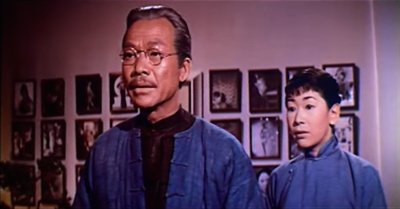
So it must have come as a pleasant shock to audiences that Flower Drum Song (1961), apart from Juanita “Bloody Mary” Hall, featured all Asian actors in the main roles—especially since that same year Breakfast at Tiffany’s presented Mickey Rooney as a buck-toothed nearsighted Asian caricature worthy of a WWII propaganda film. Also to its credit, Flower Drum Song was based on a novel by Chinese American C.Y. Lee. But while the film gets one thing right—telling an Asian American story from an Asian American perspective and using mostly Asian American actors—it lapses into the kind of flat characterizations that tend to accompany any attempt at humor. Often, unfortunately, that translates into outdated cultural stereotypes. Veteran character actor Benson Fong, who was forced into that straitjacket when he played Charlie Chan’s “Number 1 son,” is called upon for such service. And an outdated and corny routine featuring the children ends up in a See, hear, speak no evil pose.

More

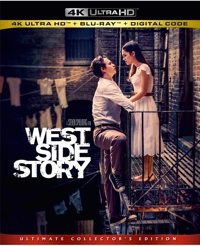
Review of WEST SIDE STORY (2021) (4K Ultra HD/Blu-ray)

1 Comment

Grade:  A-
Musical
Rated PG-13

In 1961, the average American couldn’t go to see a Broadway show. But they did go to movie theaters in droves, and West Side Story was a blockbuster of a movie that surprised audiences with gang members who danced and sang in an updating of Shakespeare’s Romeo and Juliet, set in then-contemporary New York City and featuring two warring gangs instead of feuding families. The Robert Wise-directed film received 11 Oscar nominations and won 10 of them, including Best Picture, Best Director, Best Music, Best Color Cinematography, and Best Supporting Actor/Actress.

So why would anyone even consider remaking a film so lauded and beloved? On one of the 90 minutes of bonus features on this 4K/Blu-ray release, Spielberg provided an answer—several of them.

First, Spielberg said he was not remaking a film. He was making a second film version based on the 1957 Broadway play. He reasoned that if West Side Story has been performed all over the world with different casts, why couldn’t there be a second film version?

Second, he was personally motivated. Spielberg said West Side Story was the first Broadway music he was exposed to at age 10, and that he basically “commandeered” the album his parents had bought. He loved it, and it spawned in him a love of musicals. As a result, Spielberg said that all his life he’s wanted to make a musical version of West Side Story.

A third and most compelling reason didn’t come from Spielberg. It came from my college-age daughter, who, since the film’s release, has been re-watching it and playing the songs constantly. She and many of her friends liked the music and some of the dancing from the first film version, but they weren’t exactly crazy about the characters or the narrative.

Enter Spielberg, who pinpointed the biggest difference between his new film version and the original:  the 1961 film was a hybrid—part cinematic and part theatrical. He wanted to create a film that was more fully cinematic, and to do that he had to push it away from the theatrical and make it more realistic. He had to push it away from the moist-eyed spotlight solos sung in private or in closed spaces and open it up to where they were sung with active movements (and reactions) on the streets of New York. He also added small touches of realism throughout the film and created a narrative based on logic rather than the limitations of stage.

More

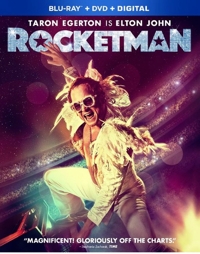
Review of ROCKETMAN (Blu-ray combo)

Leave a comment

Grade: A-/B+
Entire family: No (just families with older teens)
2019, 121 min., Color
Musical drama
Rated R for language throughout, some drug use and sexual content
Paramount
Aspect ratio: 16×9 widescreen (enhanced)
Featured audio: Dolby Atmos
Bonus features: A-
Includes: Blu-ray, DVD, Digital
Trailer
Amazon link

A year after Rami Malek channeled Freddie Mercury in Bohemian Rhapsody and introduced a new young audience to Queen we get Rocketman, which attempts to do the same for Elton John.

Make that Sir Elton John, a musician whose first smash hit (“Your Song” in 1970) propelled him to a career so successful that he was knighted by Queen Elizabeth, inducted into the Rock and Roll and Songwriters Halls of Fame, and named Billboard’s most successful male solo artist of all-time. In other words, he’s more than deserving of a biopic.

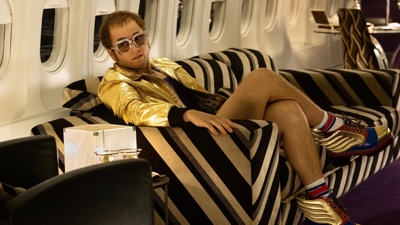
Make that a hybrid biopic—one that combines the rise (and stumble) of a musician with Broadway-style big production song-and-dance numbers that are imaginatively intercut into the film’s narrative, along with a backward-looking frame with younger alter ego that will remind some viewers of Birdman. Especially given the plume-like costume that Elton (Taron Egerton) wears to his therapy group as he recalls his former self. Is he really dressed that way, or is it a symbol or metaphor? There’s a surreal, glam-bam-thank-you-ma’am element to the film that seems very much in keeping with the real Elton John’s out-of-this-world performance persona—though the musician’s sexual orientation is treated matter-of-factly. More

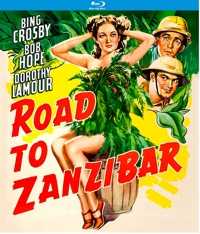
Review of ROAD TO ZANZIBAR (Blu-ray)

Leave a comment

Grade: B
Entire family: Yes
1941, 91 min., Black & White
Comedy
Kino Lorber
Not rated (would be PG)
Aspect ratio: 1.37:1
Featured audio: DTS mono
Bonus features: C+
Trailer
Amazon link

Road to Zanzibar was the second of seven Crosby-Hope-Lamour musical comedy adventures, released in 1941 at a time when Tarzan, Jungle Jim, and safari pictures were popular. There wasn’t even supposed to be a second “Road” picture, but Paramount had bought the rights to a story that was so similar to Darryl f. Zanuck’s 1939 safari pic Stanley and Livingstone that the project was dead in the water . . . until someone decided that maybe they could do a parody of safari movies instead. In no time, Bing Crosby, Bob Hope, and Dorothy Lamour were on the road again.

The Road pictures were always innocuous fun, spotlighting Crosby’s crooning, Lamour’s singing (and sometimes dancing), and Hope’s second-banana one-liners. This outing, writers Frank Butler and Don Hartman upped the quips between Hope and Crosby, and with the pair ad libbing as well there emerged a crackling comic energy.

The plot is a little more complex than Road to Singapore (1940), and that’s also a good thing for contemporary audiences. Along with Road to Bali (the only color film of the bunch), this is one of the recommended “starter” Road pictures for families with small children. Kids immediately pick up on the fact that Hubert “Fearless Frazier” (Hope) is constantly getting the short end of the stick as the one who has to do the dirty or dangerous work in their rotating carnival acts. The film begins with Frazier as the “Human Cannonball.” But instead of himself being shot through a flaming hoop, he hides in a secret compartment and substitutes a dummy. When that dummy sets the tent and half the town on fire and all the animals are released, they skedaddle, trying different carnival scams in different towns. Next up: Frazier wrestling a live octopus in a tank, except that plan never happens because they meet a man at a restaurant who’s a diamond baron. He buys them expensive champagne and even bails them out the next day after the night gets out of hand. So naturally Chuck Reardon (Crosby) falls for the diamond mine version of magic beans. Instead of buying two tickets back to America on a steamer, he buys a “lost” diamond mine map from a rich baron who turns out to be so crazy that his children won’t let him make decisions anymore. More

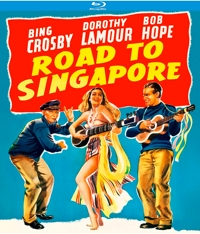
Review of ROAD TO SINGAPORE (1940) (Blu-ray)

Leave a comment

Grade: B
Entire family: Yes, but….
1940, 85 min., Black & White
Comedy
Kino Lorber
Not rated (would be PG for drinking, smoking, and innuendo)
Aspect ratio: 1.37:1
Featured audio: DTS Mono
Bonus features: B-
Trailer
Amazon link

Today’s parents may have grown up watching some of the old Bob Hope, Bing Crosby, and Dorothy Lamour “Road” pictures on television. If so, there’s a good chance they might want to share them with their children.

A showcase for Crosby’s crooning, Lamour’s singing and dancing, and Hope’s second-banana wisecracking, the Road pictures were pure escapism for an America that was weighed down by WWII. Hope and Crosby, two vaudevillians who rose to become popular stars of their own radio shows, had made the leap to film, and the genius who paired them deserves a medal. The first of the Road pictures, The Road to Singapore, became the highest grossing film of 1940. Though it’s not the best—that honor goes to Road to Morocco (1942) and Road to Utopia (1945)—it lays the foundation for the films to come, though it was originally only intended as a one-and-done film. But the public wanted more, and Road to Zanzibar followed in 1941, and Road to Rio (1947), Road to Bali (1952, the only color release), and the Cold War entry The Road to Hong Kong (1962). All of the films were made during a time when Hollywood (and the rest of the world, really) was not terribly educated about or sensitive to issues of race and gender. So you’re going to have to overlook some period-typical dialogue and characterizations, as well as “natives” that seem a blend of big Hollywood musical dancers and a bag full of different cultures. Thankfully, Hope and Crosby make that easy to do.

In all of the Road pictures, they play a couple of ne’er-do-wells who are either petty con men and womanizers seeking to stay one step ahead of the law or world-traveling vaudeville-style entertainers . . . and womanizers seeking to stay one step ahead of the law. That might not sound like family entertainment, but the pictures truly are escapist fare with an emphasis on the one-liners, ridiculous plots, and the inevitable romantic tussle over Lamour (with Crosby always getting “the girl”).

For families with younger children, a good place to start might be the only color release, Road to Bali, which is slightly faster paced than The Road to Singapore and features a squid-wrestling sequence. Despite some racist elements, The Road to Zanzibar, with its safari-centered plot, is another good option if the kids are smaller. The two best are best because of the one-liners, so they’re recommended as good starting points for families with older children. More

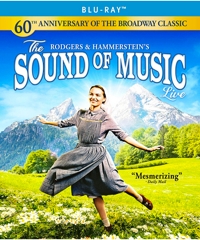
Review of THE SOUND OF MUSIC LIVE (2015) (Blu-ray)

Leave a comment

Grade: B+/A-
Entire family: Yes
2015, 119 min., Color
Musical comedy-drama
Shout! Factory
Not rated (would be G)
Aspect ratio: 1.78:1 widescreen
Featured audio: DTS-HDMA Stereo
Bonus features: B+
Sizzle reel
Amazon link

The Sound of Music opened on Broadway in 1959, starring Mary Martin as a nun-in-training who falls in love with a widower after taking a job as his children’s governess. The musical won five Tony Awards. Then in 1965, when Julie Andrews took over the role of Maria for the lavish 172-minute film adaptation, the film earned five Oscars. That film is one of our family’s favorites, so a remake seems almost sacrilegious. Why even attempt it?

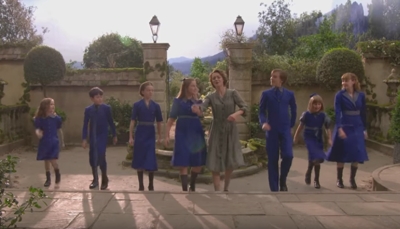
Though I was surprised to learn that there’ve been nearly a dozen film and television versions of The Sound of Music, all I knew about was the Rodgers and Hammerstein classic and The Sound of Music Live, a 2013 mistake featuring singer Carrie Underwood. So it’s probably an understatement to say that my wife and I began watching this 2015 live British television production expecting to be disappointed—especially since we’ve seen our share of lackluster filmed stage performances. While you may get a better view than if you were sitting in Row 20, it’s still a filmed version of a live performance with cameras positioned unobtrusively off-stage, creating an odd distance and dislocation. There may be three or four cameras to give you different angles, but gone is the excitement of sitting in Row 20.

As it turns out, we liked The Sound of Music Live nearly as much as the 1965 movie, partly because it’s a quality production and partly because of the very nature of the production. As one of the actors says, it’s a script-to-stage theatrical production that’s filmed on three soundstages for television, but shot in cinematic style using 17 different cameras. It feels like a movie, but it also has the look of a live performance. Instead of the bright three-point lighting that’s a film-industry standard, what’s here comes closer to stage lighting. In this version, cameras are everywhere and they follow the actors with medium shots and close-ups, but because characters go behind pillars and such and we see angles that would be denied a theatrical audience, it feels as if we’re right there on the set with the characters. It’s a strangely exhilarating feeling. More

Older Entries