Home

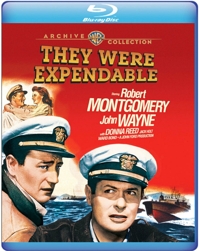
THEY WERE EXPENDABLE (Blu-ray)

Leave a comment

TheyWereExpendablecoverGrade: B+/B
Entire family: No
1945, 135 min., Black-and-white
Warner Archive Collection
Not rated (would be PG for war action and adult situations)
Aspect ratio: 1.37:1
Featured audio: DTS-HDMA 2.0
Bonus features: n/a
Trailer
Amazon link

War movies probably have more permutations than any other genre, but the most fascinating and family-friendly ones are probably those that were made during WWII when the Office of War Information had to approve content. Most of them were patriotic films aimed at boosting recruitment or morale back home, and as a result probably fewer than a dozen are good enough to entertain today. Some of the best? Wake Island (1942), Action in the North Atlantic, Bataan, Destination Tokyo, Guadalcanal Diary, and So Proudly We Hail! (1943), as well as Thirty Seconds over Tokyo (1944), Objective, Burma!, Pride of the Marines, and They Were Expendable (1945).

The latter—a black-and-white John Ford tribute to the men who served on America’s flimsy plywood PT-Boats in the Pacific—stars Robert Montgomery, John Wayne, and Donna Reed in a film that tries to capture not just the heroism of the men who fight, but also the boredom and frustration. What makes They Were Expendable doubly interesting is that it details the mostly true story of two officers who were trying to prove the worth of these Motor Torpedo Boat Squadrons, as they were initially called, when they were still an experimental dream like the 1807 steamboat people called “Fulton’s Folly.”
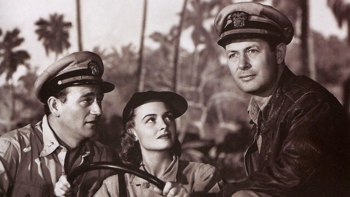
TheyWereExpendablescreen1There are battles in these wartime films, but the violence is dimmed while the spotlight is on service and the day-to-day life of soldiers, sailors, airmen, and nurses. People back home knew their loved ones were at war and that they probably saw action. Did they want to see graphic killing? No, but they did want to get some sense of what life in the military was like and what their loved ones were going through so far from homes, families, and sweethearts. And Ford’s tribute is one of the most authentic from the era.

The stars are fine in their roles, but really it’s the story that holds our attention—though it’s a long one (135 min.). The action picks up in the Philippines, where the military learns that Pearl Harbor has just been attacked. Everyone is given orders to do their part to stop the advance of the Japanese fleet, except for the Motor Torpedo Boat Squadron, which is given the token assignment of messenger and transport duty. The Navy brass can’t see value in the boats, though that doesn’t stop Lt. John Brickley (Montgomery) and Lt. Rusty Ryan (Wayne) from pushing. But even as the Japanese keep taking over more territory, it’s a fight for the Motor Torpedo Boat Squadrons just to get into the fight.

TheyWereExpendablescreen2PT-Boats became famous because of former Pres. John F. Kennedy, whose story is told in the movie PT-109 starring Cliff Robertson and Robert Culp. Watch this black-and-white movie first and then the color 1963 film for a decent double feature. In They Were Expendable Ford is careful to add plenty of detail about life on the small, fast plywood boats that were equipped with machine guns to battle aircraft and torpedoes to launch from the deck at heavier ships. We see the crew patching it up, dealing with boring assignments, and yes, mixing it up with the enemy. Eventually the boats’ value was proven: their small size made them a small target, and their speed and maneuverability enabled them to get in close enough to launch torpedoes and then get to safety.

War or not, the core story is one that everyone—even children—can identify with. Children’s books are full of characters who are disregarded because they’re too small, too insignificant, or too something to succeed. In the nautical vein, there’s Tuffy the Tugboat, the children’s book hero who is scoffed at by the boats who have bigger and more important jobs to do, until one day Tuffy is the only one with the skill set to save the day. That archetype is at work here too, while Reed provides a romantic interest that’s wholesome as can be and secondary to her own heroics as a nurse stationed at Manila and Bataan hospitals. The weepy-eyed sentimentality that creeps into Ford films is here too, but thankfully it’s limited. Still, young viewers not familiar with history might raise their eyebrows when “The Battle Hymn of the Republic” is sung while we glimpse an actor meant to be Gen. Douglas MacArthur. And if they don’t know about his famous “I shall return” promise made to the people of the Philippines as he himself fled to safety, that’s the period of history encompassed by Ford’s mostly fascinating and sometimes stirring film.

Language: Mild swearwords occasionally used
Sex: Nothing at all, wholesome as can be
Violence: No blood or gore or glorifying violence, but boats are blown up and battles are waged
Adult situations: Some drinking and smoking
Takeaway: War movies like Inglorious Basterds and Fury try to be edgy and shocking and rattle viewers out of their complacency; war movies like They Were Expendable look to tell a story that will enlighten and inspire as much as the biopics that came out of the ‘40s and ‘50s, and They Were Expendable is among the best of that type
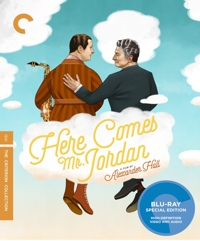
HERE COMES MR. JORDAN (Blu-ray)

Leave a comment

HereComesMrJordancoverGrade: B/B-
Entire family: No
1941, 91 min., Black-and-white
Criterion Collection
Not rated (would be PG for mild violence)
Aspect ratio: 1.33:1
Featured audio: Dolby Digital 2.0
Bonus features: B+
Trailer
Amazon link

Five years before apprentice angel Clarence would try to convince George Bailey that It’s a Wonderful Life, chief angel Mr. Jordan (Claude Rains) tried to make amends when an underling mistakenly snatched a prizefighter 51 years before he was supposed to die.

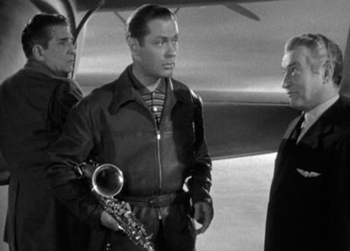
If there’s a more outlandish premise behind a Hollywood comedy, I haven’t come across it. Robert Montgomery (whose daughter, Elizabeth, would star in a supernatural comedy of her own 23 years later—TV’s Bewitched) is cast as boxer Joe Pendleton, whose hobbies are playing the saxophone (badly) and flying his private plane. It’s the latter that gets him into trouble, and when a prickly new angel (Edward Everett Horton) plucks him from the plane before a crash, thinking to spare him the final pain, it turns out that the boxer would really have survived. In heaven, Mr. Jordan instructs the new angel to return Joe to his body. That’s when things get outrageously complicated. It turns out that Joe’s fight manager, Max Corkle (James Gleason), had his body quickly cremated, so there’s no body for him to return to. Mr. Jordan’s solution: find him a suitable body from someone slated to die soon.

If it were a little more fast-paced and the dialogue overlapping, Here Comes Mr. Jordan would play like a screwball comedy. As is, there are plenty of scenes that feel absurdist enough to qualify, and just as much in the way of clever writing. Here Comes Mr. Jordan is a surprisingly solid fantasy-comedy-romance that still entertains, despite some cheesy cloud scenes featuring an airplane transporting people to their final destinations.

HereComesMrJordanscreenMontgomery is amiable enough as Joe, a plain-talking guy set on becoming heavyweight champion of the world. He isn’t about to let some heavenly mistake get in the way of his destiny, and he isn’t about to accept any body that isn’t “in the pink.” But the film turns most interesting when Mr. Jordan convinces Joe to inhabit the body of a crooked millionaire whose wife (Rita Johnson) and private secretary (John Emery) have just drugged and drowned him in his bathtub. It adds a new wrinkle to a familiar genre, and how fun is it to see the two murderers’ faces when Joe-as-Farnsworth walks out of that bathroom? But that’s only the beginning. Complicating Joe’s drive for a championship body is the instant attraction he feels for a young woman (Evelyn Keyes) whose father Farnsworth framed to take the fall for a phony bond swindle, and Mr. Jordan’s prodding to get him to do something about it before the scheming would-be murderers strike again.

Very few films have plots that are unique, and for that reason alone families with older children (with a tolerance for black-and-white movies) may enjoy this screen version of the stage play Heaven Can Wait—also the title of a 1978 Warren Beatty remake. The angel and body-swapping do seem more charming and infinitely better suited to the Forties and black-and-white. When the film was released, America hadn’t yet entered WWII, and Here Comes Mr. Jordan was a pleasant, even hopeful diversion from the threat of war.

Joe Pendleton is blunt and unrefined, often a little slow on the uptake, but he’s also a genuinely nice guy who just wants what’s coming to him. His earnestness and honesty is infectious. When he tries to communicate his situation and gets caught up in other people’s lives, you can’ help but feel for him. That, even more than the unique plot, is what makes Here Comes Mr. Jordan resonate as an example of classic Hollywood filmmaking. It can feel slow-moving at times and the subject matter probably won’t interest children under age 14, but it’s still worth watching, even 70 years later.

ROOTS (1977) (Blu-ray)

Leave a comment

RootscoverGrade: A-
Entire family: No
1977, 587 min. (8 episodes), Color
Warner Bros.
Not rated (would be TV-14 for nudity, adult themes, and violence)
Aspect ratio: 1.78:1
Featured audio: Dolby Digital 2.0
Bonus features: B+
Trailer
Amazon link

Snoop Dogg recently slammed Oscar-winning Best Picture 12 Years a Slave and the 2016 remake of the iconic miniseries Roots because “they just want to keep showing the abuse that we took hundreds and hundreds of years ago. But, guess what? We taking the same abuse. Think about that part.”

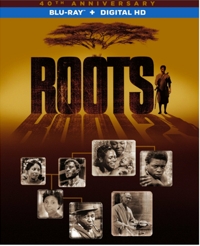
The “they” the rapper is talking about—12 Years a Slave director Steve McQueen and Alex Haley, the author of Roots—just happen to be black, though, and they’re coming at it from a different, “lest we forget” angle. The four-episode remake of Roots has gotten all the attention, but for my money the original 1977 series is still the best. As the box of the 25th anniversary edition proclaimed, “200 years to unfold. 12 years of research to discover. 2 years to create. 8 nights to make television history.” And that’s not hype.

When the final installment of Roots aired in January 1977, some 130 million viewers—then, roughly half the entire population of the U.S.—gathered around their TV sets to watch. Even the Las Vegas gaming tables slowed when it aired. Adapted from Haley’s novel about his search to unearth information about his African ancestors, the groundbreaking mini-series remains the most-watched dramatic show in television history. Everyone everywhere seemed to be talking about it, and the series was such a phenomenon that People’s Choice Awards were presented to every individual cast member, while Haley received a special citation Pulitzer (of which only nine have ever been awarded). Roots was the first mini-series to be aired on consecutive nights rather than a single episode per week, and at a time when there were few black actors in serious prime-time offerings, it featured a virtual Who’s Who of African-American actors.

The show pulled down nine Emmys, including Best Limited Series, acting awards for Louis Gossett, Jr., Olivia Cole, and Edward Asner, and awards for editing, writing, and directing. It also won the Golden Globe that year for Best Drama Series and top honors in the same category at the Television Critics Circle Awards. Hard as it is to imagine, few Americans thought much about their ancestors prior to Roots, and the show sparked a national interest in genealogy that continues to this day. But the show also generated controversy–and not because of the National Geographic-style bare breasts in early episodes, or because of the frequent use of the inflammatory word “nigger” that television viewers weren’t accustomed to hearing.

It was the white-on-black enslaving, rape, and mutilation scenes that caused all the fuss, and the rerelease of Roots has already rekindled those same heated debates about race and what Haley called his “faction” (a blend of fact and fiction). When it first aired in 1977, ABC executives feared it might incite race riots or that southern stations might refuse to broadcast the show. But there was just one mild incident at a single school, and the series was broadcast not just on every ABC affiliate in America, but in every country that syndicated American shows—including South Africa. Despite the “faction,” the series remains as powerful now as it was then, which is why John Amos and other African American cast members think it should be shown in every school in America, ad infinitum.

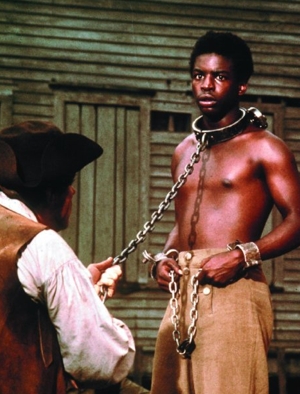
Rootsscreen1The mini-series tells the story of four generations of a single family, beginning with the birth of Kunta Kinte (LeVar Burton, who produced the remake), son of Omoro (Thalmus Rasulala) and Binta (Cicely Tyson), on the West Coast of Africa near the river Gambia. Just as Haley’s search for his roots began with the words “Kunta Kinte” and “gambi balongo” that he heard from his aunts, and the story they told him about Kunta’s enslavement, Episode 1 chronicles Kunta’s capture while he was seeking a log suitable for making into a drum. Viewers follow Kunta’s odyssey across the Atlantic in the holds of a slave ship captained by a Christian first-time slaver (Edward Asner) and his sadistic and seasoned mate (Ralph Waite). If it’s strange seeing Asner and Waite in those roles now, it was even stranger when the series first aired and The Mary Tyler Moore Show and The Waltons were still on prime time TV. Roots was an amazing production that still holds up today, but it’s even more amazing if you consider that back then miniseries were like variety shows in that recognizable TV actors from other shows were often cast. And in this one you saw a bunch of familiar faces, both black and white.

More

SHE WORE A YELLOW RIBBON (Blu-ray)

Leave a comment

SheWoreaYellowRibboncoverGrade: B-
Entire family: No
1949, 103 min., Color
Warner Archive Collection
Not Rated (would be PG for violence and adult situations)
Aspect ratio: 1.37:1
Featured audio: DTS-HDMA 2.0
Bonus features: B-
Trailer
Amazon link

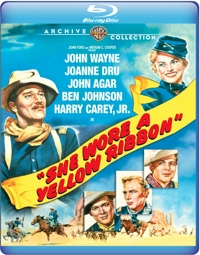
She Wore a Yellow Ribbon (1949) is the second in the so-called Cavalry Trilogy of legendary director John Ford. It’s also the only one shot in color and the last of the three to finally make it onto Blu-ray—available now from the Warner Archive Collection and at Amazon.com. While it doesn’t offer the same psychological character study as Fort Apache (1948) or the classic first pairing of John Wayne and Maureen O’Hara moviegoers saw in Rio Grande (1950), it still features one of John Wayne’s favorite performances, and Ford’s slow-boil of a plot keeps picking up steam once the film hits the 20-minute mark.

That might be a little late for a young generation of viewers coming to old Technicolor Westerns for the first time, but this film is part of America’s heritage. Like it or not, imperialist or not, America’s westward expansion put settlers in conflict with Native Americans, and it was up to the U.S. Cavalry to protect and serve. Ford obviously had a soft spot for the men in blue, but his treatment of the American West can sometimes seem contradictory. In Fort Apache he cast Henry Fonda as a stubborn commander obviously patterned after George Armstrong Custer—so much so that the commander forces his troops into a near-identical “last stand.” But in She Wore a Yellow Ribbon, a voiceover tells us that Custer and his men were just massacred and word of a massive Indian uprising was worrying even outposts in the southwest. What was treated as foolhardy in the first film is paid tribute to in the second.

Ford was a stickler for authenticity, though, and you’ll marvel at shots of horses and riders and even horse-drawn wagons going over rough terrain. The backdrop is the dramatic Monument Valley, where Ford filmed at and around the Navajo reservation, insisting on employing the Navajo as extras instead of hiring whites made to look like Indians, as was still common at the time. Ford was so respectful and appreciative of the Navajo that one harsh winter he airlifted supplies at his own expense so the people and their livestock wouldn’t perish. Yet, apart from a single scene in which Wayne’s character talks with an Indian chief, the Indians get less respect this outing.

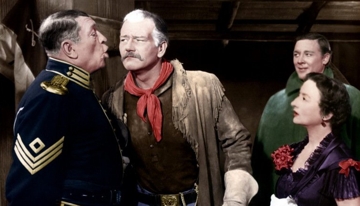
SheWoreaYellowRibbonscreenThe situation in She Wore a Yellow Ribbon is this: Capt. Nathan Brittles (Wayne in make-up that aged him 20 years) is counting down the days until he retires from the Cavalry. For his last mission he’s sent to try to contain a group of renegade Cheyenne and Arapaho that have joined forces and have attacked settlers in the area. But with danger mounting, Brittles’ commanding officer also orders him to take along his wife (Mildred Natwick) and niece (Joanne Dru) in a wagon to meet the eastbound stage to safety. The niece, meanwhile, seems more interested in toying with the affections of two young officers—the nine-year veteran 1st Lieutenant Flint Cohill (John Agar) and the rich and relatively green 2nd Lieutenant Ross Pennell (Harry Carey, Jr.). She wears a yellow ribbon in her hair, which signifies that she has a beau in the Cavalry, but won’t say which one she’s wearing it for.

The more you know about this film, the more you can appreciate it. The Monument Valley footage is stunning, especially in 1080p, and though Winton Hoch won an Oscar for his cinematography he was constantly at odds with Ford, who at one point ordered him to keep filming as a thunderstorm approached, despite Hoch’s concerns about the equipment acting as lightning rods. The West was wild, and Ford Westerns, especially those starring Wayne, have at least one character who drinks too much and a number of them who enjoy fistfights as much as drinking. In the Cavalry Trilogy it’s the highly likable Irish Sgt. Quincannon, though the equally likable Sgt. Tyree (Ben Johnson) balances the scales by not taking tobacco or alcohol. But it’s all about the soldier’s life, with an emphasis on honor and sacrifice and those comic fights that relieve the tension of serving in an outpost in the middle of nowhere.

She Wore a Yellow Ribbon is sentimental and nostalgic, a paean to Cavalry life on the frontier, and yet there’s something rousing, still, when the soldiers sing the title song as they ride off for what might be the last time. And Wayne is himself an American classic, as much as Ford and Monument Valley. Those are three great reasons for watching this film, at least once. Another is to give families a chance to talk about such things as changing attitudes. In this Western, there’s great respect for opponents and people who fought for other causes. Those who rode with the grey in the Civil War are still given the same measure of respect . . . and the Confederate flag, now widely banned, was placed atop the coffin of a soldier in one scene. Add to that attitudes towards America’s treatment of the Indians and it should make for a provocative discussion. Even one of Brittles’ mottos—“Never apologize. It’s a sign of weakness”—might prompt a family debate.

Language: n/a
Sex: n/a
Violence: Off-camera, mostly, except for a scene where one gunrunner is shot with an arrow and another is thrown repeatedly into a fire by the Indians
Adult situations: Drinking, cigars, and chewing tobacco
Takeaway: If your children are resistant to black-and-white and The Searchers is a little too intense and intensely racist, this film is probably the best to introduce them to John Ford and John Wayne’s American West

ZOOTOPIA (Blu-ray combo)

Leave a comment

ZootopiacoverGrade: A
Entire family: Yes
2016, 108 min., Color
Disney
Rated PG for some thematic elements, rude humor, and action
Aspect ratio: 2.39:1
Featured audio: DTS-HDMA 7.1
Bonus features: B+
Includes: Blu-ray, DVD, Digital HD
Trailer
Amazon link

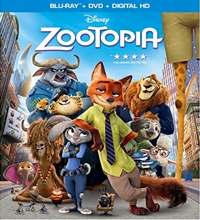
Most of the time trailers oversell a film. Not Disney’s Zootopia, which is even better and more distinctive than the trailer would have you believe.

Like Who Framed Roger Rabbit, it’s a crime mystery featuring animated characters (but without the live action component), and like any number of Disney movies it’s about a main character who dreams beyond the limitations imposed by parents, society, or physical stature. It’s about a young bunny named Judy Hopps (Ginnifer Goodwin) who wants to go against her biological destiny to farm carrots like her mother and father and instead become a police officer in the big animal city of Zootopia.

Disney has a deft way of introducing the basic premise and characters, then quickly getting to the start of the action. We saw it in that poignant montage in Up, and we see it here as directors Byron Howard, Rich Moore, and Jared Bush take us to an amusing (and spot-on) Zootopiascreen2performance of a school play with Judy’s parents filming her sketch about the history of animals—how once animals were predators and prey before they evolved into a higher order where predators and prey could peacefully co-exist and could become anything they want. But we quickly see the clash between idealism and the kind of realism that kids today can identify with, when on the school playground a fox bully takes tickets away from a group of “prey” kids, and Judy, still in her I-wanna-be-a-police-officer uniform, tries to stop the much bigger bully. She’s feisty, but is knocked down and clawed as a reminder that she is what she is, and told by the fox that she’ll never become a police officer. But some animals—and people—rise to the challenge, and when we fast-forward 15 years later we see Judy leaving her small-town environment and heading for Zootopia to train at the Police Academy.

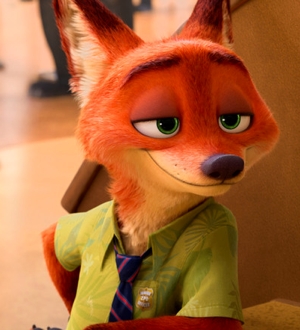
After rising to the top of her class Judy becomes the first bunny police officer, only to find herself going up against a good-old-boy network led by Chief Bogo (Idris Elba), in a a work environment where everyone is taller, bigger, stronger. Even the mayor is a lion (J.K. Simmons) who has an assistant who’s a sheep (Jenny Slate). So there are still subtle traces of a natural order based on survival of the fittest, which means Zootopiascreen1that Judy has to become more resourceful to break her glass ceiling. Assigned the demeaning job of meter maid, she nonetheless finds a way to earn a shot at finding one of 14 missing predators in the city’s biggest investigation. Given 48 hours, she partners with a con-artist Fox named Nick Wilde (Jason Bateman) the way that Nick Nolte did with Eddie Murphy in 48 Hours. And yes, the allusion is deliberate. When they later come across a lab operation that reminds you of Breaking Bad, in case you don’t get the visual allusion they toss out the line about “Walter and Jesse coming soon.” And what would an animated crime film be without an homage to The Godfather?

It’s these kind of touches that make Disney animated films entertaining for adults as well as children. The dialogue in Zootopia is sharp, and the writers have a lot of fun playing with clichés pertaining to species like lemmings, sloths, and rabbits (“Your mom and I and your 275 brothers and sisters”). The characters have as much personality as any human, the plot is complicated but not confusing, and Disney once again does what Disney does best: creating a complete world that’s fun to visit. Fans of Shakira will like that she plays pop star Gazelle, and Nate Torrence is incredibly endearing as Officer Clawhauser. Really, though, all of the voice talents—name or no name—do a fantastic job. Add on a few positive messages for children and adolescents and you’ve got another animated classic-to-be. Zootopia is top-tier Disney, the kind of film that families will want to watch over and over again, so be sure to go with the Blu-ray for top-quality HD.

Language: OMG and euphemistic versions of swearwords is all
Sex: One comic scene has Judy “shocked” to go to a “nude spa club” for animals, none of which are wearing any clothing (but no genitalia visible—think Barbie and Ken dolls)
Violence: Given the criminal investigation at the heart of the film, there really isn’t much. One character is attacked and blinded off-screen, two more are scratched, and there’s an extended moment of peril for the two main characters
Adult situations: A poisonous plant being distilled in a lab and some con-man trickery stand out, but the whole idea of a police investigation is pretty adult, and bullying emerges as a theme
Takeaway: The House of Mouse makes animation look easy, but it all starts with characters we care about, and there are plenty of likeable characters to be found in Zootopia

AGENT CODY BANKS 2: DESTINATION LONDON (Blu-ray)

Leave a comment

AgentCodyBanks2coverGrade: C+/B-
Entire family: Yes, but . . .
2004, 100 min., Color
Olive Films
Rated PG for action violence and some crude humor
Aspect ratio: 2.35:1
Featured audio: DTS-HDMA 5.1
Bonus features: C-
Trailer
Amazon link

For whatever reason, most sequels aren’t as good as the original, but it’s pretty clear what happened with Agent Cody Banks 2: Destination London (2004). Somebody looked at the demographics and told the studio that they could draw a bigger audience by pandering to a younger crowd.

The original Agent Cody Banks (2003) played like a Bond film with a teenager as 007, plucked from high school and dropped into an adult world. It was an action movie first, with tongue-in-cheek humor and the kind of innuendo Bond fans had come to expect, even if it was scaled down to teen angst level. But Agent Cody Banks 2 plays more like a Disney Channel movie deliberately dialed down a couple of notches and pitched at children instead of a general family audience.

AgentCodyBanks2screen1The tone is a dead giveaway. Agent Cody Banks had that wink-wink spy vibe that felt like Agent James Bond Jr., and the plot was fast-paced and fluid. Agent Cody Banks 2 feels fragmented and is so populated with over-the-top ridiculous adult characters, ala Disney Channel and Nickelodeon TV sitcoms, that satire and parody give way to mind-numbing silliness. But it’s clear that the studio chose this route because they also added sequences involving a horde of younger actors—as with a near-superfluous opening scene that spotlights the spy camp Cody is trained at.

The producers decided that this time, Banks, though still only 16 years old, would be a self-assured “adult” in a world of children. But take away Banks’ skateboard and the half-kid/half-adult world that it represents, and he’s about as fun to watch as a rush-hour commuter. Instead of being the least likely agent to be given an assignment, this time Banks is the best at everything, idolized by all the young agents at the secret Kamp Woody training grounds. But an underdog is far more interesting than a top dog, and Muniz doesn’t seem to know how to play a straight secret agent instead of a slightly bumbling one. Martial arts and fighting have replaced all but a few of the fun gizmos, and the tired plot is right out of Spy Kids 3-D—just another tale of a rogue trying to achieve world domination through mind control.

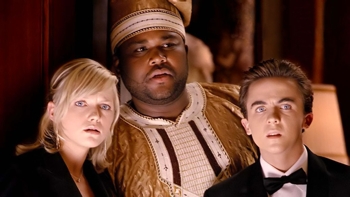
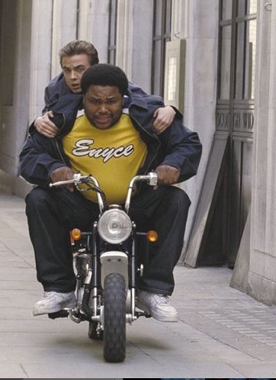
AgentCodyBanks2screen2In the opening, Banks unwittingly helps his wacko camp director escape an “assault drill” which was really a legitimate capture attempt. Victor Diaz (Keith Allen) has half the technology to pull off a mind-control scheme, while the other half is possessed by Lord Kenworth (James Faulkner), whose momentary front is a snooty summer haven for the musically gifted—which, of course, gives the filmmakers an excuse to cast another dozen or so young actors. Banks goes undercover as a clarinetist, and everyone in the British manor housing them all is an over-the-top caricature, including some of the musicians (who are actually part of a youth symphony). By playing it deliberately for laughs this time around, director Kevin Allen sacrifices suspense. The only caricatures who are remotely fun are an Indian girl who claims Banks as her “woodwind buddy,” and Derek (a more rotund Anthony Anderson than we see on Blackish), a CIA “handler” assigned to Banks. And even they can grate on you.

Agent Cody Banks 2: Destination London isn’t a bad movie, but it’s more for children and adolescents than it is for the entire family.

Language: Pretty squeaky clean; he crude humor amounts to things like Banks’ little brother calling him a “whack job,” which parents can only hope their youngsters regard as a form of “wacko”
Sex: The first film was full of innuendo, but this one is as pure as the driven adolescent plot
Violence: Lots of martial arts fighting, but toned down violence compared to the first film—bloodless and not even close to excessive
Adult situations: Nothing, really
Takeaway: It’s a shame that the filmmakers didn’t stay the course and give us the same Cody Banks as a young James Bond that we met in the original Agent Cody Banks.

HAIL, CAESAR! (Blu-ray combo)

Leave a comment

HailCaesarcoverGrade: A-
Entire family: No
2016, 106 min., Color
Universal
Rated PG-13 for some suggestive content and smoking
Aspect ratio: 1.85:1
Featured audio: DTS-HDMA 5.1
Bonus features: B
Includes: Blu-ray, DVD, Digital HD
Trailer
Amazon link

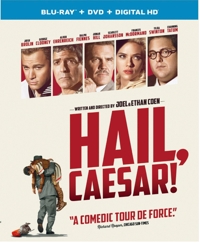
I’ve often thought that there are two main types of comedy: joke- and gag-filled ones that go for nonstop laughs, whether high brow or low, and the more subtle offbeat satires that make you smile with recognition, whether dark or infused with the positive energy of nostalgia and homage. The latter is the preferred style of people like Wes Anderson and the Coen brothers, so don’t be misled by a Hail, Caesar! trailer that was edited to showcase all the laugh-out-loud moments in the film. People who see the term “comedy” and think ha-ha funny, be warned: Hail, Caesar! isn’t as much LOL as it is a gentle satire and loving tribute to the final years of the Golden Age of Hollywood, and the genre films that were mass produced on big-studio back-lot sound stages.

That means, for families wondering if this PG-13 movie is just the ticket for home movie night, the answer is yes—but only if your kids are older and have an intellectual curiosity that delights in seeing flawed individuals making their way through a life that offers moments of absurdity. It’s a yes, too, if your children can appreciate period films and the stories they tell that differ so much from our contemporary world. Tonally, Hail, Caesar! is like Anderson’s The Grand Budapest Hotel with less quirkiness, and visually it’s like watching movies made in the early 1950s. That makes for a winning combination unless your kid thinks old movies (and facsimiles like this) are boring.

As they did with Barton Fink (1991), Ethan and Joel Coen revisit the world of Hollywood unmasked, where left-leaning intellectuals and powerful desk jockeys are funny in themselves, as politicians were in Daumier’s time—so much so that the 19th-century political cartoonist had only to draw them as they were and trust that it would be enough to make his audience smile. Hail, Caesar! operates along the same lines.

HailCaesarscreen1Trailers and the title make Hail, Caesar! look more Roman epic than it is. This film isn’t about the making of a single picture, as we saw in Hitchcock or My Week with Marilyn. The plot follows a day in the life of studio executive Eddie Mannix (Josh Brolin), the head of physical production at Capitol Pictures whose main job, it seems, is “fixer”—the troubleshooter who keeps the cameras and publicity juggernaut rolling. Eddie has been approached by Lockheed Corporation to take an executive position with them, but he clearly loves being a part of the movie business—enough to make him stay? That’s the $50,000 question.

More

AGENT CODY BANKS (Blu-ray)

Leave a comment

AgentCodyBankscoverGrade: B+
Entire family: No, but darned close
2003, 102 min., Color
Olive Films
Rated PG for action violence, mild language, and some sexual content
Aspect ratio: 2.35:1
Featured audio: DTS-HDMA 5.1
Bonus features: B-
Trailer
Amazon link

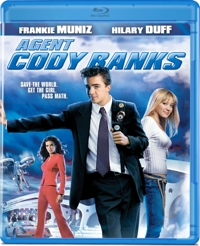
If you’re expecting Agent Cody Banks to be a cheap knock-off of Spy Kids ratcheted up a notch for the hormone-heavy teen set, director Harald Zwart’s first action outing may surprise you. Banks, Cody Banks, has the gadgets, the girls, the villains, the chases, the pyrotechnics, and the outstanding special effects to keep pace with middle-of-the-pack Bond flicks. Except that the sexual innuendos are tame by comparison, and the only consummation is a good-bye kiss at the end. It is, after all, rated PG, though there are more than a few scenes of peril and one graphic body-eating scene reminiscent of the face-melting in Raiders of the Lost Ark.

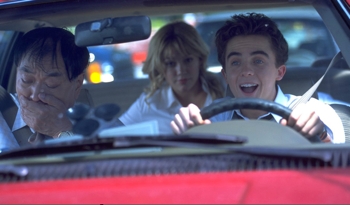
Besides action there’s plenty of humor in this film (a driver’s ed scene is classic), and the premise itself is fun. Parents who think their darlings are off at summer camp have no idea that a group of them are really being trained as junior secret agents. When a scientist (Martin Donovan) develops “nanobots,” microscopic robots that can be programmed to eat pretty much anything, the evil organization ERIS, led by the swaggeringly sinister Brinkman (Ian McShane), cons and bullies Dr. Connors into working for them. To find out what’s going on and to thwart them, the CIA assigns its first teen agent to get close to the scientist’s daughter, Natalie (Hilary Duff).

AgentCodyBanksscreenFans of the old TV series Malcolm in the Middle may be surprised at how natural TV star Frankie Muniz seems as a junior agent with one main problem: he doesn’t know how to talk to girls. As a teen Everyguy and reticent, almost painfully shy hero ala Timothy Dalton’s James Bond, he’s absolutely believable. But it was inspired casting to give The Mummy a part as Brinkman’s scarred and shaven henchman. As Molay, Arnold Vosloo is as memorably menacing as Jaws, Odd Job, or the best of the Bond villains. And Angie Harmon, the adult “handler”/partner who dresses retro in skin-tight clothes and acts unabashedly Emma Peel-like, has surprisingly good chemistry with Muniz. When the doctor disappears, then his daughter, it’s up to those unlikely partners to save them . . . and, of course, the world.

Zwart really manages to tap into the heart of teenage angst with Agent Cody Banks. Aside from the awkwardness around girls, there’s the importance of driving, encounters with bullies, chore-avoidance, the teasing siblings and friends, overly protective parents, and an ensemble of extras that makes us believe that world. Layer a spy plot on top of that, and you’ve got an entertaining blend of teen life and spy life, much more believable than the hard-to-fathom TV world of Scarecrow and Mrs. King, where a housewife was the agent and her kids the clueless ones. In Agent Cody Banks, the action never sags, and maybe that’s because Zwart was influenced by so many good films.

Astute viewers will spot homages to Dr. Strangelove, Austin Powers, Our Man Flint, Die Hard, Back to the Future, Spy Kids, and, of course, a number of the Bond films. It’s a good film for families who think their kids aren’t quite ready for Bond—even the tamer Sean Connery and Roger Moore films.

Language: Pretty mild, actually, with around a dozen lesser obscenities mouthed, often muted
Sex: An adult woman pulls the towel off a boy in a locker room, and the same woman covers herself when Cody tries on his X-ray glasses and stares at her chest
Violence: A man is eaten inside out by nanobots, a young boy is imperiled inside a runaway car, and there’s typical action violence (martial arts, fighting, explosions)
Adult situations: No smoking or drinking, which makes this ride Bond with training wheels
Takeaway: The Bond films never feel dated, and neither does Agent Cody Banks. It still plays well, and for that credit the special effects that compare favorably to today’s films and the fact that high school never seems to change.

ZOOLANDER NO. 2: THE MAGNUM EDITION (Blu-ray combo)

Leave a comment

Zoolander2coverGrade: C
Entire family: No
2016, 102 min., Color
Paramount
Rated PG-13 for crude and sexual content, a scene of exaggerated violence, and brief strong language
Aspect ratio: 2.40:1
Featured audio: DTS: X, DTS-HD MA 7.1
Bonus features: C+
Includes: Blu-ray, DVD, Digital HD
Trailer
Amazon link

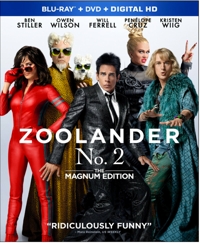
Fifteen years after Zoolander (2001) registered somewhere around the B- range on the cult comedy scale, along comes the sequel that fans never thought would happen. Yet Zoolander No. 2 feels like an uninspired knockoff rushed into production to take advantage of the first film’s popularity.

Oh, there are a few wickedly funny gags—as when Justin Bieber is hunted down and machine-gunned to death by an assassin who, like a true dis-Belieber, keeps firing much longer than necessary. And Bieber, in cameo, provides the punch line: using his dying moment to Instagram a photo of himself. But for the most part the jokes fall flat, and even the comedy of character seems cramped by the script’s far-fetched plot and pedestrian dialogue.

The original Zoolander probably worked as well as it did because the outrageous characters were balanced by a satiric plot that at least made some sense. Egotistical male model Derek Zoolander (Ben Stiller) lost his top male model crown to the upstart Hansel (Owen Wilson), and lost his marbles in the process. Enter the evil fashion designer Mugatu (Will Ferrell), who, teamed with modeling agent Maury Ballstein (Jerry Stiller), act on behalf of the entire fashion industry, which will collapse if they can no longer obtain cheap child labor in Malaysia. And that’s just what could happen after a new progressive Prime Minister wins election in that Asian country. They decide to program a brainless assassin, and who’s more vacuous, and, since his rapid decline, more ripe for manipulation than Derek Zoolander?

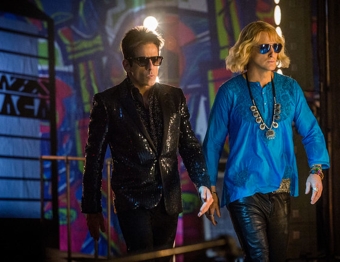
Zoolander No. 2 begins with both former top male models in seclusion following the collapse of a building that Derek built with “popsicle sticks and glue,” during which Derek’s beloved wife Matilda (Christine Taylor) was killed and Hansel, who had just been hanging out, was horribly, facially disfigured. Many years afterwards both receive a visit from Billy Zane, who Zoolander2screenpersuades them to attend a House of Atoz fashion show. For Derek, the added incentive is to resume living a productive life so he can regain custody of Derek Jr., whom he lost because of parental neglect (he couldn’t make spaghetti sauce—seriously). But someone is also systematically killing the world’s pop stars, and an apparent Interpol agent (Penélope Cruz as Valentina) asks for their help. Meanwhile, Mugatu has been in a special prison, and somehow Derek waltzes in and Mugatu waltzes out. And new models like the androgynous All (Benedict Cumberbatch) and the hipster Don Atari (Kyle Moody) have taken over the runway.

Stiller, who directed and produced this sequel, has a lot of friends, and almost all of them make an appearance. Yet even the cameos, which are normally a source of delight, seem to be more of a “huh” moment, again because the whole sequel seems to fall flat. Appearances by Katie Couric, Jim Lehrer, Christiane Amanpour, Jane Pauley, Justin Theroux, Mila Jovovich, Matt Lauer, Kristen Wiig, Susan Boyle, Andy Dick, Olivia Munn, Naomi Campbell, Ariana Grande, Willie Nelson, Katy Perry, Sting, M.C. Hammer, John Malkovich, Tommy Hilfiger, Kate Moss, and a host of fashion icons don’t seem to add any effervescence. And there’s no hilariously stupid-but-energetic scene to match the one from the first film, in which Derek’s equally dim-witted male model friends have a gasoline war at a gas station, frolicking as if for a photographer, only to explode when someone decides to light a match.

Is Zoolander No. 2 bad enough to take the second half of its title as an ironic appraisal? No, because there are still a few scenes that will make you smile, and if you’re a fan of the first film there’s still Wilson and Stiller in character that are fun to watch. But laugh-out-loud moments are harder to come by in the sequel, and for that you can thank the writers: Stiller, Theroux, Nicholas Stoller, and John Hamburg. For whatever reason, their “wouldn’t it be funny if” gauges were malfunctioning.

Language: one muttered f-bomb and milder swear words (bitch, bastard, damn, hell, whore) used throughout
Sex: Talk of orgies and masturbation, a woman puts a man’s hands on her breasts
Violence: Bieber’s gun-down, several stabbings
Adult situations: In addition to what’s been mentioned, just a weird everybody’s pregnant in Hansel’s family scene
Takeaway: You’d think after 15 years they could come up with something a little funnier. As is, Zoolander No. 2 is really really really ridiculously average at best.

CAROL + 2: THE ORIGINAL QUEENS OF COMEDY (DVD)

Leave a comment

Carolplus2coverGrade: B+
Entire family: Yes (Once Upon a Mattress)
1963-1972, 277 min., Color and black-and-white
Time Life/StarVista Entertainment
Not rated (Once would be G, the others PG)
Aspect ratio: 1.37:1
Featured audio: Dolby Digital 2.0
Bonus features: n/a
Amazon link

The Carol Burnett Show aired from 1967-78, making it one of the last yet longest running of the old vaudeville-inspired variety shows that combined song and dance with sketch comedy. Burnett broke into TV as a regular on The Garry Moore Show and in 1966 was given her own TV special. The network wanted her to ask Lucille Ball to guest star, as well as the Tony Award-winning Zero Mostel, who was currently appearing on Broadway as Tevye in Fiddler on the Roof. Both said yes, and the result is Carol + 2, a one-hour special that all but set the format for The Carol Burnett Show to follow.

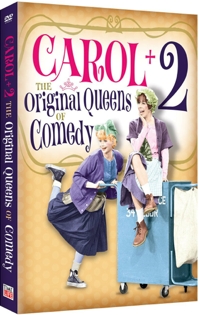
Carol + 2 is a part of television history, and for general fans it will be the gem on this DVD, which (sorry, Mr. Mostel) is being marketed as Carol + 2: The Original Queens of Comedy. But it’s not the big draw for families with children. The reason to buy this DVD, if you have children, is the colorful TV movie version of the beloved Hans Christian Andersen fairy tale, “The Princess and the Pea,” starring Burnett as the princess.

Burnett got her big break in 1959 as a 26 year old when she was cast by the legendary George Abbott to star in the off-Broadway production of a new show based on that fairy tale, and Once Upon a Mattress quickly moved on Broadway for a total run of 244 performances. Burnett earned a Tony nomination for her role as Princess Winifred the Woebegone, and as a TV personality she would star in three special televised productions of Once Upon a Mattress: in 1966, 1972, and 2005, the latter in which she would play the queen rather than the unconventional princess. The version on this DVD is the 1972 special, which is indeed special because Jack Gilford and Jane White reprise their original off-Broadway roles as King Sextimus and Queen Aggravain.

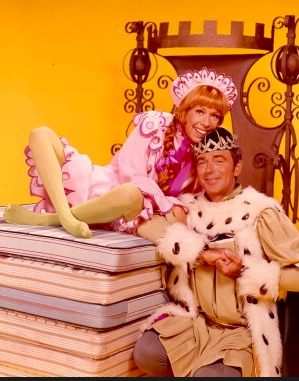
Carolplus2screen1Once Upon a Mattress is aimed at families, which is made clear from the beginning as Burnett reads and shares an abbreviated picture-book version of the fairy tale, after which we’re told we’re about to see the “adult version” of what really happened. Don’t be alarmed. Even your four year old can watch and enjoy this production, which sports outrageous and colorful costumes and lines that are delivered slowly enough that the smallest children won’t need much in the way of narrative summary. Once Upon a Mattress is an engaging 90-minute romp that showcases Burnett’s talents as a physical comedienne and also features verbal comedy, singing, and dancing.

The plot is simple, yet, like so many fairy tales, timeless. Queen Aggravain is so domineering that her husband, the king, has been rendered unable to speak. Communicating only in pantomime, he’s like the fifth Marx Brother. Their son, Prince Dauntless (Ken Berry), is also dominated by the queen, yet this mama’s boy, despite being in his mid-thirties, yearns to marry. Trouble is, he can only marry a true princess, and Mama devises a different test each time so devious that none of the princesses who visit the castle are ever able to pass. When a rain-drenched Princess Winifred (who prefers to be called “Fred”) turns up on the doorstep, the vetting process begins anew. Children will especially get a kick out of a “dance off” in which Fred instantly masters the silliest local folk dance and outlasts everyone else in the kingdom. The Queen tells the princess that she needs to get her sleep because the big test will be tomorrow, when in fact the test is whether she can detect a tiny pea placed underneath a stack of 20 mattresses. The “adult version” is that this happily-ever-after tale didn’t come about because Fred was indeed able to detect that pea. She had a little help. Bernadette Peters stars as Lady Larkin, while Carol Burnett Show regular Lyle Waggoner appears as Sir Studley, and Wally Cox (who gave voice to the TV cartoon Underdog) narrates as The Jester. Look closely and you’ll even see a cameo by Kermit the Frog. All in all, it’s a highly entertaining 90-minute TV musical special.

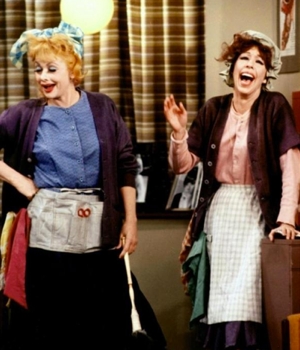
Carolplus2screen2Carol + 2 is geared more for adults than families, and while it’s great to see two of television’s First Ladies perform together and Zero Mostel is as wild-eyed and manic as ever, the sketches and performances are a mixed bag. The funniest might be the opening sketch featuring Burnett and Mostel as a married couple grown spiteful of each other who find out briefly that a mistake means they’re not married after all . . . and that changes the way they see each other. Close behind is “Goodbye Baby,” in which Ball plays an older sister who drops in for a visit on her way to her annual vacation. Burnett is the younger sister with a baby buggy in the park who insists that her sister not leave until she hears the little guy say “Goodbye.” Of course, as with all sketch comedy, things escalate, and while the ending might be a little far-fetched it’s the progression that’s fun to watch. Some of the other sketches are less successful, but Ball and Burnett sing a spirited song about “Chutzpah” as Hollywood charwomen, and this one-hour color special gives contemporary audiences a chance to see three legendary talents at work.

Thrown in as a bonus feature is the very first black-and-white Charwoman sketch that Burnett performed as part of her first special, An Evening with Carol Burnett. It was a character that, animated, would become part of her long-running TV show’s title credits. This 1963 sketch is more of a historical artifact than a family entertainment, though Burnett’s introduction to it, as with her introductions to the two TV specials included on this DVD, is nice to have.

Older Entries Newer Entries