Home

INNERSPACE (Blu-ray)

Leave a comment

InnerspacecoverGrade: B+
Entire family: Yes
1987, 120 min., Color
Rated PG for briefly exposed male buttocks, some comic violence, some mild profanity, and drinking
20th Century Fox
Aspect ratio: 1.85:1
Featured audio: English DTS-HD MA 5.1
Bonus features: B+
Trailer
Amazon link

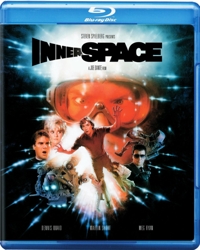
Like Fantastic Voyage, which preceded it by twenty years, Innerspace won an Academy Award for special effects that simulated the interior of a human body—great effects, actually, considering they were accomplished before the advent of computer-generated images. In Voyage, a team of doctors was miniaturized and injected into a human being in a dramatic attempt to save an important political life. But Innerspace director Joe Dante (Small Soldiers) opts for low comedy, not high drama, with Batmanesque villains, pre-Mask morphing, and more than one Austin Powers-style “mini-me.”

A young looking Dennis Quaid stars as Lt. Tuck Pendleton, a bad-boy Navy pilot with a weakness for alcohol and Lydia, the reporter-girlfriend (Meg Ryan) who walked out on him. Tuck resigns his commission to pilot a submersible pod for an independent lab working on miniaturization. But instead of being Innerspacescreeninjected into a rabbit, as planned, when an industrial terrorist raid interrupts the procedure and a lab technician flees with the syringe containing the tiny Tuck, the pilot is injected instead into the bloodstream of Jack Putter, a frazzled milquetoast supermarket clerk (Martin Short). In a relationship that becomes symbiotic out of sheer necessity, Tuck and Jack party in order to “bond,” then work together to battle personal defects, the bad guys, and (tick, tick) time. Tuck’s oxygen supply is limited, you see, and he needs a microchip the villains have in order to coordinate his reentry into peopledom. But it’s a double search, because the evil Victor Scrimshaw (Kevin McCarthy)–a comic cross between Mr. Freeze and The Penguin–has one microchip and needs Tuck’s in order to complete the technology theft, and he and his henchmen, his oversexed lead doctor (Fiona Lewis), and industrial spy/hit man “The Cowboy” (Robert Picardo) will do anything to get it.
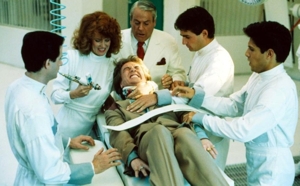
Since Quaid spends most of the movie sitting inside the pod, it’s a tall order for Short to provide all of the visual action and handle most of the proxy interaction with Ryan. But like Paul Blart, Mall Cop, Short’s character rises to the challenge and the trio has a project chemistry that really makes this otherwise lightweight film an engaging adventure—especially on widescreen and in high def. Together, they really sell the situation. Even when Jack begins to fall for Lydia and compete for her attentions, it’s totally credible—which balances the tonally cartoonish villains.

“For a while, we thought we should call it Fantastic Voyage 2,” Dante quips, adding that they chose Innerspace instead because no one could come up with a better title. Dante teams with producer Michael Finnell and co-stars McCarthy and Picardo on a commentary track that’s almost as entertaining as the film. Warner Brothers’ marketing people get roasted, as does Martin Short for bowing out of the commentary, and Quaid for refusing. As the camera pans across the laboratory, one of them tells how the extras were all real scientists from a nearby jet-propulsion laboratory. As the memorable bonding scene between Tuck and Jack runs, another remarks, “I can’t believe that we were gonna cut that scene.” And as the camera pulls closer to the heart valve opening and closing like the beak of the giant squid in 20,000 Leagues under the Sea, threatening to swallow up Tuck’s pod and kill them both, one of them laughs, “The heart valve opening and closing? Two guys with sticks pulling as fast as they can!”

Dante and Finnell said that early on they realized that Innerspace was “a good audience movie,” and self-deprecating humor aside, Innerspace holds up better than Fantastic Voyage precisely because they don’t take themselves or what they’re doing too seriously. Yes, the hair is dated and some of the special effects now seem rudimentary, but the laughs are still here, and the action is pure fun. And it’s rated PG. Innerspace is one of the better, older comedy-adventures and a great candidate for family movie night. Unlike Fantastic Voyage, this one seems to get better with age. Right now at Amazon Innerspace is selling for under $10 on Blu-ray, and the price seems “righter” if you consider the repeat play this one is going to get.

Language: No f-bombs, but a few milder d, s, and h words
Sex: Just a “swapping spit” kiss that’s a plot device
Violence: Fighting, some shooting, a body dissolving to skeleton
Adult situations: Drunkenness, assassin stripped to his shorts
Takeaway: Parodies can actually have a life of their own.
THE SECOND BEST EXOTIC MARIGOLD HOTEL (Blu-ray)

Leave a comment

SecondBestExoticcoverGrade: B-/C+
Entire family: Yes, but….
2015, 122 min., Color
Rated PG for some language and suggestive comments
20th Century Fox
Aspect ratio:
Featured audio:
Includes: Blu-ray, Digital HD
Bonus features: C+
Trailer
Amazon link

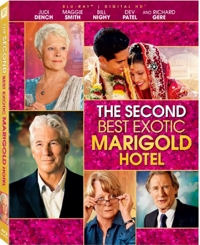
The Best Exotic Marigold Hotel (2012) was a surprise hit because it hit home with its basic messages. A group of older British retirees traveled to India because of a brochure that glamorized The Best Exotic Marigold Hotel and made it look like the ideal place to retire, to find a replacement husband, or to stay there while getting a hip operation. Unknown to each other, they discovered things in common; foreign to India and some of them suspicious or awkward, they found an appreciation for a different culture and a level of comfort; and feeling a little tired and depressed by their late stage of life, they found some measure of renewal by their association with the hotel’s optimistic and energetic young owner. It was a feel-good movie about growing old, and there aren’t many of those around.

But The Second Best Exotic Marigold Hotel (2015) is a sequel that really didn’t need to be made. Missing is the charm and freshness of the first film, replaced by a formulaic plot and a paucity of humor, with a running gag that’s a 180-degree turn from the positive attitude toward aging that we encountered in the first film. In the original, one of the residents died, but what kind of tone does it set when in the sequel the proprietor, Sonny (Dev Patel), begins each morning with a roll call so the residents can answer . . . and let him know they’re still alive?

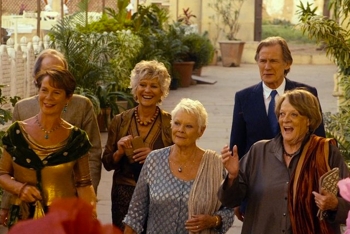
Two standard plot devices that we’ve seen before drive the narrative: a wedding and an anonymous visiting inspector who will decide whether Sonny can create a second hotel. Sonny is finally marrying the love of his life, Sunaina (Tina Desai), and there are some song-and-dance numbers SecondBestExoticscreenthat liven up the film. As with the first, each character has a subplot. Evelyn and Douglas (Judi Dench, Bill Nighy) are now working and fully immersed in local culture and finding occasional times to date each other. Carol and Norman (Diana Hardcastle, Ronald Pickup) are learning how to be exclusive to each other, while Madge (Celie Imrie) still plays the field and juggles two wealthy suitors. Somewhat lost in the shuffle is Muriel (Maggie Smith), who has been named co-manager of the hotel and seems to exist only as a confidante for everyone else. Meanwhile, there are two new arrivals (Richard Gere, Tamsin Greig) and only one nice room, and of course one of them is thought to be the inspector. Another sideplot about a business rival seems thrown in for good measure.

More than in the first, the screenplay feels like a paint-by-numbers affair, but the acting and the characters remain strengths. Patel is as energetic as a stand-up comic, and his onscreen mother (Lillete Dubey) gets something fresh to do as the object of Gere’s attentions. As with the first film, India itself is really the most colorful draw, and if you want to make a pilgrimage you can visit the Pearl Palace Heritage Guesthouse in Jaipur, where Second Best was filmed. But the movie truly is “second best,” which is not an uncommon thing for sequels. I was charmed by the first film, yet as much as I wanted to like this one I found it slightly dull. So did my family.

Language: some mild swear words
Sex: n/a
Adult situations: n/really
Takeaway: No matter what your age, after watching this film or the first you’ll dream of going to India.

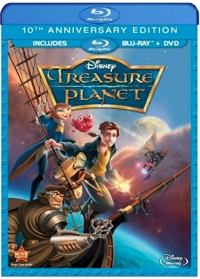
TREASURE PLANET (10th Anniversary Edition) (Blu-ray Combo)

Leave a comment

TreasurePlanetcoverGrade: B
Entire family: Yes
2002, 95 min., Color
Rated PG for adventure and peril
Disney
Aspect ratio: 1.66:1
Featured audio: English DTS-HD MA 5.1
Includes: Blu-ray, DVD
Bonus features: C+
Trailer
Amazon link

Pirates in space?

Why not? But Treasure Planet is a strange combination of futuristic space age, recent pop culture, and 17th century elements. The plot and characters have one foot in the past and one in the future. It’s the same with visual design. Ships that look like Spanish galleons fly in the air. Whales fly. Jim Hawkins, the lad at the center of this Robert Lewis Stevenson adaptation, has a solar board and rides it like a skate punk or parasailor. And the architecture? It’s like Tortuga in space. Disney was trailblazing in its combined use of 2D and 3D animation, and the results are stunning to look at. But the past-and-future mix doesn’t work nearly as well when it comes to content.

Fans of Disney’s live-action Treasure Island may be disappointed that the spaced-up version has more breakneck action and not nearly the intrigue of the 1950 classic. What’s more, Robert Newton carried the old film as Long John Silver, playing just the right blend of a benign old peg-legged pal who fascinates Jim Hawkins, and a menacing fellow with a hidden agenda—a blackguard who could be ruthless when the time came.

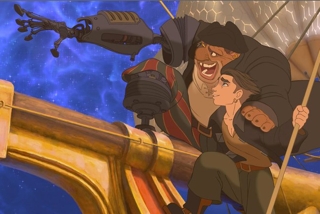
We don’t get that same type of character in Treasure Planet’s John Silver, who’s a menacing looking cyborg from the start. His face is drawn a little like Fagin from Oliver & Company, but fuller and meaner. And he’s armed with a gadget that slices, dices, shoots, and scares the heck out of everyone. There’s only menace in this fellow, so he’s nowhere near as interesting as Newton was in the more complex live-action role.

TreasurePlanetscreenBut fans of Stevenson’s novel will at least have fun picking up plot points and variations. In this animated version from directors Ron Clements and John Musker (Aladdin, The Little Mermaid), Jim Hawkins (voiced by Joseph Gordon-Levitt) is a bit of a delinquent at a crossroads. His mother (Laurie Metcalf) runs the Benbow Inn, and the adventure begins when Jim finds a dying pirate named Billy Bones (Patrick McGoohan) and brings him back to the Inn. In short order, the pirate is dead, Jim is holding an orb the size of a grapefruit and told to “beware the cyborg,” and pirates are ransacking and torching the place, forcing Jim, his mom, and a family friend, Dr. Doppler (David Hyde Pierce), to flee.

As in the book, Silver (Brian Murray) and his crew keep their identities secret and hire on as hands on a mission to follow the orb-map to Treasure Planet . . . which is curious, since their own planet, Montressor, is French for basically the same thing. Oh well.

Unlike the 1950 film, this souped-up, spaced-out version drags a little, despite the action, because the characters and their relationships are more superficial. Take Ben Gunn, for example. Instead of a lunatic who’s been away from people for too long, it’s an annoying robot named B.E.N., who’s supposed to provide some of the comic relief. The rest comes from the doddering Dr. Doppler, a dog creature with an obvious fondness for the catlike ship’s captain (Emma Thompson), and a little thing that looks like one of those goofy, unidentifiable things that Olympic cities present as mascots. Morph (Dane A. Davis) is a shape-shifting blob of pink mass that perches on Silver’s shoulder, like a parrot. But I’ll take the parrot any day.

So what does that leave us with? The stunning art and animation. Andy Gaskill worked as a visual development artist on The Little Mermaid, and, promoted to art director, he oversees a crew that creates frame after frame and sequence after sequence of breathtaking art design and animation. The palette is largely orange and brown, and yet there’s plenty of visual pop. Only in a few scenes do we get grain and a soft image.

Given the artwork, if a better character had been inserted than the one-dimensional cyborg Silver, we’d be talking about Treasure Planet as another Disney classic. As is, it’s still a stirring animated adventure with near non-stop action that can be shelved in the “underappreciated Disney” category.

Language: n/a
Sex: n/a
Violence: The usual peril and fighting
Adult situations: Several deaths of minor characters
Takeaway: Disney’s adaptations continue to be inventive, if not always successful at the box office. And Treasure Planet deserves a second life.

THE LONGEST RIDE (Blu-ray)

Leave a comment

LongestRidecoverGrade: B-
Entire family: No
2015, 139 min., Color
Rated PG-13 for some sexuality, partial nudity, and some war and sports action
20th Century Fox
Aspect ratio: 2.40:1
Featured audio: DTS HD-MA 7.1
Includes: Blu-ray, Digital HD
Bonus features: B
Trailer
Amazon link

This could have been the shortest review I’ve written. All I had to do was say that The Longest Ride is based on a novel by romance writer Nicholas Sparks, and everyone would get the picture.

Sparks’ audience is and has always been primarily women, and the movie adaptations of his books have fallen into the category of “chick flicks.” That’s not bad, mind you, but the reality-check is that families with adolescent and teenage girls are more likely to fall for this opposites-attract love story than families with boys. That’s just the way it is, and it’s not a slam. Sparks has written 18 romance novels, and 11 of them (including Message in a Bottle, The Notebook, and Dear John) have been turned into films. They’re tremendously popular.

This one falls right in the middle, in terms of worldwide gross, but it’s decent enough entertainment if you’re into romance. The plot is a two-strand weave that involves two couples.

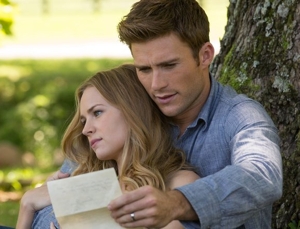
LongestRidescreenRomantic comedies always have a “meet cute,” and though this isn’t a comedy, that’s how it works. Wake Forest college student Sophia Danko (Britt Robertson) is coerced by her sorority sisters into donning cowboy boots and going to a rodeo to check out the “beef.” When Luke—who was seriously injured a year earlier and is still mentally and emotionally scarred as a result—falls off a bull right in front of her and loses his hat, she tosses it to him . . . and he tosses it back. “Keep it,” he says. Eye contact. Later they meet at a party where she’s just about to accept a drink with him but has to cut the evening short because of a friend who drank too much. Yep, there’s drinking and implied sex in this film, though the nudity we see is full-body without full reveal, hence the PG-13 rating.

They start to see each other, but an otherwise ordinary love story is given another layer when they come across an accident. Luke (Scott Eastwood—Clint’s youngest son) pulls the man out, while Sophia goes back at the man’s request to retrieve a box. Sparks has never been bashful about using plot devices, and this one’s a doozy. With a curious Sophia reading the love letters contained in the box, Sparks sets up a double love story—one in the past, with the woman (Oona Chaplin) deceased and the man (Alan Alda) on life support, and the other a young couple just trying to find someone. Sparks and director George Tillman, Jr. (Soul Food, Barbershop) do a nice job of pacing the reveals and relationship development, and a surprise-but-inevitable ending ties that neat bow that romance lovers have come to expect on every package.

In between there are some exciting and wonderfully filmed bull riding sequences, and the stars are plenty likable—which is really important in a formulaic romance, so that we care about their characters and their outcomes. It also looks great in HD, with a bundle of bonus features that should appeal to fans.

Language: Surprisingly little. Maybe a few s-words but that’s about it
Sex: A number of sex scenes, with one brief breast shot and a brief men’s top half of a butt shown. Also plenty of talk about sex.
Violence: Not much. Really just the bull riding sequences and the car crash
Adult situations: Drinking, smoking, partying, etc.
Takeaway: You’re doomed to repeat the past, unless you can learn from someone else’s past. Oh, and love is timeless.

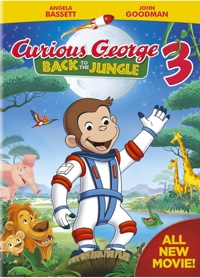
CURIOUS GEORGE 3: BACK TO THE JUNGLE (DVD)

1 Comment

CuriousGeorge3coverGrade: B+/A-
Entire family: Yes, but ….
2015, 81 min., Color
Rated G
Universal
Aspect ratio: 1.78:1
Featured audio: Dolby Digital 5.1
Bonus feature: C-/D
Trailer
Amazon link

After a disappointing Curious George 2: Follow That Monkey and a relatively pedestrian Curious George Swings into Spring, executive producers Ron Howard and Brian Grazer have given this popular children’s book character the kind of animated adventure he deserves. Curious George 3: Back to the Jungle may be better than the original Curious George theatrical release, and that’s quite a compliment for a direct-to-DVD release.

This outing, George (voiced by animated voiceover genius Frank Welker) is recruited by a space program run by a man named Houston (John Goodman) to fly into space to link a gizmo to a satellite and then return to Earth with it so that the gizmo can be installed in Africa to prevent flooding. And yes, we do get the line, “Houston, we have a problem.” So while the previous two Curious George films were aimed directly at preschoolers and everyone else be gosh-darned, this time there are a few more embedded allusions to entertain the older siblings and parents who watch with them.    More

THE BLACK STALLION (Criterion) (Blu-ray)

Leave a comment

BlackStallioncoverGrade: B+
Entire family: Yes, but . . .
1979, 117 min., Color
Rated G
Criterion Collection
Aspect ratio: 1.85:1
Featured audio: DTS-HD MA 2.0 Surround
Includes: 17×11 color poster, five short films by Ballard
Bonus features:  B-/C+
Amazon link

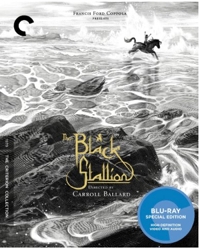
The Black Stallion—at least the 1979 adaptation that Francis Ford Coppola “presents”—is an interesting hybrid. It’s part family movie and part indie/art house film. Director Carroll Ballard takes the 1941 book for young readers and infuses the story of a boy and a wild horse who “save” each other with indie film sensibilities and art-house cinematography.

The result is a film that’s obviously made for adults but suitable for children. There are a few less warm fuzzies and sappy moments in this hybrid (a good thing!), though the pacing in the first act might seem a bit too leisurely for the youngest viewers. There’s not much you can do for them except to assure them that the action picks up, but older children who squirm can be shown the luxurious cinematography from Caleb Deschanel (Zooey Deschanel’s father), with breathlessly original shots and angles and the space for those shots to breathe and expand in our consciousness.

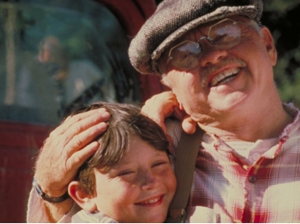
BlackStallionscreen1Ballard isn’t quite as lavish with his plotting and narrative. Some directors like to show rather than tell; Ballard likes to suggest rather than show. We see a young boy and his father on a steamer off the coast of North Africa, where Dad (Hoyt Axton) is gambling with dangerous-looking people, and the boy, Alec (Kelly Reno), has the run of the ship. The boy glimpses a wild black stallion roped and whipped by Arab trainers and forced into one of the ship’s holds. Feeling sorry for the horse, Alec returns with sugar cubes he swiped but is caught and treated almost as roughly by the Arab. Shortly thereafter, his father shares with him a trinket from his poker winnings: a small statuette of Alexander the Great’s horse. We hear the story of how the horse was so wild the king was going to put him down, but conceded that the boy Alexander could keep him if he could ride him. Of course, that tiny statuette and story become a controlling metaphor for the narrative of The Black Stallion, for soon afterwards a violent storm kicks up, the boy releases the horse so he won’t go down with the ship, and after watching him leap into the sea the boy is thrown overboard and calls for help.

So begins a relationship between the boy and the horse that develops on the island until he’s rescued by a group of men who also take the animal that Alec refuses to leave behind. And yet, what Alec does leave behind is any apparent feeling for his father. We really don’t know what happened to the man, nor did we see any emotional reaction in Alec after he awakens on the beach of a desert island. He’s as concerned about what happened to his father as he is about finding fresh drinking water (a detail that’s never addressed). We aren’t told, as readers of the book were, that the two of them had been visiting an uncle in India, so viewers really have no idea why the pair was on a ship so far from his home somewhere in the states where horses are raced. Even after Alec returns home to his mother (Terri Garr), we aren’t given much in the way of information.

BlackStallionscreen2But this is an impressionistic film, one that is more image-driven and scene-driven than it is dependent on plot, especially in the early going. For a while, it’s like Cast Away, but with a horse instead of a volleyball. Then turns into National Velvet, but with a teenage boy instead of a teenage girl, and a thoroughbred horse race rather than steeplechase. Perhaps not coincidentally, just as actor Mickey Rooney played the role of the former jockey and mentor in National Velvet who helps young Velvet train for the steeplechase, he’s a former jockey and mentor here too, helping Alec to learn what it takes to harness all that wild energy and race Black, as he’s simply called.

The payoff will ultimately satisfy young viewers if they can make it through the slower parts. But frankly, it wouldn’t hurt today’s children to learn how to appreciate those slow-down moments in life—especially when they’re so beautifully filmed.

If you’re building a Blu-ray collection, by all means, add this title. But the master had a lot of grain that carries over onto the HD release, so this title would probably look just as good on DVD. As for the bonus features, they’re geared for adults—though older, curious young filmmakers-in-waiting might be drawn to several of the five short films by Ballard, especially one on the “Rodeo” and another in which Ballard interviewed centenarians talking about what L.A. was like a hundred years ago . . . juxtaposed against the chaos of images that flood 1971 Los Angeles. What he does will inspire young filmmakers, who will find a way to take the best of what he does and speed it up for the current time and generation.

Language: Clean as can be
Sex: Same here
Violence: That brief boat beat-down, a violent storm, and a cobra incident
Adult situations: Loss of the father
Takeaway: It IS possible to have it both ways, to craft a film that’s aesthetically pleasing out of a story intended for a young audience.

THE WONDER YEARS: SEASON 3 (DVD)

Leave a comment

WonderYears3coverGrade: A-
Entire family: No. Age 10 and older.
1990-91, 520 min. (23 episodes), Color
Rated TV-PG for mild swearing, rude humor, and coming-of-age situations
Time Life/StarVista Entertainment
Aspect ratio: 1.37:1
Featured audio: English Dolby Digital 2.0
Bonus features: B+
Amazon link

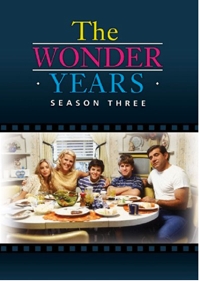
There are plenty of coming-of-age stories, but the classics for me are still Stand by Me and A Christmas Story in film, and The Wonder Years on TV. In each, you get the full impact of adolescence, but with a terrific sense of the time period, along with plots that bring everything into sharp focus. The Wonder Years is funny, it’s fresh, it’s thought provoking, it insightfully and colorfully captures the attitudes of the era, and it plays well 20 years later.

Like Leave It to Beaver, the series’ episodes were seen from the point of view of an adolescent, and you knew you were in for an interesting ride when this half-hour comedy-drama shunned a laugh track and introduced the kind of voiceover narrator that we got in A Christmas Story—an adult version of the main character, who was 12 years old when the series began. And you knew that The Wonder Years would meet the ‘60s head-on when the pilot called for the girl-next-door’s older brother to be killed in Vietnam, and for our hero to comfort her in a scene that would culminate in a first kiss for each of them—both as characters, and as actors.

In short, The Wonder Years gets it right. Kids Kevin’s age were too young to worry about a draft number, yet too old to ignore the events that were shaping history and the lives of Americans—things like the Martin Luther King, Jr. and Robert F. Kennedy assassinations, the moon landing, Woodstock, the Apollo 13 crisis, and events that were an outgrowth of Civil Rights, women’s liberation, and increasingly strident anti-war protests. The result is a series that combines the innocence of childhood—of who likes whom, and passing notes—with a world that’s pushing them to grow up more quickly.

Fred Savage was perfectly cast as Kevin Arnold, who at 13 became the youngest actor ever nominated for a Primetime Outstanding Lead Actor for a Comedy Series Emmy. His doe eyes reflected innocence, while his impish smile was a sign that he might say or do something impulsive or mischievous at any moment. The girl next door, Winnie Cooper, was also well cast, with Danica McKellar perfect as someone who would be both a best friend and love interest over the course of the show’s six seasons. And for comic relief and guy-to-guy matters there was bespectacled Paul (Josh Saviano), a brainy pal who was also Kevin’s best friend. The tone was wink-wink one minute and woe-is-me another as this group navigated the halls of junior high, then high school and all of the problems that seem so major to this age group: crushes, dates, tormentors, cliques, and run-ins with teachers and coaches.

On the home front, older brother Wayne (Jason Hervey) was obviously fond of his brother but lived to torment him, while much older sister Karen (Olivia d’Abo) was so caught up in the ‘60s that she was a flower child from the very first episode. The parents were especially well cast, with Dan Lauria returning from work each day grumpy and feeling chewed up and spat out, and Alley Mills deferring to him while also trying to act as mediator when he got on the kids.

Mr. Arnold swears almost as much as the dad from A Christmas Story, but without the mumbling. For him, “hell” and “damn” are normal everyday words. Many dads were like that, especially when the country seemed to be coming apart at the seams. But while historical events provided a backdrop, like the terrific music from the period that we hear in every episode, this show was still about growing up, and growing up in the ‘60s and early ‘70s was more complicated. The Wonder Years managed to capture the perfect storm of events that were always in a family’s consciousness even as the father tried to put food on the table, siblings fought and sought to find their place in the world, and the mother tried to hold them all together.

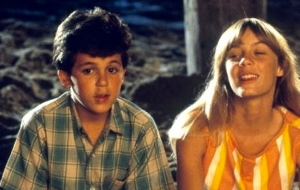
WonderYears3screenIf your family is into binge-watching, The Wonder Years is a perfect candidate, and you don’t have to begin with Season 1. This season Kevin meets an older girl during summer vacation, butts heads with an unreasonable teacher, tries to help Winnie get over her stage fright when they’re all in a play together, takes a break from best-pal Paul, gets his first pimple, learns a lesson about cheating, sabotages himself on a test, joins a band, gets a dog, struggles in glee club, builds a treehouse with his dad, and has to deal with an awkward moment when he and Winnie are invited to a make-out party. And brainy Paul develops a crush on Mrs. Arnold. Meanwhile, the Apollo 13 astronauts are in trouble and Kevin worries that his family is also in trouble, with a sister trying to enroll in a “liberal” college and his father complaining about the old house so much that Kevin is afraid they might move away from his friends and school.

The Season 3 DVD includes interviews with the actors who play Karen, Wayne, Winnie, and Becky Slater, along with a roundtable featuring the main three actors and a featurette, “At Home with the Arnolds.”

WELCOME TO SWEDEN: SEASON 1 (DVD)

Leave a comment

WelcometoSwedencoverGrade: B/B+
Entire family: No
2014, 220 min. (10 episodes), Color
Not Rated (would be PG)
Entertainment One
Aspect ratio: 1.78:1
Featured audio: Swedish and English Dolby Digital 5.1 (English subtitles)
Bonus features: N/A
Amazon link

Welcome to Sweden is a Swedish situation comedy in English and Swedish (with English subtitles) that aired simultaneously on The Comedy Network in Canada and on NBC in the United States last year. Executive produced by comedian Amy Poehler (Saturday Night Live, Parks and Recreation), it stars her brother, Greg, as a New York accountant to celebrities who makes a ton of money but realizes that what he really wants is to be Swedish . . . to move to Sweden to live with his serious new Swedish girlfriend.

In a TV series that’s built around culture (and personality) clashes, because of his honesty poor Bruce (Poehler) gets into almost as much inadvertent trouble as Larry David does in Curb Your Enthusiasm—except that unlike David, he’s actually a nice, thoughtful guy. Bruce was raised in a small midwestern town, though he isn’t nearly as conservative or religious as his parents. His philosophy is the kind of laid-back “things will work out” (i.e., fix themselves) attitude more common to California than New York. So when he meets Emma (Josephine Bornebusch) and they hit it off, he decides to quit his lucrative job and follow her to Sweden, where she returns to be with family and to work in a bank.

For a sitcom, Welcome to Sweden has a real low-key indie vibe to it, but once Greg gets off the plane in Stockholm and moves in with Emma and her family, it also starts to feel like a milder, more sophisticated, tongue-in-cheek version of Meet the Parents. Viveka (Lena Olin) is the vivacious mom who feels herself getting older and wants to live a second-chance life through her daughter, but the fact that she married a much older man (Claes Mansson as Birger) who’s now less vital is an annoying reminder of how much she herself has aged. A former sea captain, Birger is as tall as Bruce is short, quiet and reserved as Bruce is prone to babble nervously. And those contrasts too add fuel to the comic fire. So does Emma’s slacker brother Gustaf (Christopher Wagelin) and a host of minor characters with single quirks or identifiers.   More

CPO SHARKEY: SEASON 1 (DVD)

Leave a comment

CPOSharkeycoverGrade: B/B-
Entire family: No
1976-77, 374 min. (15 episodes), Color
Not rated (would be PG-13 for rude/racial humor)
Time Life
Aspect ratio: 1.33:1
Featured audio: Dolby Digital Mono
Bonus features: B+
Amazon link

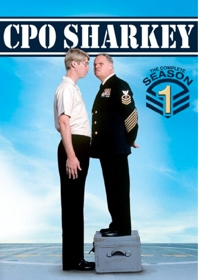
Stand-up comedian Don Rickles made a career out of insult humor and politically incorrect jokes aimed at all races. So what better sitcom for him to star in than one that has him playing a Chief Petty Officer at a U.S. Naval training facility in San Diego, where he gets to go off on recruits—especially when those recruits include a Polish American, a Jewish American, an Italian American, and a Puerto Rican?

Call it Sgt. Bilko revisited, because Rickles is surprisingly good at playing a tough, acerbic CPO with a warm heart. The show lasted only two seasons, but it’s not because the sitcom isn’t funny or because the cast isn’t likeable. My guess is that it was another case of bad timing. The public already had one sitcom with politically incorrect humor, and did America really want or need another Archie Bunker?

That’s not fair, though, because Bunker was racist without knowing or admitting it. He tolerated black neighbors but wasn’t really friends with them. Sharkey is best buddies with fellow CPO Dave Robinson (Harrison Page), an African American with whom he feels comfortable enough to make racial jokes. Notice I said “racial,” not “racist.” There’s a difference, and in today’s hyper-politically correct world that difference isn’t acknowledged—hence the warning on the back of this DVD: “Some of the jokes and ethnic references heard in these episodes would most likely not be allowed on network TV today and reflect the tenor of the times.” Because of that racial humor, CPO Sharkey will only be for families with children old enough to realize that such jokes can’t be made today, no matter how fond you are of a person.   More

SCOOBY-DOO! 13 SPOOKY TALES: SURF’S UP SCOOBY-DOO! (DVD)

Leave a comment

ScoobyDooSurfsUpcoverGrade: B+
Entire family: Yes
1969-2015, 272 min. (13 cartoons), Color
Not rated (would be G, easily)
Warner Bros.
Aspect ratio: Varies (see below)
Featured audio: Dolby Digital 2.0
Bonus features: N/A
Trailer/Amazon link

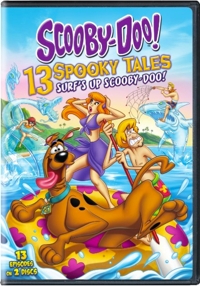
“Scooby-Doo! and the Beach Beastie” is a brand-new 22-minute cartoon and the sixth direct-to-DVD offering of its kind. But when you compare this latest effort with the “filler” added to flesh out the two-disc Scooby-Doo! 13 Spooky Tales: Surf’s Up, Scooby-Doo!, you almost wish that Warner Bros. had substituted a few more older episodes instead. “Beach Beastie” is by far the weakest, a going-through-the-motions affair that relies too much on Fred’s paranoia over nets and Scooby’s new love interest. It also offers too little in the way of mystery and phony monster moments—the two driving forces behind the popular franchise. What we get this time is a water monster that we’ve seen too many times before in other films.

Though a few voiceover actors and the style of drawing and animation changed over the years, the formula remains mostly the same: the Mystery, Inc. gang (timid Great Dane Scooby-Doo, always hungry Shaggy, bookish Velma, stylish Daphne, and All-American guy Fred) rambled onto the scene where a monster or ghost was terrifying people. Sometimes they were hired to get to the bottom of things, while other times they helped out a friend or simply “fell into” a mystery while trying to take a vacation—often to some exotic location. And always the unmasking revealed a phony monster with someone inside or with a remote control manipulating it for revenge or personal gain.

I don’t know if Warner Bros. deliberately chose “filler” episodes from a full range of Saturday-morning Scooby-Doo! cartoon shows, but to me that variety is the chief bonus. You really get a sense of the whole arc of this franchise. If only Warner Bros. had arranged the episodes in order, so viewers could better see how the characters and the series developed over 40 years. As is, the episodes are arranged either thematically (if you’re a glass half-full person) or randomly (if half-empty).  More

Older Entries Newer Entries