Home

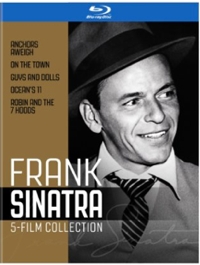
FRANK SINATRA 5-FILM COLLECTION (Blu-ray)

Leave a comment


FrankSinatra5FilmcoverGrade: B
Entire family: Yes, but…
1945-1964, times vary (see below), Color
Approved (would be PG for some adult situations)
Warner Bros.
Aspect ratio: Varies (see below)
Featured audio: DTS-HD MA 1.0 and DTS-HD MA 5.1 (Guys and Dolls)
Bonus features: C
Amazon link

For family movie night, the best bet in the Frank Sinatra 5-Film Collection is Robin and the 7 Hoods—a 1964 prohibition musical-comedy set in Chicago that offers an amusing gangster version of the Robin Hood legend. That film and others in this collection new to Blu-ray are available as single titles as well. Whether the five-film collection is worth buying will depend on how much your family likes old musicals (four out of five films are musicals) and how tolerant the kids are of older films. But at least all five are in color, and all are the equivalent of PG-rated films. The discs seem to be identical to the single releases, with the same bonus features, but with a handsome hardcover book of color and black-and-white photos from the five films and the discs on separate plastic pages in an oversized Blu-ray case, all tucked inside a sturdy cardboard slipcase. Picture quality is terrific for all five films, though the Mono DTS on four of them may not be what viewers are used to. But if your family loves musicals—old ones included—this is a great collection.
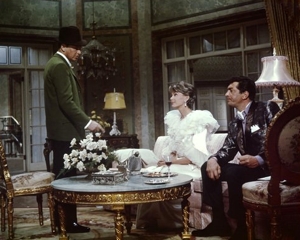
Robin7HoodsscreenRobin and the 7 Hoods (1964, 123 min., 2.40:1 widescreen, trailer)—This clever and funny riff on the Robin Hood legend stars Peter Falk (TV’s Columbo) in a hilarious role as Guy Gisbourne (in the movies, it was Sir Guy of Gisbourne), who bumps off Big Jim and takes control of the city racketeering, with the Sheriff offering protection for a fee. Naturally Robbo (Sinatra) objects, and their rival factions square off in a battle for speakeasy supremacy. Bing Crosby stars as the troubadour Allen A. Dale, with Dean Martin playing John Little (instead of Little John), and Sammy Davis Jr. as Will Scarlet. But the Robin Hood legend really kicks in when Big Jim’s daughter, Marian (Barbara Rush), thinks the Sheriff responsible for her father’s death and Robbo responsible for his disappearance. She gives Robbo a $50,000 payoff. “Get rid of it,” Robbo says, and his merry men donate the whole bunch to an orphanage. Other charities follow, and it’s fun to watch this legend play itself out on Chicago gangsterland turf. There’s bootlegging and flappers in skimpy costumes but no sex, no language to speak of, and no onscreen violence. Great songs, clever plot, and funny moments. My teenage son gave it an A, he liked it so much. I’d say it’s more of an A-.
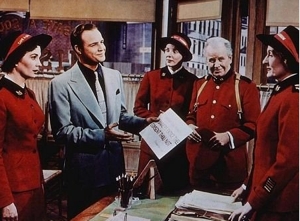
GuysandDollsscreenGuys and Dolls (1955, 150 min., 2.55:1 widescreen, trailer)—The second best title in this collection is the film adaptation of the Broadway hit that itself was based on a Damon Runyon story about Broadway gamblers. Nathan Detroit (Sinatra) runs a floating crap game and has been dating dancer Adelaide (Vivian Blaine) for more than a decade. He’s fond of her but unable to commit to marriage because he’s just as fond of gambling and his gambling pals, which include his “second,” Nicely-Nicely Johnson (comic actor Stubby Kaye). There are plenty of Broadway denizens in need of saving, and Jean Simmons plays Sarah Brown, who is in charge of the local Salvation Army. The action is set in motion when Lt. Brannigan (Robert Keith) puts the heat on and the only place that will host Nathan’s illegal gambling operation for one night wants $1000. How to get it? With famous better Sky Masterson (Marlon Brando) in town, Nathan tries to get him to bet on a sure thing for him. When Sky brags that he can convince any woman to go with him to Havana for the night Nathan looks out the window and points out Sarah Brown. “I choose her,” he says, and the bet is on. The song-and-dance numbers are old-school musical and the dialogue is Runyonesque, but after a while you get used to it. My son liked this one too, and we’d give it a B+.   More
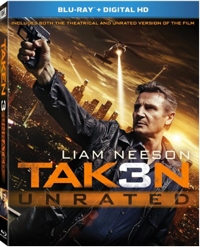
TAKEN 3 (Blu-ray)

Leave a comment

Taken3coverGrade: B-
Entire family: No
2014, 109 min., Color
Rated PG-13 for intense sequences of violence and action, and for brief strong action
20th Century Fox
Aspect ratio: 2.39:1 widescreen
Featured audio: English DTS-HD MA 5.1
Includes: Blu-ray, Digital HD
Bonus features: C-
Trailer/Amazon link

In Taken 3, nobody’s really “taken” until the third act, but I guess it was time for the franchise to shake it up a bit.

The original Taken (2008) featured Liam Neeson as a former CIA operative who used his skills to save a daughter kidnapped in France. Then, in Taken 2, a Patriot Games-style revenge theme drove the plot, with the father of the kidnapper from the first film “taking” both Bryan Mills (Neeson) and his ex-wife (Famke Janssen) while they’re in Istanbul. The third time around they’re in L.A., where Mills learns from his now-pregnant daughter (Maggie Grace) that his ex-wife is having marital problems. There’s some hint of their getting back together, but early in the first act he finds his ex- in his bed with her throat slit. When the cops show up, his survivalist instincts kick in again. He goes “down the rabbit hole” to hide and, like The Fugitive, try to clear his name.

Neeson makes a credible action hero, so much so that you have to wonder “what if” he had been given the Bond role back in 2006 when his name was bandied about as a possibility. As cast and filmmakers say in one of the bonus features, the film’s appeal comes from the core principle of a father wanting to protect his family, and Neeson does have an appealing “everyman” quality—despite also having superman survival skills that would have eliminated most ordinary men from the challenge 30 seconds into the film. At times the action and close-call escapes border on the cartoonish because they’re so outlandish, but Luc Besson and his co-writers seem to understand that audiences expect him to survive anything. At some point, they don’t even bother to explain how he managed them, they start to feel that routine.

Taken 3 offers a plot that also feels familiar, and unfortunately relies on the cheap trick of printing sequences with some frames removed and slightly blurring them—a shortcut for action films that we first saw in Gladiator. It produces the kind of strobe effect that can drive some people crazy and basically excuses the filmmakers from having to mount expensive and highly choreographed fight scenes.

That said, Taken 3 is still a credible action film that’s entertaining despite its familiarity, largely due to Neeson’s talents and appeal. But Forest Whitaker is also engaging as the LAPD detective in charge of the investigation, making the best out of a two-dimensional role, and Dougray Scott and Sam Spruell spark enough hatred as the film’s bad guys. Neither sequel can touch the original, but fans of the franchise won’t care.    More

BIG EYES (Blu-ray)

1 Comment

BigEyescoverGrade: B+
Entire family: No
2014, 105 min., Color
Rated PG-13 for thematic elements and brief strong language
Anchor Bay
Aspect ratio: 1.78:1
Featured audio: English DTS-HD MA 5.1
Includes: Blu-ray, Digital HD
Bonus features: C-
Trailer/Amazon link

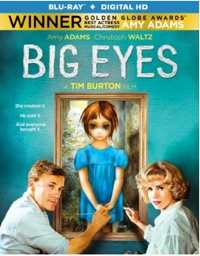
Big Eyes isn’t your usual Tim Burton film. Though there’s a twisted aspect to the relationship between painter Margaret Keane and her controlling husband Walter—along with a vibe that’s faintly reminiscent of Edward Scissorhands—it’s still a pretty straightforward biopic. But don’t be misled by the box blurb announcing that Amy Adams won the Golden Globe for Best Actress in a Musical/Comedy. Big Eyes is neither. It’s a drama made fascinating by Adams’ flawless performance, with occasional comedic moments provided by Christoph Waltz’s brilliant-but-delusional P.T. Barnum-like antics as Walter Keane.

Walter manipulates the art world and the buying public as much as he does his wife, whose paintings he takes credit for—first, to make a sale, then, because it feeds his ego. Throughout the Sixties they continue this charade, with Walter rising as a public figure and Margaret shrinking to even smaller dimensions than when they first met and she was overwhelmed by his personality.

You forget that it’s a Tim Burton film until Margaret goes grocery shopping and has hallucinations of all the other shoppers looking at her with the trademark “big eyes” that she featured on all of her paintings of children. That’s the one creepy moment in the film that feels Burtonesque. But you can see why the director was drawn to Margaret’s story. Like Edward Scissorhands, she’s forced to live in isolation and spends much of her time in an attic, working away. Like Scissorhands, she’s timid and naive and easily manipulated. And the big eyes she paints? It’s those paintings of big-eyed, dark-eyed, sad-looking waifs that come closest to what we expect from Burton.

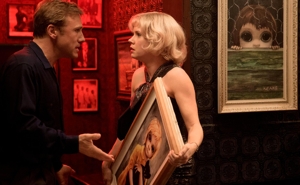
BigEyesscreenBig Eyes tells Margaret’s story, beginning with her flight in 1958 from her first husband and her meeting Walter Keane at a San Francisco art fair, where they both were trying to sell their works. It’s rated PG-13 for thematic elements and brief strong language, but I’d have to say that it’s pretty understated, with far less language and violence than most PG-13 movies, and no sex. It wouldn’t hurt young teens to see that an abusive relationship doesn’t have to involve physical violence. There’s no hitting in their marriage, only intimidation and manipulation, with Margaret being an unwitting enabler because of her timidity. Yes, there’s one scene where Walter gets drunk and menaces his wife and stepdaughter, but young girls might benefit from seeing a film like this, and how easily things can snowball in a controlling relationship. While Big Eyes is the story of a twisted relationship, the focus remains on the art, the phenomenon that this “kitsch” art became, and what art and those children mean to Margaret. In that respect, it’s quirkier and more upbeat than your typical sour relationship story.   More

FRASIER: COMPLETE SERIES (DVD)

1 Comment

FrasiercoverGrade: A-
Entire family: Yes, but . . .
1993-2004, 5,895 min. (263 episodes), Color
Rated TV-PG (mostly for innuendo)
CBS/Paramount
Aspect ratio: 1.33:1
Featured audio: Dolby Digital 2.0 Stereo
Includes: 44 discs in two sturdy plastic cases w/cardboard slipcase
Bonus features: C+
Amazon link

Modern Family may be King of the American Sitcoms now, but in the ‘90s it was Frasier, a spin-off from the popular sitcom Cheers starring Kelsey Grammer as a pompous but endearing psychologist who reveled in his intellect and haute culture tastes, but also yearned to be “one of the guys.” Frasier won a Primetime Emmy for Outstanding Comedy Series for each of its first five seasons and continued to win Emmys in other categories for all of its 11 seasons—though it wasn’t a runaway hit with audiences. Its best showing came with Season 6, when Frasier finished as the #3 most watched TV show in America, behind Friends and ER.

In Boston’s Cheers bar, Grammer made arrogance endearing as he played a good-but-jilted doctor who hung out with a dim-witted Iowa bartender, a narcissistic ex-ballplayer, a know-it-all mailman, and an overweight, professional barfly. Sometimes you laughed with him, while at other times (most of the time, actually) the humor came at the doctor’s expense—a book smarts vs. street smarts face-off. In Seattle, fresh from a divorce from his domineering wife Lilith (Bebe Neuwirth), Frasier found a fresh start as a Dr. Phil-style radio psychologist and acquired a new hangout: Café Nervosa, where he and equally effete brother Niles (David Hyde Pierce) would indulge their cappuccino tastes and parade their knowledge in front of a generally apathetic public.

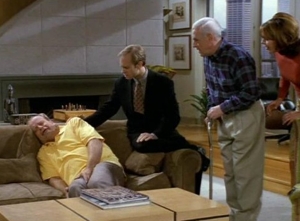
FrasierscreenThe show, with chapter tiles that played with puns, had two main sets. The first was KACL-Radio, where Frasier dispensed his psychiatric bromides and producer Roz Doyle (Peri Gilpin) was a perfect “give it a rest” foil to his pompous side. Obnoxious sportscaster Bob “Bulldog” Briscoe (Dan Butler) took him down a few more pegs with his cuts and practical jokes, and restaurant critic Gil Chesterton (Patrick Kerr) was the uncomfortable mirror that showed reflections of what Frasier might be like without such irreverent and frequent shots to keep him grounded. Much of the at-work time is spent with Frasier talking to unseen call-ins with a host of problems, and much of the fun for fans is watching the end-credits to see what famous celebrities posed as the callers from week to week.

At home, the brandy-oriented Frasier met his match with his blue-collar dad (John Mahoney), a Ballantine-loving ex-cop who walks with a limp and has a live-in therapist, a Brit named Daphne (Jane Leeves). With dad and son facing off and Daphne offering her humorous third-party, third-culture take on things, it made for more dry humor. And Niles visited so often that it felt as if the four of them lived—and bantered—there. His epic crush on Daphne and the brothers’  sibling rivalry and sharp contrast with their down-to-earth dad became series-long storylines.   More

THE BRADY BUNCH: COMPLETE SERIES (DVD)

1 Comment

BradyBunchcoverGrade: B
Entire family: Yes
1969-74, 2,980 min. (117 episodes), Color
Not rated (would be G)
CBS/Paramount
Aspect ratio: 1.33:1
Featured audio: Dolby Digital Mono
Includes: 20 discs in sturdy plastic case w/cardboard slipcase
Bonus features: C+
Amazon link

The Brady Bunch was one of the very last squeaky-clean family sitcoms in the old ’50s mold, airing as an anachronism of sorts during the Vietnam War years amid the chaos of Civil Rights, women’s rights, and anti-war protests. But in the Brady household, father Mike, a working architect, was still king of the castle with a den all his own, while his wife, Carol, was a stay-at-home mom who had the luxury of a servant. The children got into all sorts of minor conflicts and mischief, but none of the storylines tackled serious parental concerns of the day. Everything was sibling rivalry and innocent mix-ups.

There were conflicts over clubhouses, shared things and spaces, class elections, invented boyfriends, broken things that had to be replaced, and even talent shows. Drugs? Not here. Peer pressure to smoke? Only briefly. Teen pregnancy? Please! While other teens from the time were raiding their parents’ liquor cabinets, this group was content to raid the cookie jar. No one got into really serious trouble, and there was usually a lesson to be learned . . . from dad. When he wasn’t around, there was always mom or Alice, the housekeeper/cook (Ann B. Davis), to help them find their way.

First telecast on Sept 26, 1969, the show was a surprise hit, no doubt because it felt like comfort food to Americans who snuggled together during a turbulent era to watch and relive happier, more uncomplicated times. Divorce was becoming a widespread phenomenon for the first time, and the show about BradyBunchscreen1second-chance family life probably struck a chord with broken families. The range of the Brady children’s ages (7 through 14, when the show began) was broad enough for most youngsters to identify with. Airing on Friday nights, the show connected especially with children too young to have a social life, or, like the Bradys, too awkward and introverted. The Brady Bunch never finished in the Nielsen Top-30 and never won any Emmys, yet the show has become a cultural icon, lampooned in two feature films and held up as an example of one of the last wholesome family sitcoms to be telecast . . . before TV sitcom families would start spouting one-liners and zapping each other with zingers, before families (or rather, writers) got “hip.”   More

50 to 1 (DVD)

1 Comment

50to1coverGrade: B
Entire family: No, but ….
2014, 111 min., Color
Rated PG-13 for some suggestive material and a bar brawl
Sony Pictures
Aspect ratio: 1.78:1 anamorphic widescreen
Featured audio: Dolby Digital 5.1 Surround
Bonus features: C
Trailer/Amazon link

50 to 1 just about describes the odds of a low-budget, small-studio movie with mostly B-list talent and a writer-director of former box-office disappointments being able to compete with slicker big-studio horse racing titles.

But I’ll tell you right now, like Mine That Bird, the subject of this 2014 sport drama with comedic moments, 50 to 1 beats the odds. I liked it as much as Seabiscuit (2003) and Secretariat (2010).

Notice I said “liked it as much” rather than “as good as.” The budgets for Seabiscuit and Secretariat were respectively 8.7 and 3.5 times larger and the production values sometimes show it. The script for 50 to 1 also is more uneven, with character development that falls a little short. William Devane is the most recognizable name actor onboard, and while the acting won’t win any awards, the cast does a good job of making you believe their characters.

50to1screen1Everybody loves an underdog story, and 50 to 1 is a doozy. The horse, a smaller-than-usual gelding with a strange walk, has been running as slow as can be and gets no respect. Neither does the rag-tag group of New Mexico cowboys and their families who own him, train him, ride him, invest in him, and, most importantly, believe in him. They’re not wealthy dabblers who race horses as a hobby. They need one good horse to help them keep their stables in business, and with creditors knocking at the door they’re as much of an underdog as Mine That Bird. Even if you’re an urbanite, it’s tough not to appreciate this rough-around-the-edges group and the joy they take in the small things in life. They’re not phony posers, they’re real people, so when the snobs in racing circles treat them as if they were the Clampetts from The Beverly Hillbillies, it’s hard not to secretly (or not so secretly) pull for them to show those bluebloods a thing or two.   More

WILD KRATTS: SHARK-TASTIC! (DVD)

Leave a comment

WildKrattsSharktasticcoverGrade: B+
Entire family: No
2011, 60 min., Color
TV-Y (young viewers)
PBS Kids
Aspect ratio: 1.78:1 widescreen
Featured audio: Dolby Digital 2.0 Stereo
Bonus features: None
Episode segment/Amazon link

When television first featured nature shows for a family audience, it was hosted by serious and sedate fellows like Marlin Perkins, a zoo director whose long-running Mutual of Omaha’s Wild Kingdom first aired in 1963. The photography was a combination of long and medium shots, with Perkins mostly relying on voiceovers. Think public television and you’ve got the right tone.

How times have changed . . . even on public TV.

Martin and Chris Kratt are two animal-loving brothers who put together a kids’ nature show for PBS back in 1994. Kratt’s Creatures was popular enough to warrant 50 episodes, and when the show was phased out, another, even more insanely popular Kratt brothers nature show replaced it: Zoboomafoo, which ran for 65 episodes from January 1999 to April 2001. What made the show click with the training pants set was a Lemur that “transformed” into a talking animal (translation: puppet) that engaged the kids on another level besides the appreciate nature message. And the filming style? It was Crocodile Hunter for the wee ones, with a HIGH ENERGY, ARMS WAVING, SHOUTING ENTHUSIASTICALLY style that featured the hosts interacting with the animals as they talked about them in language small children could understand. The brothers weren’t above jumping into a kiddie pool to frolic with the animal of the day, either, and their zaniness kept the kids coming back for more.

With Wild Kratts the brothers embarked on their third highly successful nature series, this time aimed at a pre-school through third grade audience. Eighty-four episodes have been produced since the show was first broadcast in January 2011. Instead of a puppet, this time Martin and Chris mix it up by returning to a format that was a staple with early kiddie show hosts: a live-action beginning and end, with animated cartoons in-between.

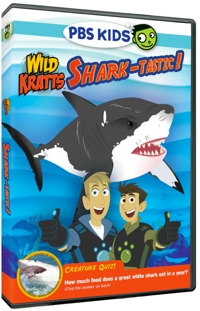
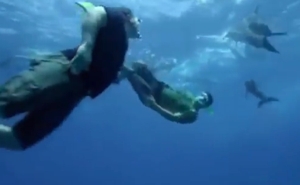
WildKrattsSharktasticscreen1First the brothers are shown live in nature or a lab and we see them engaging animals. Then there’s a segment that’s structured somewhat like the popular Magic School Bus plots. The brothers morph into animated characters and they’re off on adventures via Tortuga HQ, a sub-plane-vehicle piloted by Jimmy and computers, with communications handled by Koki. The leader of the Tortuga expeditions is Aviva, and while they’re all supposed to be in their 20s, as cartoon characters entering animal habitats to learn more about them they look a lot younger. Every outing they experience momentary danger or distress in the middle of their “schooling,” or have to do something to save the animals in one way or another. Sometimes there are villains to deal with, like Gourmand, who tries to capture a shark to make a soup. Naturally, you can’t fight villains or be scientists without gadgets and gizmos, and the ones the Kratts use most are Creature Power Suits that are powered by various Creature Power Discs that enable them to become animals that can interact with the herd, the school, the whatever.   More

MANHATTAN: SEASON 1 (Blu-ray)

Leave a comment

ManhattancoverGrade: A-
Entire family: No
2014-15, 622 min. (13 episodes), Color
Not rated (would be TV-14 for sexual situations, brief nudity, language, some violence)
Lionsgate
Aspect ratio: 1.78:1
Featured audio: English DTS-HD MA 5.1
Includes: Blu-ray, Digital HD
Bonus features: B+
Trailer/Amazon link

Fact: On August 6 and 9, 1945, the United States dropped a pair of atomic bombs—each with the force of 10 million tons of dynamite—on the Japanese cities of Hiroshima and Nagasaki, killing at least 130,000 civilians but also abruptly ending the war and its daily body count. It was a morally questionable decision then, when the U.S. was racing a team of German scientists to become the first nation to develop a nuclear weapon that would guarantee victory, and it remains so many years later.

Fact: Under the direction of Major General Leslie Groves and physicist J. Robert Oppenhemer, the Manhattan Project had components scattered across the U.S., but its main facility was located at Los Alamos National Laboratory in a remote part of New Mexico, where top minds were recruited to work on the design and construction of the bombs.

Fact: Because it was top secret, Los Alamos was never referred to by name, only as “Site Y” or “the Hill.” Recruits and their families went there with only a post office box to guide them and found a primitive, heavily restricted community of Quonset huts and wood frame buildings. The birth certificates of children born there list only P.O. Box 1663 as their place of birth.

Fiction: Manh(a)ttan, an original WGN period drama, has a Mad Men vibe to it, not only because it drops you so believably into a different era, but also because of its similar use of music and camera angles, its emphasis on old guard vs. new, and a cast of characters that all seem to face moral dilemmas. It also has a West Wing feel because of the high stakes, crisp dialogue, and scenic constructions that somehow manage to squeeze tension out of seemingly “normal” conversations. Director Thomas Schlamme is a veteran of The West Wing, and Manhattan is just as strong of a series.

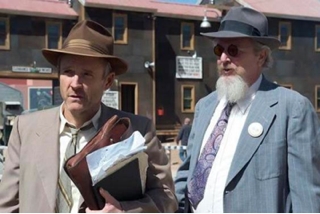
ManhattanscreenWe don’t know if it’s fact or fiction that the Army created a competition at Los Alamos between a better funded “A” team of scientists under the direction of Dr. Reed Akley (David Harbour) and a “B” team run by the maverick Dr. Frank Winter (John Benjamin Hickey). But we don’t care, because the situation itself is rooted in history and it’s believable, given the urgency of the situation and the U.S. Government’s practice of making sure that no one knows more than what their compartmentalized section is working on. Loose lips sink ships. And atomic bomb projects.

Manhattan is a taut drama because so much is in play, often at the same time. The Americans are racing the Germans and an imaginary clock, the A team of scientists is competing with the B team and their alternate vision of what will make an A-bomb work, newcomers like wiz kid Charlie Isaacs (Ashley Zukerman) are competing with jealous colleagues, the scientists are sometimes at odds with the military establishment responsible for maintaining security and secrecy, the scientists find themselves facing new tension and resentments from the suddenly bored and “captive” women they brought with them to the base, those who feel the project should forge ahead at all costs are at odds with those who want to exercise some caution because of the contaminants they’re working with, and when it’s clear that a spy is among them more tension ensues when a government official (West Wing veteran Richard Schiff) conducts his own version of a McCarthy witch hunt.   More

THE BOOK OF NEGROES (DVD)

1 Comment

BookofNegroescoverGrade: B+/A-
Entire family: No
2015, 265 min. (6 episodes), Color
Not rated (would be TV-14 for disturbing content)
Entertainment One/BET Networks
Aspect ratio: 1.78:1
Featured audio: Dolby Digital 5.1
Bonus features: B
Trailer/Amazon link 

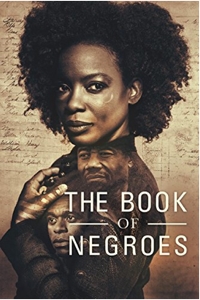
The Book of Negroes sounds like a politically incorrect Golden Book, but it was really a 150-page document recorded in 1783—a list of black loyalists who escaped being returned to slavery after the Revolutionary War because the British evacuated 3000 of them to work as freemen in their colony of Nova Scotia. In 2007, Canadian novelist Lawrence Hill tweaked and embellished that history to write The Book of Negroes, a still-cringeworthy title that was changed for U.S. audiences to Someone Knows My Name. He invented a central female character and a plot line loosely inspired by historical accounts, and Canadian director Clement Virgo adapted the book into a six-part TV miniseries that premiered first in Canada, then on the BET network in February 2015 for Black History Month.

That’s the background of this excellent miniseries, which rivals Roots for its character development, plotting, and production values. It’s a little more melodramatic than the 1977 Alex Haley miniseries and features a more upbeat (and, many would say, unlikely) story. There’s more idealism here than realism, but that also means it’s not as difficult to watch—though any depiction of slavery doesn’t exactly make for a cheery evening in front of the TV set. Still, for families who are into history and who want their children to gain some understanding of the baggage that many North American blacks carry, The Book of Negroes is a good place to start.

It covers slightly different ground, too. Roots tended to demonize whites and focus on the cruelties that the slaves had to endure and the things they had to do to survive, whereas The Book of Negroes strives for slightly more moral balance. As with every slave movie or miniseries, we see bad slave owners and good. But in Negroes the rapes and consensual sex aren’t nearly as graphic, and neither is the violence. Negroes primarily spotlights a strong heroine, whose journey we follow.   More

WITHOUT A CLUE (Blu-ray)

Leave a comment

WithoutaCluecoverGrade: B
Entire family: Yes . . . but
1988, 107 min., Color
Rated PG for some violence, smoking, and drinking
Olive Films
Aspect ratio: 1.66:1 (says the box, but it looks more like 1.85:1)
Featured audio: English DTS-HD MA 2.0
Bonus features: D (trailer only)
Trailer/Amazon link

From 1982-1987 Stephanie Zimbalist starred as the assistant to private detective Remington Steele, whom she had invented because no client would trust a female detective. He got the credit, but she was the sleuth. TV writers Gary Murphy and Larry Strawther took that concept and applied it to the world’s most famous detective, Sherlock Holmes. And TV veteran Thom Eberhardt made the leap with them to direct the 1988 PG-rated crime comedy-mystery Without a Clue.

It’s a PG-rated light comedy that tries for slapstick at times and satire other times and often gets caught in-between. The result is a kind of tongue in cheek (or maybe bubble-pipe in mouth) parody that has a warm, tea cozy feel to it.

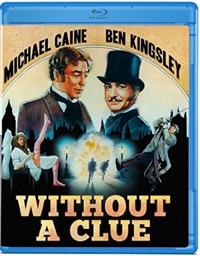
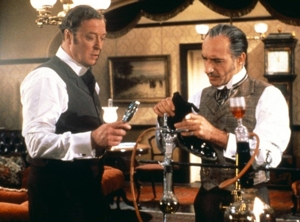
Ben Kingsley and Michael Caine make a good pair as Dr. Watson and the third-rate actor he hired to play the part of Sherlock Holmes so that he could be free to practice medicine and deduce all he wanted, without criticism or scrutiny. Of course, when you hire a bad actor it should come as no surprise that he turns out to be a ham who hogs the spotlight and has any number of habits that annoy the real detective—including drinking too much and clumsy attempts at womanizing.

By film’s end, of course, they’ll end up becoming a real team, but the fun comes from watching them get there. Without a Clue is a light mystery that features famed Holmes nemesis Professor Moriarty (Paul Freeman, who played Indiana Jones’ nemesis René Belloq) masterminding a plot to flood the market with counterfeit British money and cause the collapse of the British economy. The £5 printing plates have disappeared, and so has the printing supervisor. Scotland Yard’s Inspector Lestrade (Jeffrey Jones, who was the principal in Ferris Bueller’s Day Off) is jealous of Holmes and competes with him to solve the case, standing in the wings every time adoring reporters surround Holmes.

WithoutaCluescreenThere’s a kidnapping and several skirmishes, all of which are handled with the same light touch as elsewhere in the film. Any potential trauma from the kidnapping, for example, is muted by a comic sequence that has Holmes pinned behind the door so that all we can see is his scrunched face as he threatens to pounce on the ruffians and urges a woman to keep a stiff upper lip. A few gunfights and an explosion are the only exceptions. Otherwise, moments of tension are defused by similar humorous devices, so that there’s never much in the way of serious peril—only comic danger. There’s no language, and the only sexuality comes from the unmasking of a transvestite and a little keyhole peeping in which a woman is seen taking off stockings. Overall, it’s a relatively wholesome film that relies on some familiar, but softened elements from private detective mysteries—including a woman in distress (Lysette Anthony) and a housekeeper (Pat Keen) who sees more than anyone thinks.   More

Older Entries Newer Entries