

 Grade: B
Entire family: Yes
2014, 91 min., Color
Rated PG for mild language and thematic elements
Arc Entertainment
Aspect ratio: 16×9 widescreen
Featured audio: Dolby Digital 5.1
Bonus features: C+
Trailer
There’s always something a little hokey about movies made for children to watch with their parents—kind of like Norman Rockwell paintings that depict life, but also simplify and idealize it. There’s a cheery afterschool special tone to them that resists any comparison to reality as we know it.
Then again, when something in that facile genre gets an infusion of talent and its heart is in the right place, it’s tough to find fault.
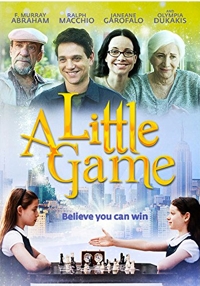
That’s how I felt watching A Little Game, which struck me as Karate Kid plays chess instead of learning martial arts. It struck co-star Ralph Macchio the same way, only in this 2014 film from Arc Entertainment he plays the dad rather than the kid in this coming-of-age story. In a bonus feature that mixes interview clips with behind-the-scenes NYC shooting footage, Macchio admits it’s just like the Karate Kid. And playing the Mister Miyagi role brilliantly is F. Murray Abraham as an irascible chess master who spends his time in Washington Park playing pick-up chess games for money. He has a background that we assume is impressive, though it’s never really stated. Like Pat Morita in Karate Kid, he also has a roundabout way of instruction that teaches his pupil as much about life as about the game itself. And as in Karate Kid, his pupil is bullied and feeling lonely and ostracized. Chess becomes a focal point that changes everything.
I know what you’re thinking. Chess??? That slow-moving Rook-to-A-3 strategy game of intellectuals that’s been around since the 6th century? Yep. Part of the fascination comes from the way that chess master Norman Wallach teaches—insisting, in true “wax on, wax off” fashion, that his pupil learn step by step and discover things in the city that will help her to understand the moves on the chess board, and part of the fun comes from Norman’s cranky personality and feisty exchanges with a precocious 10 year old whose parents let her ride the subway by herself.
I wouldn’t say that newcomer Makenna Ballard carries the film, but she co-carries it with Abraham. Without them, there’s really no interest, despite a smarter-than-usual screenplay. Without them, the minor characters stand out as stock types who function in ways we’ve seen at least a thousand times. But Ballard and Abraham’s characters are both so darned likeable and their relationship so deliciously testy that you really don’t need much else. More











 Family Home Theater