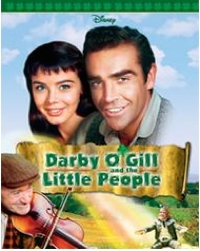
Nine years after Disney got into live-action filmmaking with their 1950 adaptation of Treasure Island, the House of Mouse scored a modest success with their 17th live-action entry, Darby O’Gill and the Little People. It wasn’t the box-office hit that The Shaggy Dog was that year, but solid enough now to appear on an IMDB.com list of “25 greatest films of 1959”—a list that The Shaggy Dog failed to make.
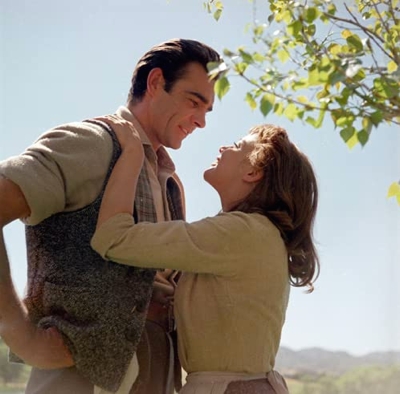
When Darby O’Gill was released, the selling point for this family fantasy-adventure was the film’s depiction of leprechauns. Now the big attraction is a very young pre-Bond Sean Connery in his first starring role in a feature film. And he sings. How’s that for a pot of gold?
Connery plays a dashing young Dublin man who finds himself in an awkward position when he is assigned by Lord Fitzpatrick to replace an old man named Darby O’Gill (Albert Sharpe) as the caretaker for his country estate in the tiny town of Rathcullen. O’Gill is a popular man in town, even though everyone laughs at his earnest stories of leprechauns and his claim to have met their king, Brian Connors (Jimmy O’Dea).
A “city” fellow is a natural disruption to local rural life, but Michael McBride finds other challenges. For one thing, there’s Pony Sugrue (Kieron Moore), a boisterous town bully who could be the prototype for Gaston in Disney’s Beauty and the Beast. A big strong man who tends to brag and mock others, Pony thinks he’s the natural choice to replace O’Gill and marry Katie, the old man’s daughter. In fact, he feels entitled. Then there’s Katie (Janet Munro), a charming young woman that Michael quickly falls for, creating a classic romantic triangle. Finally there’s O’Gill himself—a charismatic and likable old man that Michael grows fond of and would prefer not to hurt. Conflicts like these create a narrative structure that manages to entertain the adults who watch with children.
In 1987, when I interviewed David Zucker—one of the trio responsible for inflicting non-stop gags on movie audiences in such zany satires as Airplane! and The Naked Gun— Zucker, brother Jerry, and Jim Abrahams were basking in the success of Ruthless People. But they were also thinking a great deal about what made Airplane! a run(a)way success and wondering why Top Secret!and their short-lived Police Squad TV series weren’t as popular with audiences.
Cult favorite “The problem with Top Secret! was that the story wasn’t strong enough, even though the jokes were probably funnier than Airplane! or Ruthless People, and many of the scenes were far more clever,” Zucker said. “We were very much in tune with the jokes, but the characters weren’t very well-developed. We just used them to spout these jokes. The other thing is, it really wasn’t a readily identifiable concept. The idea of a rock ‘n’ roll singer who goes to East Germany to fight what seem to be Nazis is kind of an esoteric concept. It was surrealism, and intended to be surrealistic”—which is why Top Secret!, though not a mainstream hit, has achieved a kind of cult status among comedy fans who relish the trio’s mind-boggling juxtapositions and the way the actors somehow manage to maintain deadpan faces as they deliver those deliciously funny lines. As Zucker explained, “With our style, the writers are the funny characters. When people watch our movies, they’re aware that somebody had to write this stuff.”
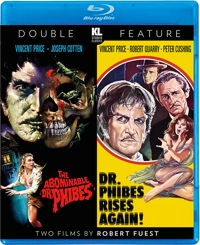
The Abominable Dr. Phibes (1971) and its sequel, Dr. Phibes Rises Again (1972), are cult films—but that doesn’t automatically mean they’re not suitable for family viewing. In the case of this double feature—available now on Blu-ray from Kino Lorber—there’s far less violence, sex, and jump-scares than in contemporary horror films (see the trailer). But these are definitely cult classics, which is to say that they’re not mainstream popular.
For me, a cult classic is defined by a string of “usuallys”: Usually it’s a low-budget B-movie, one that courts in-your-face difference and has an air of scandal or controversy about it, often with acting and a script that make you wonder if it’s unintentionally bad or bad for the purpose of being campy. Rarely is a cult film deadly serious, but most of the time there’s a “weird” factor. In part they’re also defined by their audiences, who celebrate “getting” the film when others don’t, and whose embrace can be exuberant, if not obsessive.
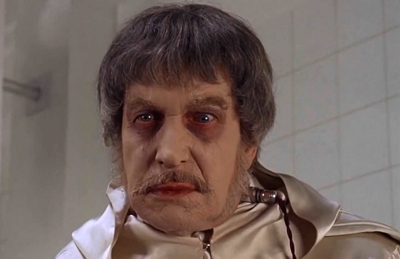
When it was first released, Dr. Phibes nudged viewers toward a cult film mindset just by featuring Vincent Price, who had built up a following as the star of campy director Roger Corman’s B-movie adaptations of Edgar Allan Poe horror stories. Price’s silky villainous voice and stage-actor mannerisms in those films had already earned him cult status—something that would continue throughout his career, whether he was featured in The Brady Bunch Hawaii episodes and the beach-party film Dr. Goldfoot and the Bikini Machine, embraced by Tim Burton for two films (Vincent and Edward Scissorhands), enlisted by Michael Jackson (“Thriller” song/video) and Alice Cooper for musical gigs, celebrated in song by Deep Purple and ZZ Top,or parodied on The Simpsons and SNL.
Well, it’s out: Spider-Man’s identity and the film that almost wasn’t, now available on home video.
Spider-Man: No Way Home (2021) almost didn’t happen because of corporate greed, but ironically ended up making more money than ever for Sony and Marvel-Disney, who couldn’t come to an agreement over future Spider-Man movies. Fan backlash sent them back to the negotiating table, and the resulting sequel to 2019’s Spider-Man: Far from Home became the highest grossing Spider-Man film and sixth-highest grossing film of all time.
No Way Home also got the highest ratings from critics and fans on Rotten Tomatoes, with 93 percent of critics and 98 percent of audience members loving it—better, even, than fan favorite Spider-Man 2 (2004) featuring Doc Oc.
See? Good things happen when you play nice and listen to fans. But it’s next to impossible to keep a secret from them. Word leaked that somehow previous Spider-Men Tobey Maguire and Andrew Garfield would be involved.
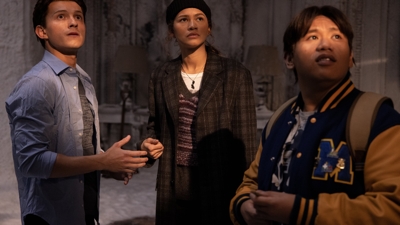
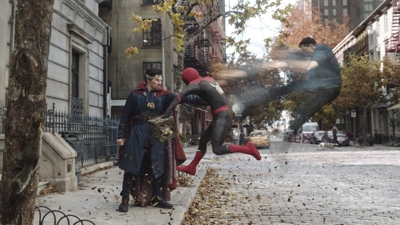
Writers Chris McKenna and Erik Sommers had taken inspiration from It’s a Wonderful Life, where a wish provided the basis for the plot and a domino chain of revelations. Far from Home ended with Spider-Man’s identity exposed and reputation destroyed. The writers decided to have him do what any young and still immature adult would do: wish it away. Peter Parker (Tom Holland) asks Dr. Strange (Benedict Cumberbatch) to use his magic to make everyone forget Spider-Man’s identity so things can return to normal. But because he keeps tinkering with the spell by adding people he wants to still remember him—girlfriend MJ (Zendaya), best friend Ned (Jacob Batalon), and Aunt May (Marisa Tomei)—the spell goes awry. The multiverse breals open, and visitors good and bad enter his universe.
McKenna and Sommers wrote the screenplay before Maguire and Garfield even agreed to participate. But their wishful thinking paid off. Fans have debated who’s the best, as they have with Bond actors. Dropping all three into the same film was pure genius—and it’s not just fan-candy or a curtain-call film. There’s actual chemistry among the three, and it’s fun seeing them not only work together as superheroes and compare powers, but also reference their own films.
There’s consistency, too, because Jon Watts—who directed the first two films starring Holland—is also behind the camera for this one. The light touch that’s been a part of his sensibilities is here in triplicate, and that’s good news for families. When the tone is light and there are moments that spark laughter, it tends to balance the fantasy-adventure violence and traumatic moments, sending a message to young viewers that this is first and foremost a fun ride. Enjoy it. Although a beloved character does die and there’s some blood, stabbing, and serious punching, the “reunion” aspect of former villains and heroes entering the current Spider-Man universe takes a little off the edge of the violence.
No Way Home earned an Oscar nomination for its special effects, and apart from a sequence involving power lines in a forested area that looks very much like it was shot using miniatures, I can see why. The complicated Tetris-like shifting of the urban landscape completely suggests a universe that is fracturing, and the portals that lead from one universe to the next are rendered convincingly. The film’s budget was estimated to be a whopping $200 million, but the opening weekend box office alone was $260 million in the U.S. and Canada.
Just one question: When a superhero fall, lands, or finds their footing again, is it deliberately campy that every single time they assume that low-crouch, one-hand-on-the-ground superhero pose? And how long will it take Disney to realize that they can build a fun theme-park attraction for fans if they have people take turns assuming the pose in front of a green screen so they can see themselves in a finished shot with background added?
Entire family: No (age 8 and older?) Run time: 148 min. Aspect ratio: 2.39:1 widescreen Featured audio: DTS-HDMA 5.1 Studio/Distributor: Columbia Pictures/Pascal Pictures/Marvel Studios Bonus features: B Includes: Blu-ray, DVD, Digital Code Trailer Amazon link Rated PG-13 for sequences of action/violence, some language, and brief suggestive comments
Language: 2/10—A few of the characters use the “s” word and there might be a few other lesser profanities, but no f-bombs
Sex: 1/10—Chaste as can be, with a few kisses plus an instance where a man is shown from the torso-up saying “I’m butt-ass naked”
Violence: 6/10—Punching, pummeling, explosions, and superhero-villain battling, but not much blood except for one emotional scene
Adult situations: 2/10—Really, all Marvel Universe films are adult-world films that kids have been a part of since the comic books first appeared, but in this one there are no drugs and the only scene that has anything close to drinking is an end-credit scene set in a bar
Takeaway: The ending sets up fourth film, but thus far nothing is in pre-production
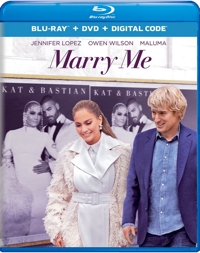
If you and your family are suckers for feel-good romantic comedies that follow the rom-com formula to the first 10 digits of pi, you might think about adding Marry Me to your home video collection. This far-fetched but cute 2020 movie pairs a low-key junior high math teacher with a pop superstar that’s way out of his league.
How far out?
Jennifer Lopez plays the sexy performer Kat Valdez, who is known and loved worldwide, while Owen Wilson is meek and nerdy math teacher Charlie Gilbert, the custodial single parent of a junior-high age daughter named Lou (Chloe Coleman). The idea of a romance between a celebrity and an average person no doubt stems from those happily-ever-after fairy tales about commoners marrying a prince . . . or beauty marrying a beast. Here Wilson is the common “beast,” and that’s not just me throwing shade. There are more than a few jokes in the film about the disparity in their looks and appeal.
Instead of a “meet cute” there’s a “marry cute.” Charlie reluctantly agrees to go to a Kat Valdez concert with his best friend/co-worker (Sarah Silverman) and daughter to prove he’s a cool dad. It’s the hottest ticket in town, as the whole world is talking about the hit song that Valdez made with Latinx heartthrob Bastian (Maluma). At this concert, in front of 5000 fans and 20 million people watching on TV, the couple will perform the song live and then get married onstage.
But as Parker hands Charlie her “Marry Me” sign to hold while she takes a few photos, everyone in the room begins gasping and looking at their phones. They’re looking at film of Bastian “canoodling” (we have to bring that word back!) with Valdez’s assistant. Ouch. Valdez not only stops the concert; she talks about breaking patterns and taking a leap of faith. Seeing Charlie in the first few rows with his “Marry Me” sign she declares, “Yes. I’ll marry . . . YOU.”
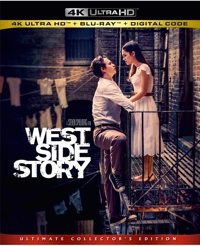
In 1961, the average American couldn’t go to see a Broadway show. But they did go to movie theaters in droves, and West Side Story was a blockbuster of a movie that surprised audiences with gang members who danced and sang in an updating of Shakespeare’s Romeo and Juliet, set in then-contemporary New York City and featuring two warring gangs instead of feuding families. The Robert Wise-directed film received 11 Oscar nominations and won 10 of them, including Best Picture, Best Director, Best Music, Best Color Cinematography, and Best Supporting Actor/Actress.
So why would anyone even consider remaking a film so lauded and beloved? On one of the 90 minutes of bonus features on this 4K/Blu-ray release, Spielberg provided an answer—several of them.
First, Spielberg said he was not remaking a film. He was making a second film version based on the 1957 Broadway play. He reasoned that if West Side Story has been performed all over the world with different casts, why couldn’t there be a second film version?
Second, he was personally motivated. Spielberg said West Side Story was the first Broadway music he was exposed to at age 10, and that he basically “commandeered” the album his parents had bought. He loved it, and it spawned in him a love of musicals. As a result, Spielberg said that all his life he’s wanted to make a musical version of West Side Story.
A third and most compelling reason didn’t come from Spielberg. It came from my college-age daughter, who, since the film’s release, has been re-watching it and playing the songs constantly. She and many of her friends liked the music and some of the dancing from the first film version, but they weren’t exactly crazy about the characters or the narrative.
Enter Spielberg, who pinpointed the biggest difference between his new film version and the original: the 1961 film was a hybrid—part cinematic and part theatrical. He wanted to create a film that was more fully cinematic, and to do that he had to push it away from the theatrical and make it more realistic. He had to push it away from the moist-eyed spotlight solos sung in private or in closed spaces and open it up to where they were sung with active movements (and reactions) on the streets of New York. He also added small touches of realism throughout the film and created a narrative based on logic rather than the limitations of stage.
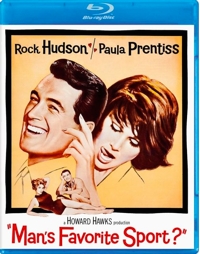
When Man’s Favorite Sport? was first released, film critic and cinema snob Andrew Sarris called it “a complete waste of time,” and it’s been underrated ever since. Still, Man’s Favorite Sport? finished among the 25 highest grossing pictures of 1964, so average viewers liked it well enough. It was a simple and silly diversion at a time when the country was recovering from the assassination of President Kennedy.
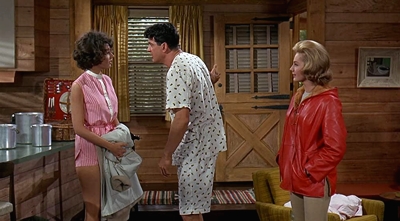
It was also one of my favorite rom-coms that I watched growing up, so kids also liked it well enough. In the late ‘50s and early ‘60s, rom-coms were typically bedroom romps set in cities. Man’s Favorite Sport? takes place mostly in the woods by a lake, and the plot revolves around an Abercrombie & Fitch fishing expert that’s forced to enter the annual tournament at Lake Wakapoogee . . . though he’s a big fake who’s thrown many a line but never wetted one. The attraction for younger viewers—at least back then—were such non-rom-com gags as a black bear mucking things up (even riding a scooter at one point), inflatable waders that overinflate, a running gag about a toupee that looks alive, a campsite that floats away in a storm, and plenty of accidental fishing catches played for laughs.
Nearly 30 years after his quintessential screwball comedy Bringing Up Baby, Howard Hawks decided the first of three pictures he agreed to do for Paramount would be a broad romantic comedy that paid homage to his earlier classic. It would turn out to be the legendary director’s fourth-to-last film, and his last comedy. Although Rock Hudson is no Cary Grant (Hawk’s first choice), Paula Prentiss turns in a screwball performance worthy of Katharine Hepburn herself. In fact, she’s less annoying than Hepburn’s character and her deep voice and mischievous actions were a welcome change from the high-pitched, quasi-innocent Doris Day characters.
Prentiss plays Abigail Page, a PR director for a big resort on the lake, and throughout the film her sidekick is the resort owner’s grown-up daughter, “Easy” Mueller (Maria Perschy). From an opening meet-cute involving a car and a parking space that pays obvious tribute to Bringing Up Baby, the fast-talking, insecure, but determined Abby spends most of the film trying to help Roger Willoughby (Hudson) once she learns his secret . . . and trying to help herself to Willoughby in the process. Call her a more competent and less ditzy version of Hepburn’s character, while Hudson is a more befuddled and expressionless version of Grant’s exasperated character.
I love movies. Sometimes it’s love at first sight. It was that way in 2018 when I first saw Alfonso Cuaron’s Roma, and it happened again a year later with Taika Waititi’s Jojo Rabbit. Now I feel the same way about Kenneth Branagh’s Belfast, and it makes perfect sense: Belfast feels like a cross between those two films.
Like Roma, Branagh’s film is a loving, artsy, cinematic tribute to his home city. Filmed for the most part in black and white to feed the nostalgia, it begins in color with spectacular shots of Belfast that put to shame anything a tourist bureau could pay an advertising company to design. And soulful, start-to-finish songs by Van Morrison—arguably Ireland’s best export since pubs—help to create the deeply profound outpouring of love you feel when you watch this film.
Like Jojo Rabbit, this 2021 film also manages to combine a serious topic with humor and quirky, endearing characters—a feat accomplished, in part, because the story is largely told from the point of view of an exuberant nine year old who doesn’t quite understand everything that’s going on. There’s a boyish fantasy, an imagination at work here too that suggests the amalgam of cultural images that’s rattling around inside his head and helping to shape his world view. That’s evident just from looking at the covers of the Blu-rays, with Waititi’s and Branagh’s young boys soaring above the ground like figures in a Marc Chagall painting. Buddy’s world view is also influenced by pop culture, including American Westerns that the boy watches with extended family—intended by Branagh as a thematic and structural parallel.
In Belfast, our first glimpse of Buddy (Jude Hill) is of him playing in the streets with the other kids as parents watch or dance in the street to a phonograph record. Some children are jumping rope or playing soccer, but others, like Buddy, are having a mock battle, with Buddy wielding a homemade gladiator-style sword and garbage-can lid shield. That play gets real really fast, as a gang of Protestant thugs shows up at the end of this cul-de-sac neighborhood—one Branagh depicts as loving and communal—and starts hurling Molotov cocktails and rocks, bashing windows, and threatening people. So much for nostalgia. So much for an idyllic childhood, as Buddy needs to be rescued by his mother (Caitríona Balfe), who uses his shield not for play but to protect both of their heads from rocks and missiles.
Ghostbusters: Afterlife (2021) is the kind of film that unapologetically panders to fans of the franchise. Dedicated to the late Harold Ramis, this fourth incarnation features nostalgia-inducing cameos by stars of the original 1984 smash hit: Dan Akroyd, Bill Murray, Ernie Hudson, Annie Potts, and Sigourney Weaver.
That original cast appeared in a slightly disappointing 1989 sequel, but was absent in the polarizing 2016 all-female reboot starring Melissa McCarthy, Kristen Wiig, Kate McKinnon, and Leslie Jones.
Ghostbusters: Afterlife seems aimed at an audience of both fans who have felt like the franchise owed them one and fans of child-centered mystery-drama-adventures like TV’s Stranger Things or the newer Jumanji films.
So who ya’gonna call to direct a heavily nostalgic picture that aims to please both old and young viewers? How about Jason Reitman (Juno, Thank You for Smoking), son of Ivan Reitman—the man who directed the first two Ghostbuster films.
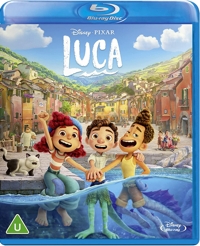
Since Pixar was acquired by Disney in 2006, the look and sensibility of the studio’s films have changed to the point where you have to read the credits to tell if it’s a Pixar or Disney film. Cases in point? Brave had all the earmarks of a Disney princess film set in Ireland, but it was produced by Pixar. Coco (2017) and Encanto look like they were cut from the same cloth, but Pixar did the scissoring on the former title and Disney the latter. Wreck-It Ralph (2012) felt like a Pixar film, but it came out of Disney animation studios.
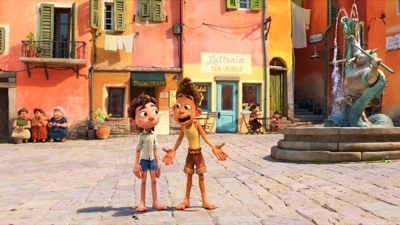
Now we get Luca, a 2021 film that, under the direction of Enrico Casarosa, does for the Italian Riviera what Pixar’s Ratatouille did for Paris: it celebrates the landscape and the culture in a loving tribute, while focusing on a duo that hides a secret and goes against the social grain. Fans of the 1984 live-action Splash—starring Tom Hanks as a young man who has a close encounter with mermaid Daryl Hannah—might also see a few similarities.











 Family Home Theater