Home

CINDERELLA (2015) (Blu-ray combo)

Leave a comment

CinderellacoverGrade: A-/B+
Entire family: Yes
2015, 105 min., Color
Disney
Rated PG for mild thematic elements
Aspect ratio: 2.39:1
Featured audio: English DTS-HDMA 7.1
Bonus features: B+
Included: Blu-ray, DVD, Digital HD
Trailer
Amazon link

Only Disney would have the audacity to attempt a live-action remake of an animated classic, and to play it fairly straight as a romantic drama—with even less comic relief than the original. And only Disney could pull it off.

Everyone knows the story of Cinderella, so it’s really a matter of how the story is told. I think the studio made the right call. They decided to craft an origin story: to fill in the information gaps, to flesh out the characters, and to focus on the romance. The devil is in the details, but details—and devilish characters, for that matter—have always been Disney’s strong suit. Cate Blanchet plays the stepmother with the same complexity as Angelina Jolie’s Maleficent, the backgrounds are as striking as anything you’ve seen in The Lord of the Rings trilogy, and the interiors of this live-action feature rival what we saw in Disney’s animated Beauty and the Beast. I wouldn’t say the CGI elements are seamless—you can certainly tell that the lizards and mice are computer-generated—but they’re cute as the Dickens.

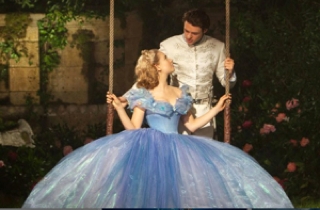
Scottish actor Richard Madden (Klondike, Game of Thrones) plays the Prince, but Lily James (Downton Abbey) is even more charming as Ella, nicknamed “Cinderella” by her stepmother after she’s found lying next Cinderellascreen1to the hearth to keep warm. It’s easy to become as captivated by Ella as the Prince is, enthralled by her fresh optimism and live-by mantra: to have courage and to be kind. In other words, Cinderella has an inner strength and beauty to complement her physical good looks, and Disney drives home the point that what’s inside matters more. The screenwriters also are mindful of the Disney princess “brand” as they suggest that while little Ella wasn’t royalty, she was a princess to her mother and father, who loved her very much. And Disney being Disney, death is handled matter-of-factly. “Way of all flesh, boy,” a dying father tells his offspring.
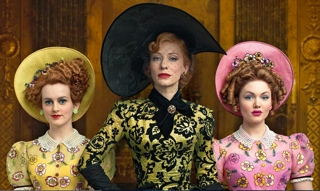
If there’s a surprise, it’s that the live-action stepsisters (Sophie McShera, Holliday Grainger) aren’t as broadly comic as they’re often played, and that the fairy godmother is played a little more comically by the incomparable Helena Bonham Carter, who has as much fun with this role as she did playing Disney’s Red Queen in the live-action Alice and Wonderland.
Cinderellascreen2In this version of Cinderella there’s much more development of the Prince and his relationships. We see him interacting with a captain of the guard (Nonso Anozie), a manipulative Grand Duke (Stellan Skarsgard), and his father, the King (Derek Jacobi). Collectively those interactions make the pair’s coming together more satisfying, and more than anything else the live-action Cinderella is a grand romance that does for this fairy tale what Neuschwanstein Castle—the inspiration for Disney’s theme-park castles—did for all of them: it celebrates the magic, the majesty, and the happily-ever-after ending that everyone, deep down inside, still craves.

The characters, the story, and the wonderful details will make this a repeat play, no matter how familiar it is. Don’t hesitate to add it to your collections. You may know the story, but, like Hoosiers, it’s somehow rousing every time you watch. Get it in Blu-ray combo pack to enjoy a flawless and room-filling DTS-HDMA 7.1 soundtrack (which, surprisingly, is song-free except for one number that Ella and her mother sing) and a gorgeous-looking 2.39:1 widescreen presentation that really pops in HD.

Language: n/a
Sex: n/a
Violence: None, really
Adult situations: Characters die off-screen
Takeaway: Disney is still king when it comes to bringing grand romances and fairy tales to life on the big screen.

THE CAROL BURNETT SHOW: THE LOST EPISODES (DVD)

Leave a comment

CarolBurnettShowcoverGrade: B+
Entire family: Yes, but…
1967-73, 1255 min. (16 shows), Color
Time Life/StarVista
Not rated (mostly G, some PG sketches)
Aspect ratio: 1.33:1
Featured audio: Dolby Digital 2.0
Bonus features: B+
Includes: 6 discs, color booklet
Amazon link

The Carol Burnett Show is a tough one to review because it’s a variety show, and that brand of television is nearly extinct—TV-land’s dinosaur. It’s like trying to assess a pterodactyl, even though this particular old bird won 25 Emmys, eight Golden Globes, and three People’s Choice Awards.

Now TV is dominated by reality shows and snarky talk and news shows, but during TV’s golden age the variety show was king. The Ed Sullivan Show, which ran from 1948 to 1971, preserved the vaudeville format almost exactly, televising animal acts, circus acts, magicians, mind readers, musical acts, dancers, musical acts, and comedians. But it was Sid Caesar in Your Show of Shows (1950-54) and Caesar’s Hour (1954-57) who pioneered sketch comedy as the meat-and-potatoes of future variety shows, and that’s the direction that Carol Burnett took.

The Carol Burnett Show ran for 11 seasons, tying her with Milton Berle for eighth all-time among variety shows, and it was as popular as TV gets. But to watch her show now just isn’t the same as watching it then. So many of the sketches were parodies of TV shows, movies, and commercials, and topical humor loses its edge. Plus, as SNL fans know, sketch comedy is hit or miss. Amazingly, many of the sketches in this six-disc collection still work. In fact, I’d say that there are more “hits” here than the current SNL group manages to muster in an average week.

“Interactive” is a big buzzword now, but Burnett interacted with her audience from the time her show debuted. Instead of doing a monologue, Burnett strode out onto the stage and took questions from the audience for a full three to four minutes. Sometimes she was quick to crack jokes, while other times the questions prompted more serious responses. But can you see a studio allowing a live audience to interact with stars today? Stars would be a nervous wreck, and network honchos would be that times 10. So it’s a fascinating part of every show, and half of Burnett’s weekly traditions.

As for the other half, Bob Hope had his “Thanks for the Memories” theme, and Burnett often closed her shows by singing the words to her own theme song:

I’m so glad we had this time together
Just to have a laugh or sing a song
Seems we just get started and before you know it
Comes the time we have to say, So long.

CarolBurnettShowscreenIn between there was song and dance and performing guests. But anchoring the show were the comedy sketches, starring, at first, Burnett, Harvey Korman, Vicki Lawrence and Lyle Wagoner, and later Tim Conway, after Wagoner left the show to do “Wonder Woman.” Guest stars got in the act too, and the talents on these 16 episodes are Chita Rivera, Bob Newhart, Don Rickles, Mel Tormé, Nanette Fabray, Jim Nabors, Bing Crosby, Paul Lynde, Tim Conway, Eydie Gorme, Burt Reynolds, Lesley Ann Warren, Don Adams, Lucille Ball, Bobbie Gentry, Phyllis Diller, Gwen Verdon, Nancy Wilson, Andy Griffith, Bernadette Peters, Cass Elliot, Flip Wilson, Vicki Carr, Carol Channing, Steve Lawrence, Jack Jones, and Ruth Buzzi. I suspect that the more of these celebrities you recognize, the more likely you will be to appreciate The Carol Burnett Show. It’s suitable for families, but children and a new generation of viewers may find the musical numbers especially dated, though the sketches are still funny, and Burnett is as likable as ever.   More

THE HEE HAW COLLECTION (DVD)

Leave a comment

HeeHawcoverGrade: B/B-
Entire family: Yes
1969-71, 369 min. (5 episodes), Color
Not rated (would be G despite some innuendo)
Time Life
Aspect ratio: 1.33:1
Featured audio: Dolby Digital 2.0 Mono
Bonus features: B-
“Pfft You Was Gone” clip

The hay-day (sorry, bad pun) of rural comedy on American TV was between 1960, when The Andy Griffith Show debuted, and 1971, when all of them were put out to pasture. The novelty of The Beverly Hillbillies, Petticoat Junction, Gomer Pyle: USMC, Green Acres, and Mayberry R.F.D. had worn off, so it was no surprise that in 1971 CBS also cancelled Hee Haw—a country version of Rowan & Martin’s Laugh-In.

But like the Grand Ole Opry, this corny variety show, which debuted in 1969 and featured a group of talented regulars and some of the top country stars of the time, had a life of its own. It became an institution, going into syndication and lasting nearly another 20 years.

Hee Haw managed to have it both ways, featuring characters and jokes that celebrated rural life, but also poked fun of rural stereotypes. You’ll see nostalgic, folksy segments that lament the loss of cracker barrel philosophers, with Archie Campbell playing a barber and regaling customers with stories, Grandpa Jones and Junior Samples doing the same at Gordie’s General Store, or Stringbean reading a letter from home. Always it was a tall tale modernized or a long simmering lead-in to a corny punch line. Yet there were also recurring segments featuring not-too-bright farmer’s daughters in short-shorts or the country equivalent of mini-dresses, and a recurring sketch about barefooted moonshiners in overalls lying in the front yard next to a jug and a bloodhound. In fact, Junior Samples, with his slow-witted and deliberately speaking persona, was the anti-sophisticate, and darned proud of it. Put Junior in a Shakespeare sketch (as they often did) or making a used car commercial and it was instant laughs.

Hee_HawLaugh-In was hosted by a comic duo. Hee Haw’s hosts were musicians first and comedians second, which fit the corny concept just fine. Roy Clark, best known for his instrumental work on banjo, guitar, and mandolin, first appeared on the Grand Ole Opry at the age of 17. Buck Owens was a popular country singer and band leader whose best-known songs were “Act Naturally,” “Together Again,” and “Tiger by the Tail.” The pair appeared to have fun together and provided the perfect anchor for a boatload of sketches and musical numbers. Buck and Roy started each show with a rendition of “Hee Haw” and at some point did a vaudeville-style routine called “Pickin’ and Grinnin’” that strung jokes together with musical riffs. They also did at least one solo per episode.

Though the humor could be adult, the show was obviously intended for families because kids were included in some sketches and the show relied on animated farm animals to add to the laughs. One minute the audience could be enjoying some serious guitar-playing from Clark, and the next minute a chorus line of pigs would be dancing across the screen while he’s playing, lightening the mood.  More

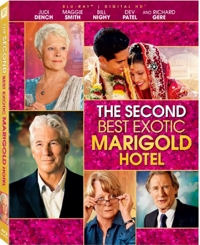
THE SECOND BEST EXOTIC MARIGOLD HOTEL (Blu-ray)

Leave a comment

SecondBestExoticcoverGrade: B-/C+
Entire family: Yes, but….
2015, 122 min., Color
Rated PG for some language and suggestive comments
20th Century Fox
Aspect ratio:
Featured audio:
Includes: Blu-ray, Digital HD
Bonus features: C+
Trailer
Amazon link

The Best Exotic Marigold Hotel (2012) was a surprise hit because it hit home with its basic messages. A group of older British retirees traveled to India because of a brochure that glamorized The Best Exotic Marigold Hotel and made it look like the ideal place to retire, to find a replacement husband, or to stay there while getting a hip operation. Unknown to each other, they discovered things in common; foreign to India and some of them suspicious or awkward, they found an appreciation for a different culture and a level of comfort; and feeling a little tired and depressed by their late stage of life, they found some measure of renewal by their association with the hotel’s optimistic and energetic young owner. It was a feel-good movie about growing old, and there aren’t many of those around.

But The Second Best Exotic Marigold Hotel (2015) is a sequel that really didn’t need to be made. Missing is the charm and freshness of the first film, replaced by a formulaic plot and a paucity of humor, with a running gag that’s a 180-degree turn from the positive attitude toward aging that we encountered in the first film. In the original, one of the residents died, but what kind of tone does it set when in the sequel the proprietor, Sonny (Dev Patel), begins each morning with a roll call so the residents can answer . . . and let him know they’re still alive?

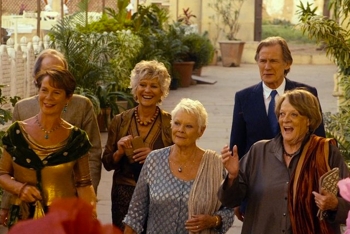
Two standard plot devices that we’ve seen before drive the narrative: a wedding and an anonymous visiting inspector who will decide whether Sonny can create a second hotel. Sonny is finally marrying the love of his life, Sunaina (Tina Desai), and there are some song-and-dance numbers SecondBestExoticscreenthat liven up the film. As with the first, each character has a subplot. Evelyn and Douglas (Judi Dench, Bill Nighy) are now working and fully immersed in local culture and finding occasional times to date each other. Carol and Norman (Diana Hardcastle, Ronald Pickup) are learning how to be exclusive to each other, while Madge (Celie Imrie) still plays the field and juggles two wealthy suitors. Somewhat lost in the shuffle is Muriel (Maggie Smith), who has been named co-manager of the hotel and seems to exist only as a confidante for everyone else. Meanwhile, there are two new arrivals (Richard Gere, Tamsin Greig) and only one nice room, and of course one of them is thought to be the inspector. Another sideplot about a business rival seems thrown in for good measure.

More than in the first, the screenplay feels like a paint-by-numbers affair, but the acting and the characters remain strengths. Patel is as energetic as a stand-up comic, and his onscreen mother (Lillete Dubey) gets something fresh to do as the object of Gere’s attentions. As with the first film, India itself is really the most colorful draw, and if you want to make a pilgrimage you can visit the Pearl Palace Heritage Guesthouse in Jaipur, where Second Best was filmed. But the movie truly is “second best,” which is not an uncommon thing for sequels. I was charmed by the first film, yet as much as I wanted to like this one I found it slightly dull. So did my family.

Language: some mild swear words
Sex: n/a
Adult situations: n/really
Takeaway: No matter what your age, after watching this film or the first you’ll dream of going to India.

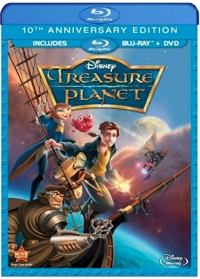
TREASURE PLANET (10th Anniversary Edition) (Blu-ray Combo)

Leave a comment

TreasurePlanetcoverGrade: B
Entire family: Yes
2002, 95 min., Color
Rated PG for adventure and peril
Disney
Aspect ratio: 1.66:1
Featured audio: English DTS-HD MA 5.1
Includes: Blu-ray, DVD
Bonus features: C+
Trailer
Amazon link

Pirates in space?

Why not? But Treasure Planet is a strange combination of futuristic space age, recent pop culture, and 17th century elements. The plot and characters have one foot in the past and one in the future. It’s the same with visual design. Ships that look like Spanish galleons fly in the air. Whales fly. Jim Hawkins, the lad at the center of this Robert Lewis Stevenson adaptation, has a solar board and rides it like a skate punk or parasailor. And the architecture? It’s like Tortuga in space. Disney was trailblazing in its combined use of 2D and 3D animation, and the results are stunning to look at. But the past-and-future mix doesn’t work nearly as well when it comes to content.

Fans of Disney’s live-action Treasure Island may be disappointed that the spaced-up version has more breakneck action and not nearly the intrigue of the 1950 classic. What’s more, Robert Newton carried the old film as Long John Silver, playing just the right blend of a benign old peg-legged pal who fascinates Jim Hawkins, and a menacing fellow with a hidden agenda—a blackguard who could be ruthless when the time came.

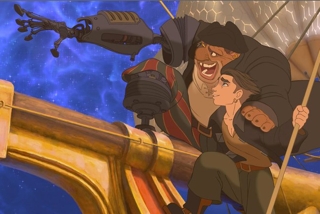
We don’t get that same type of character in Treasure Planet’s John Silver, who’s a menacing looking cyborg from the start. His face is drawn a little like Fagin from Oliver & Company, but fuller and meaner. And he’s armed with a gadget that slices, dices, shoots, and scares the heck out of everyone. There’s only menace in this fellow, so he’s nowhere near as interesting as Newton was in the more complex live-action role.

TreasurePlanetscreenBut fans of Stevenson’s novel will at least have fun picking up plot points and variations. In this animated version from directors Ron Clements and John Musker (Aladdin, The Little Mermaid), Jim Hawkins (voiced by Joseph Gordon-Levitt) is a bit of a delinquent at a crossroads. His mother (Laurie Metcalf) runs the Benbow Inn, and the adventure begins when Jim finds a dying pirate named Billy Bones (Patrick McGoohan) and brings him back to the Inn. In short order, the pirate is dead, Jim is holding an orb the size of a grapefruit and told to “beware the cyborg,” and pirates are ransacking and torching the place, forcing Jim, his mom, and a family friend, Dr. Doppler (David Hyde Pierce), to flee.

As in the book, Silver (Brian Murray) and his crew keep their identities secret and hire on as hands on a mission to follow the orb-map to Treasure Planet . . . which is curious, since their own planet, Montressor, is French for basically the same thing. Oh well.

Unlike the 1950 film, this souped-up, spaced-out version drags a little, despite the action, because the characters and their relationships are more superficial. Take Ben Gunn, for example. Instead of a lunatic who’s been away from people for too long, it’s an annoying robot named B.E.N., who’s supposed to provide some of the comic relief. The rest comes from the doddering Dr. Doppler, a dog creature with an obvious fondness for the catlike ship’s captain (Emma Thompson), and a little thing that looks like one of those goofy, unidentifiable things that Olympic cities present as mascots. Morph (Dane A. Davis) is a shape-shifting blob of pink mass that perches on Silver’s shoulder, like a parrot. But I’ll take the parrot any day.

So what does that leave us with? The stunning art and animation. Andy Gaskill worked as a visual development artist on The Little Mermaid, and, promoted to art director, he oversees a crew that creates frame after frame and sequence after sequence of breathtaking art design and animation. The palette is largely orange and brown, and yet there’s plenty of visual pop. Only in a few scenes do we get grain and a soft image.

Given the artwork, if a better character had been inserted than the one-dimensional cyborg Silver, we’d be talking about Treasure Planet as another Disney classic. As is, it’s still a stirring animated adventure with near non-stop action that can be shelved in the “underappreciated Disney” category.

Language: n/a
Sex: n/a
Violence: The usual peril and fighting
Adult situations: Several deaths of minor characters
Takeaway: Disney’s adaptations continue to be inventive, if not always successful at the box office. And Treasure Planet deserves a second life.

CURIOUS GEORGE 3: BACK TO THE JUNGLE (DVD)

1 Comment

CuriousGeorge3coverGrade: B+/A-
Entire family: Yes, but ….
2015, 81 min., Color
Rated G
Universal
Aspect ratio: 1.78:1
Featured audio: Dolby Digital 5.1
Bonus feature: C-/D
Trailer
Amazon link

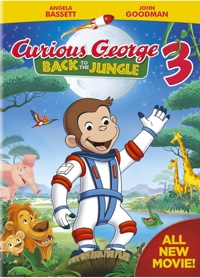
After a disappointing Curious George 2: Follow That Monkey and a relatively pedestrian Curious George Swings into Spring, executive producers Ron Howard and Brian Grazer have given this popular children’s book character the kind of animated adventure he deserves. Curious George 3: Back to the Jungle may be better than the original Curious George theatrical release, and that’s quite a compliment for a direct-to-DVD release.

This outing, George (voiced by animated voiceover genius Frank Welker) is recruited by a space program run by a man named Houston (John Goodman) to fly into space to link a gizmo to a satellite and then return to Earth with it so that the gizmo can be installed in Africa to prevent flooding. And yes, we do get the line, “Houston, we have a problem.” So while the previous two Curious George films were aimed directly at preschoolers and everyone else be gosh-darned, this time there are a few more embedded allusions to entertain the older siblings and parents who watch with them.    More

THE BLACK STALLION (Criterion) (Blu-ray)

Leave a comment

BlackStallioncoverGrade: B+
Entire family: Yes, but . . .
1979, 117 min., Color
Rated G
Criterion Collection
Aspect ratio: 1.85:1
Featured audio: DTS-HD MA 2.0 Surround
Includes: 17×11 color poster, five short films by Ballard
Bonus features:  B-/C+
Amazon link

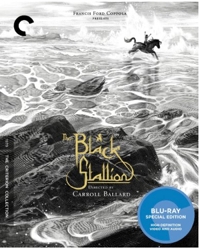
The Black Stallion—at least the 1979 adaptation that Francis Ford Coppola “presents”—is an interesting hybrid. It’s part family movie and part indie/art house film. Director Carroll Ballard takes the 1941 book for young readers and infuses the story of a boy and a wild horse who “save” each other with indie film sensibilities and art-house cinematography.

The result is a film that’s obviously made for adults but suitable for children. There are a few less warm fuzzies and sappy moments in this hybrid (a good thing!), though the pacing in the first act might seem a bit too leisurely for the youngest viewers. There’s not much you can do for them except to assure them that the action picks up, but older children who squirm can be shown the luxurious cinematography from Caleb Deschanel (Zooey Deschanel’s father), with breathlessly original shots and angles and the space for those shots to breathe and expand in our consciousness.

BlackStallionscreen1Ballard isn’t quite as lavish with his plotting and narrative. Some directors like to show rather than tell; Ballard likes to suggest rather than show. We see a young boy and his father on a steamer off the coast of North Africa, where Dad (Hoyt Axton) is gambling with dangerous-looking people, and the boy, Alec (Kelly Reno), has the run of the ship. The boy glimpses a wild black stallion roped and whipped by Arab trainers and forced into one of the ship’s holds. Feeling sorry for the horse, Alec returns with sugar cubes he swiped but is caught and treated almost as roughly by the Arab. Shortly thereafter, his father shares with him a trinket from his poker winnings: a small statuette of Alexander the Great’s horse. We hear the story of how the horse was so wild the king was going to put him down, but conceded that the boy Alexander could keep him if he could ride him. Of course, that tiny statuette and story become a controlling metaphor for the narrative of The Black Stallion, for soon afterwards a violent storm kicks up, the boy releases the horse so he won’t go down with the ship, and after watching him leap into the sea the boy is thrown overboard and calls for help.

So begins a relationship between the boy and the horse that develops on the island until he’s rescued by a group of men who also take the animal that Alec refuses to leave behind. And yet, what Alec does leave behind is any apparent feeling for his father. We really don’t know what happened to the man, nor did we see any emotional reaction in Alec after he awakens on the beach of a desert island. He’s as concerned about what happened to his father as he is about finding fresh drinking water (a detail that’s never addressed). We aren’t told, as readers of the book were, that the two of them had been visiting an uncle in India, so viewers really have no idea why the pair was on a ship so far from his home somewhere in the states where horses are raced. Even after Alec returns home to his mother (Terri Garr), we aren’t given much in the way of information.

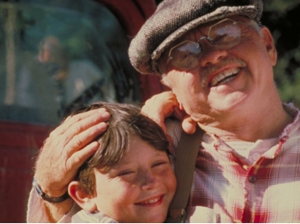
BlackStallionscreen2But this is an impressionistic film, one that is more image-driven and scene-driven than it is dependent on plot, especially in the early going. For a while, it’s like Cast Away, but with a horse instead of a volleyball. Then turns into National Velvet, but with a teenage boy instead of a teenage girl, and a thoroughbred horse race rather than steeplechase. Perhaps not coincidentally, just as actor Mickey Rooney played the role of the former jockey and mentor in National Velvet who helps young Velvet train for the steeplechase, he’s a former jockey and mentor here too, helping Alec to learn what it takes to harness all that wild energy and race Black, as he’s simply called.

The payoff will ultimately satisfy young viewers if they can make it through the slower parts. But frankly, it wouldn’t hurt today’s children to learn how to appreciate those slow-down moments in life—especially when they’re so beautifully filmed.

If you’re building a Blu-ray collection, by all means, add this title. But the master had a lot of grain that carries over onto the HD release, so this title would probably look just as good on DVD. As for the bonus features, they’re geared for adults—though older, curious young filmmakers-in-waiting might be drawn to several of the five short films by Ballard, especially one on the “Rodeo” and another in which Ballard interviewed centenarians talking about what L.A. was like a hundred years ago . . . juxtaposed against the chaos of images that flood 1971 Los Angeles. What he does will inspire young filmmakers, who will find a way to take the best of what he does and speed it up for the current time and generation.

Language: Clean as can be
Sex: Same here
Violence: That brief boat beat-down, a violent storm, and a cobra incident
Adult situations: Loss of the father
Takeaway: It IS possible to have it both ways, to craft a film that’s aesthetically pleasing out of a story intended for a young audience.

SCOOBY-DOO! 13 SPOOKY TALES: SURF’S UP SCOOBY-DOO! (DVD)

Leave a comment

ScoobyDooSurfsUpcoverGrade: B+
Entire family: Yes
1969-2015, 272 min. (13 cartoons), Color
Not rated (would be G, easily)
Warner Bros.
Aspect ratio: Varies (see below)
Featured audio: Dolby Digital 2.0
Bonus features: N/A
Trailer/Amazon link

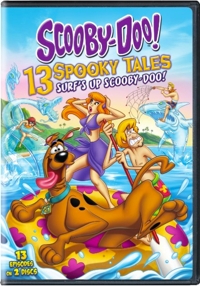
“Scooby-Doo! and the Beach Beastie” is a brand-new 22-minute cartoon and the sixth direct-to-DVD offering of its kind. But when you compare this latest effort with the “filler” added to flesh out the two-disc Scooby-Doo! 13 Spooky Tales: Surf’s Up, Scooby-Doo!, you almost wish that Warner Bros. had substituted a few more older episodes instead. “Beach Beastie” is by far the weakest, a going-through-the-motions affair that relies too much on Fred’s paranoia over nets and Scooby’s new love interest. It also offers too little in the way of mystery and phony monster moments—the two driving forces behind the popular franchise. What we get this time is a water monster that we’ve seen too many times before in other films.

Though a few voiceover actors and the style of drawing and animation changed over the years, the formula remains mostly the same: the Mystery, Inc. gang (timid Great Dane Scooby-Doo, always hungry Shaggy, bookish Velma, stylish Daphne, and All-American guy Fred) rambled onto the scene where a monster or ghost was terrifying people. Sometimes they were hired to get to the bottom of things, while other times they helped out a friend or simply “fell into” a mystery while trying to take a vacation—often to some exotic location. And always the unmasking revealed a phony monster with someone inside or with a remote control manipulating it for revenge or personal gain.

I don’t know if Warner Bros. deliberately chose “filler” episodes from a full range of Saturday-morning Scooby-Doo! cartoon shows, but to me that variety is the chief bonus. You really get a sense of the whole arc of this franchise. If only Warner Bros. had arranged the episodes in order, so viewers could better see how the characters and the series developed over 40 years. As is, the episodes are arranged either thematically (if you’re a glass half-full person) or randomly (if half-empty).  More

THE BEST OF THE ED SULLIVAN SHOW: 6-DVD COLLECTOR’S SET

Leave a comment

EdSullivancoverGrade: C+
Entire family: Yes, but….
1948-71, 444 min., B&W and Color
Not rated (would be G)
StarVista
Aspect ratio: 1.37:1
Featured audio: Dolby Digital 2.0
Bonus features: C+/B-
Amazon link

Baby Boomers grew up with The Ed Sullivan Show, the last great variety series that TV produced. From 1948 to 1971, families tuned in every Sunday night to watch Sullivan’s TV version of the old vaudeville shows: an odd and often surprising mixture of novelty acts, animal acts, musical acts, and comedy acts. But he also introduced cutting-edge rock ‘n’ roll, soul, and pop bands, and it was such an American tradition that The Ed Sullivan Show was immortalized in the Broadway play Bye Bye Birdie and ranked #15 on TV Guide’s list of 50 Greatest TV Shows of All Time.

Most people who buy this set will do so because of nostalgia. Like me, they grew up watching Sullivan and, like so many comedians, probably even tried their hand at imitating him. Many Americans first saw Elvis Presley and The Beatles on Sullivan’s show, and this 6-DVD Collector’s Set celebrates those milestones and others.

But there are two things that you should know about this set. First, five of the discs have been previously available as single DVDs. The Very Best of The Ed Sullivan Show, Vol. 1: Unforgettable Performances is the same disc we get here—a clip show hosted by Carol Burnett. Same with The Ed Sullivan Show: 50th Anniversary Special (a clip show hosted by The Smothers Brothers), The Ed Sullivan Show: The All-Star Comedy Special (another clip show hosted by Mary Tyler Moore), The Ed Sullivan Show: World’s Greatest Novelty Acts, and The Ed Sullivan Show: Amazing Animal Acts. The sixth disc of bonus interviews included in this set seems culled from the two main clip shows.

The other thing you should know is that there isn’t a single complete show included in this collection, and the clips are REALLY clipped. My family isn’t a fan of clip shows, because you don’t get the full context or, in this case, even the full performance most of the time. Everything is just a snippet here and a snippet there, and with so many different clip DVDs there’s a lot of repetition, too.

The only disc where you are really okay with the length of the clips is the Amazing Animal Acts disc. That’s because the idea of animals performing tricks is enough of a unifying theme that you don’t mind seeing only snippets . . . plus, the clips vary in length, with some of the performances longer than others, and some close to complete appearances. There are trained birds that count, a dog that counts, chimps that do acrobatic routines and walk on stilts, trained sea lions, elephants, a bear that grabs an ice cream cone right out of Sullivan’s mouth, and a historic moment when lion tamer Clyde Beatty assembled his act on a smaller-than-usual stage against his better judgment and lost control of a lion. Rather than focus on the problem on center stage, Sullivan walks into the audience to introduce celebrities. You can hear Beatty firing blanks in the background as he tries to scare the big cat back into submission. There are a number of moments like that on this five-disc clip compilation, but few that run as long or feel as complete. If you remove nostalgia from the equation, the “Amazing Animal Acts” disc is probably the only disc that my family enjoyed, and you can pick up the Amazing Animal Acts DVD separately for $14.95.

Don’t get me wrong. We liked seeing Bill Haley and the Comets, Elvis Presley, Sonny & Cher, The Byrds, Janis Joplin, and The Beatles, but with each of those acts we wanted more. The clips felt like a tease, and I frankly would have preferred a set that offered the two main clip shows plus discs that featured complete installments of The Ed Sullivan Show so that today’s families could really get a taste of what their counterparts 50 years ago watched. And it’s surprising how much of the comedy in that clip show seems dated or is no longer funny. Were they really the best of the show’s long run? It didn’t seem so to us.

Bottom line: The Ed Sullivan Show is an American classic, but chopping it into itty bitty pieces isn’t the best way to experience it.

FRASIER: COMPLETE SERIES (DVD)

1 Comment

FrasiercoverGrade: A-
Entire family: Yes, but . . .
1993-2004, 5,895 min. (263 episodes), Color
Rated TV-PG (mostly for innuendo)
CBS/Paramount
Aspect ratio: 1.33:1
Featured audio: Dolby Digital 2.0 Stereo
Includes: 44 discs in two sturdy plastic cases w/cardboard slipcase
Bonus features: C+
Amazon link

Modern Family may be King of the American Sitcoms now, but in the ‘90s it was Frasier, a spin-off from the popular sitcom Cheers starring Kelsey Grammer as a pompous but endearing psychologist who reveled in his intellect and haute culture tastes, but also yearned to be “one of the guys.” Frasier won a Primetime Emmy for Outstanding Comedy Series for each of its first five seasons and continued to win Emmys in other categories for all of its 11 seasons—though it wasn’t a runaway hit with audiences. Its best showing came with Season 6, when Frasier finished as the #3 most watched TV show in America, behind Friends and ER.

In Boston’s Cheers bar, Grammer made arrogance endearing as he played a good-but-jilted doctor who hung out with a dim-witted Iowa bartender, a narcissistic ex-ballplayer, a know-it-all mailman, and an overweight, professional barfly. Sometimes you laughed with him, while at other times (most of the time, actually) the humor came at the doctor’s expense—a book smarts vs. street smarts face-off. In Seattle, fresh from a divorce from his domineering wife Lilith (Bebe Neuwirth), Frasier found a fresh start as a Dr. Phil-style radio psychologist and acquired a new hangout: Café Nervosa, where he and equally effete brother Niles (David Hyde Pierce) would indulge their cappuccino tastes and parade their knowledge in front of a generally apathetic public.

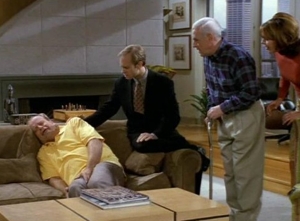
FrasierscreenThe show, with chapter tiles that played with puns, had two main sets. The first was KACL-Radio, where Frasier dispensed his psychiatric bromides and producer Roz Doyle (Peri Gilpin) was a perfect “give it a rest” foil to his pompous side. Obnoxious sportscaster Bob “Bulldog” Briscoe (Dan Butler) took him down a few more pegs with his cuts and practical jokes, and restaurant critic Gil Chesterton (Patrick Kerr) was the uncomfortable mirror that showed reflections of what Frasier might be like without such irreverent and frequent shots to keep him grounded. Much of the at-work time is spent with Frasier talking to unseen call-ins with a host of problems, and much of the fun for fans is watching the end-credits to see what famous celebrities posed as the callers from week to week.

At home, the brandy-oriented Frasier met his match with his blue-collar dad (John Mahoney), a Ballantine-loving ex-cop who walks with a limp and has a live-in therapist, a Brit named Daphne (Jane Leeves). With dad and son facing off and Daphne offering her humorous third-party, third-culture take on things, it made for more dry humor. And Niles visited so often that it felt as if the four of them lived—and bantered—there. His epic crush on Daphne and the brothers’  sibling rivalry and sharp contrast with their down-to-earth dad became series-long storylines.   More

Older Entries Newer Entries