Home

Review of ROCK-A-DOODLE (Blu-ray)

Leave a comment

Grade: C+/B-
Entire family: Yes
1991, 77 min., Color
Animation/Live-action
Olive Films
Rated G
Aspect ratio: 1.85:1 widescreen
Featured audio: DTS-HDMA 2.0 Stereo
Bonus features: n/a
Trailer
Amazon link

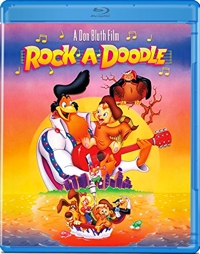
Don Bluth forever will be known as a talented artist who left Disney to start an animation company that produced The Secret of NIMH, All Dogs Go to Heaven, and The Land Before Time in the ‘80s under his direction. But the studio’s titles in the first half of the ‘90s struggled to connect with viewers, and Rock-a-Doodle (1991), Thumbelina (1994), A Troll in Central Park (1994), and The Pebble and the Penguin (1994) all had disappointing box-office returns.

The problem with Rock-a-Doodle, as is so often the case with non-Disney animated features, is the concept itself—and that includes a live-action “frame” that seems gratuitous, even clunky. Bluth had been the animation supervisor on Disney’s Pete’s Dragon and obviously wanted to showcase his talents. But The Princess Bride-style frame about a boy reading a book doesn’t work because it’s introduced a little too late in the film and the whole parallel of the boy’s parents fighting a flood while he’s transformed into a cat who tries to bring a rooster back from the city to “save” the farm (and the parents’ farm) seems strained. Plus, the live-action simply doesn’t hold up as well as the animation.
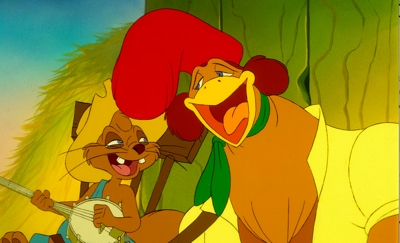
As for the rest of the premise, it certainly had promise, as a rollicking opening sequence and song prove. The rooster Chanticleer (Glen Campbell) is the strutting king of the barnyard whose singing wakes up the sun every day. That story and opening musical number have all the charm that fables usually provide, and had Bluth stayed with a simpler fabulistic fabric he might have had something. Instead, he offers a villain whose motives and actions are just a little fuzzy.

More

Review of EMMET OTTER’S JUG-BAND CHRISTMAS (40th Anniversary DVD)

Leave a comment

Grade: B+/B
Entire family: Yes
1977, 53 min., Color
Family
Sony Pictures
Not rated (would be G)
Aspect ratio: 1.78:1
Featured audio: Dolby Digital 5.1
Bonus features: B+
Trailer
Amazon link

You know the old expression, “They don’t make them like they used to?”

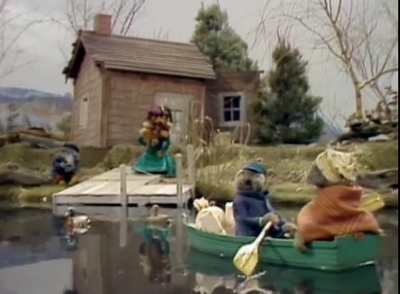
With Emmet Otter’s Jug-Band Christmas that’s absolutely true. Jim Henson and his Muppeteers used traditional hand-operated puppets, string-manipulated marionettes, and remote controlled Muppetry to make this 1977 TV Christmas special. It’s hard not to have some reaction when you watch Emmet rowing his mother across real water while Ma sings about the good old days. But it could seem so totally new to today’s youngsters that they may not even be sure how to react. What they’re watching is a lost art, with such detailed sets and models and characters that you have to feel charmed by the whole process. And that rowing scene? It’s the equivalent of watching a ventriloquist work his dummy while drinking a glass of water. Such technical wizardry abounds in Emmet Otter’s Jug-Band Christmas.

Henson enlisted composer Paul Williams to create the songs for this 48-minute film, which he told Williams was a “trial run” before he went all-out to make a full-length feature film. That means fans of The Muppet Show and The Muppet Movie will find this especially fascinating. You can see what Henson thought worked and what he thought needed to be juiced up a bit in order to be effective in the theaters.

Emmet Otter looks a bit like an Ewok, and he’s cute as the Dickens. He and his Ma are both good singers, but, like everyone else in their watery corner of the world, poor as can be. When they see signs for a talent show featuring a $50 prize, they both decide to enter because, shades of O. Henry’s “Gift of the Magi,” each wants to buy a Christmas present for the other. While Ma practices her solo, Emmet gets his musical friends together to form a jug band. But while they all are performing old-time music, that prize money starts to look like a pipe dream when a bunch of kids with electric guitars are cranking out tough-to-beat rock music.

Whether Emmet and his Ma win or lose is almost irrelevant. There’s a lesson to be learned here, and models of behavior and life attitudes that have almost become as “old timey” as some of the early songs in this musical family film. The tone of the film is like a story told around a pot-belly stove, a warm-your-hands (and heart) affair that’s played pretty straight. Missing is the irreverence of The Muppet Show and the Muppet movies, no doubt because Henson and Co. were aiming for a wholesome family Christmas show that evokes the “good old days.”

More

Review of SUPERGIRL: SEASON 2 (Blu-ray)

1 Comment

Grade: B+
Entire family: Yes
2016, 931 min. (22 episodes), Color
Sci-fi action-drama

Warner Bros.
Not rated: would be PG for fantasy violence
Aspect ratio: 1.78:1
Featured audio: DTS-HDMA 5.1
Bonus features: C+/B-
Includes Blu-ray, Digital Copy
Trailer
Amazon link

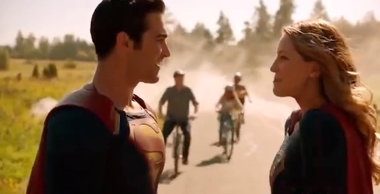
As I said when I reviewed Season 1, there are two DC Universes, and Melissa Benoist really brightens up the television one. She has the kind of charisma that propelled Lynda Carter (who appears as the President this season) to stardom as TV’s Wonder Woman during the seventies and the kind of girl-next-door likeability and warmth that inspired the writers of Supergirl: Season 2 to emphasize her “humanity” after otherwise drawing a distinction between humans and aliens.

In this winning 2016 CW series she’s the “girl” you want to be friends with, to confide in, to rely on, to have fun with, and, if you’re a guy, to date. Though Supergirl comes from the planet Krypton, with Benoist wearing the costume she embodies everything that’s good in humanity. She may be a badass, but she’s as amazed by her powers and the fun of being a hero as any teenage Earthling would be. And teens can identify with her because she’s also awkward in social situations, still trying to find her way in the work world, just a little geeky, and a little too wide-eyed for a typical adult her age. In other words, the character was deliberately crafted with a teen and young adult audience in mind, though the show is entertaining enough for all ages.

Supergirl offers a less dark DC Universe in which characters have down time, bond, laugh, share food and drink, and grapple with problems that audience members face—like questions about identity, body image, relationships, glass ceilings, and juggling career and personal life. The series’ first-season feminism and “stronger together” theme was reflected in the Hillary Clinton campaign, and this season remarks exchanges like this one tip viewers off that the left-leaning politics continue:

Supergirl (as Kira, defending a young woman in the office): “She went to Yale.”
Cat Grant: “So did George Bush.”

More

Review of WITH GREAT POWER: THE STAN LEE STORY (DVD)

Leave a comment

Grade: A-/B+
Entire family: Yes
2010, 80 min., Color
Documentary
Not rated (would be G)
MPI Home Video
Aspect ratio: 1.37:1
Featured audio: Dolby Digital 2.0
Bonus features: A-/B+ (includes second disc of extras)
Trailer
Amazon link

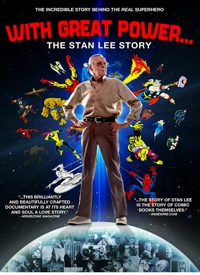
If your family is like ours, the kids don’t exactly clamor for documentaries. But when the subject of a documentary is Marvel comics legend Stan Lee, and when the documentary employs graphics that remind you of comic books, suddenly there’s interest. Enough for them to watch the whole thing, in fact.

Even years after the hey-day of comic books, when kids could indulge themselves for just 12 or 15 cents, the low-culture genre still holds plenty of fascination. Back then, Lee says, they created a comic per day, and most of the kids I knew purchased at least one per week. It was our pulp fiction. “I learned to read because of Spider-Man comics,” one of the many celebs on this documentary confesses. But a new generation has come to know the Marvel characters mostly through TV and movies—and in this, too, we discover, Lee played a pivotal role.

Since the age of 19, Lee has been the driving force behind and larger-than-life face of Marvel, a genius who co-created more than 500 distinctive characters over his long career as a story man. Teaming with legendary comic-book artist Jack Kirby and others, he absolutely owned the Sixties, coming up with nine characters who would become major Marvel success stories: Fantastic Four (Nov. 1961), Ant-Man (Jan. 1962), Hulk (May 1962), Thor (Aug. 1962), Spider-Man (Aug. 1962), Iron Man (Mar. 1963), The Avengers (Sept. 1965), Daredevil (April 1964), and Silver Surfer (Oct. 1966). “I just put the words in the people’s mouths and I may have come up with the original idea, but after that it was a partnership,” Lee says.

More

Review of CLAMBAKE (Blu-ray)

Leave a comment

Grade: B-
Entire family: Yes
1967, 99 min., Color
Musical comedy-romance
Not rated: Would be PG (for smoking, drinking, and some suggestive scenes)
Kino Lorber
Aspect ratio: 2.35:1 widescreen
Featured audio: DTS-HDMA 2.0
Bonus features: B- (an audio commentary from Videodrome video rental store)
“Clambake” clip
Amazon link

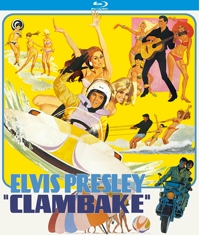
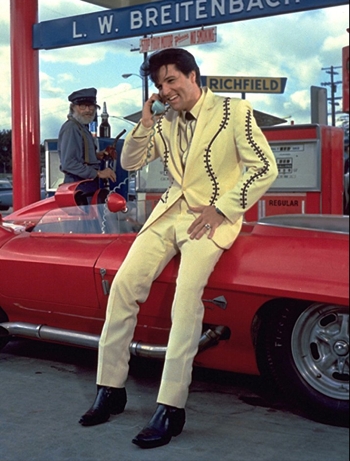
It started with Jailhouse Rock (1957), the film that established the Elvis film character as a brooding James Dean, often with a chip on his shoulder, but with a good guy hiding under the facade. That character would appear with only minor alterations in most of his 23 films made between 1962 and 1969. By comparison, during that same period John Wayne made 17 films. Both were box-office giants.

Many of the films from this period are “a-go-go” films, and if you’re a fan of the Zucker-Abrahams-Zucker spoof Top Secret! you’ll see in the formula Elvis movies what they were making fun of. Today’s families will find these lightweight musical comedy-romances fun to watch, but also fun to make fun of. Some of the dancing, some of the clothes, some of the antics are just plain hilarious now, though they were intended, like the Frankie Avalon and Annette Funicello “beach” movies, to be campy and fun even back then. They feature plenty of mod and mini-skirted and bikinied women and goofy guys doing the swim, the frug, the monkey, the jerk, and all those dances that were so cool then but look so silly now. What will seem even sillier to modern audiences are the backgrounds that were clumsily and unapologetically used (like the mountains in the background of this film set in Miami), or the far-fetched ways in which the writers sought to bring Elvis in contact with children.

Yes, children. You see, the Elvis film persona was meant to be everything to women: a bad boy, a nice guy, a singing romantic, a tough guy when he had to be, a clean-living guy who usually refrained from alcohol and tobacco, and a good-looking guy who was so good with kids that women saw him as father material. Despite the attitude, Elvis was the kind of guy you could bring home to meet Mom and Dad.

More

Review of ROARING ABYSS (DVD)

Leave a comment

Grade: A-/B+
Entire family: Yes (though small children may tire)
2015, 87 min., Color
Music documentary
Not rated: Would be G
IndiePix Films
Aspect ratio: 16×9 widescreen
Featured audio: Dolby Digital Stereo
Bonus features: n/a
Trailer
Amazon link

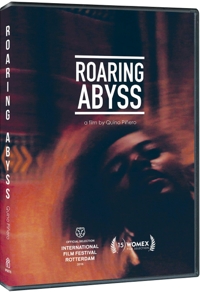
Roaring Abyss is an unfortunate title, and the cover art just as unfortunate. Both give a false impression of turbulence, pain, struggle, or a profound feeling of being trapped. That couldn’t be more misleading. Roaring Abyss is a feel-good film, a start-to-finish musical journey across Ethiopia, where, we’re told, “Ninety million people in the second most populated African country” are “singing in eighty different languages on both sides of the Rift Valley.”

This 2015 documentary from Quino Piñero could very well do for traditional music from Ethiopia what Buena Vista Social Club did for Cuban music and musicians. The musicians celebrate their lives through music, and Piñero celebrates that too, along with celebrating their talent, passion, and dedication to preserving traditional music.

You don’t have to be a music lover to enjoy this film, but it certainly helps, since music is a constant. From the terrific opening song you know what sort of journey awaits. A pattern unfolds: you see film of everyday life in a section of Ethiopia while you hear music, then a cut to the musicians so you can see the source of the sound and watch the rest of the performance—and in a sense, every one of these songs, no matter where it was recorded, is a performance because they have been recorded in front of microphones for posterity. After the performance we get more of the same, with that pattern occasionally interrupted by interviews with some of the performers.

“A song is not only for dancing,” one of them remarks. “It reminds you of your dear ones, it brings back memories of far relatives, it reminds you of those who passed away, it reminds you of the love you experienced in your life. Indeed, songs are rarely made for dancing only.”

More

Review of THE LEMON DROP KID (Blu-ray)

Leave a comment

Grade: B
Entire family: Yes
1951, 91 min., Black and White
Comedy
Not rated (would be G)
Kino Lorber
Aspect ratio: 1.33:1
Featured audio: DTS-HDMA 2.0
Bonus features: n/a
“Silver Bells” clip
Amazon link

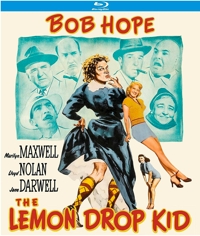
If the title isn’t a tip-off that this is a Damon Runyon story, the rest of the nicknamed character roster ought to be a dead giveaway: Brainey Baxter, Oxford Charlie, Nellie Thursday, Moose Moran, Straight Flush Tony, Gloomy Willie, Sam the Surgeon, Little Louie, Singing Solly, and Goomba.

Runyon famously wrote about colorful characters he met on Broadway and at the racetracks in Florida—guys and dolls, racketeers and henchmen, horse trainers and grooms, bookies and touts, and just plain down-and-outs.

Like Pocketful of Miracles (1961)—which was also inspired by a Runyon short story—The Lemon Drop Kid is set around Christmas, a film in which the main character wavers between being a selfish Scrooge or an unselfish giver. He’s the only character who has any kind of arc at all; the rest are stock types or foils.

Like the Shirley Temple film Little Miss Marker and the Bob Hope remake, Sorrowful Jones (both based on another Runyon story), it revolves around a debt or a bet. In this case, The Lemon Drop Kid (Bob Hope) touts a horse to a woman holding $10K, and that horse loses. What’s worse, the woman turns out to be the girlfriend of notorious racketeer Moose Moran (Fred Clark).

Naturally, Moose wants his money back, and he gives the Lemon Drop Kid until Christmas to settle the score . . . or else. So the Kid goes to New York and looks up his old girlfriend Brainey Baxter (Marilyn Maxwell) and also racketeer Oxford Charlie (Lloyd Nolan) to see if he can get a loan. When that falls through, the Lemon Drop Kid gets a brainy idea of his own: seeing a Salvation Army bell-ringer dressed as Santa, the Kid decides to ring a bell in a Santa Suit with a kettle and a sign that reads “Save a Life.” Meaning, his own.

More

Review of ROAD TO BALI (Blu-ray)

Leave a comment

Grade: B
Entire family: Yes
1952, 91 min., Color
Musical comedy-adventure-romance
Not rated (would be PG for mild peril and innuendo)
Kino Lorber
Aspect ratio: 1.33:1
Featured audio: DTS-HDMA 2.0
Bonus features: B-
APC teaser
Amazon link

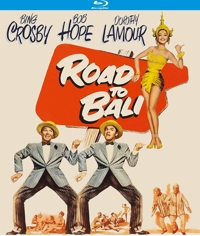
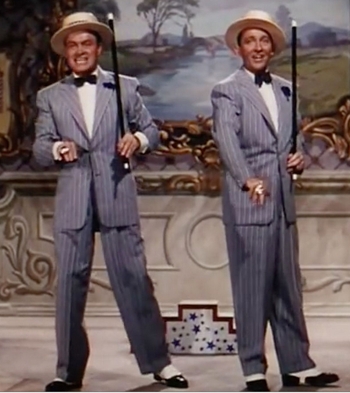
In the 1940s, singers Bing Crosby and Dorothy Lamour hooked up with hook-nosed comedian Bob Hope for five “road” pictures—comedies about two erstwhile male vaudeville performers in exotic locations who end up meeting and falling for Lamour’s character. Was it a formula? Yes and no. Audiences knew exactly what to expect, but Hope and Crosby ad-libbed so much that the films had the added energy of unpredictability.

After taking the road to Singapore (1940), Zanzibar (1941), Morocco (1942), Utopia (1946), and Rio (1947), the trio took to the road again in 1952 for their first and only color excursion, Road to Bali. Crosby plays George Cochran and Hope is Harold Gridley, two entertainers forced to cut engagements in Australia short when they end up wooing one too many farmer’s daughters and are forced to find other work. The first job that presents itself is “deep sea diver,” and so they’re off on another adventure.

Though it’s not as funny as Road to Morocco and Road to Utopia, this 91-minute comedy is a good place to start for families with younger children because it is color and because Road to Bali is a kitchen sink film. Writers Frank Butler, Hal Kanter, and William Morrow throw everything into the film, including the kitchen sink, among them:

—A treasure hunt
—A South Seas princess
—A romantic triangle
—A long-lost father who turns up
—A wedding
—A battle with a giant squid
—A fight between a tiger and a gorilla
—A close call with crocodiles
—A lovelorn gorilla who decides Harold is the perfect replacement for the mate she lost
—An exploding volcano
—A “Scottish” song-and-dance routine Hope and Crosby perform in kilts
—Cameo appearances by Humphrey Bogart (in a film clip) and Dean Martin, Jerry Lewis, and Jane Russell
—“Balinese” dancers who move to music that sounds suspiciously like jazz
—A snake-charmer takeoff in which the flute player summons not a cobra but a beautiful woman

Road to Bali may not feature the kind of breakneck pacing that young people are used to, but the film shifts gears enough times and has enough color and humor to make it fun for family viewing—if, that is, your children are open to older movies. And if your family includes a Baby Boomer or fans of vintage television shows, a bonus is that Carolyn Jones (Morticia on TV’s The Addams Family) appears in just her second career role as one of the jilted farmer’s daughters; Leon Askin (Gen. Burkhalter on TV’s Hogan’s Heroes) turns up as King Ramayana, the ruler of an unspecified idyllic island somewhere between Australia and Bali; and Michael Ansara (Cochise on TV’s Broken Arrow and the Blue Djinn on I Dream of Jeannie) is one of the guards that serve the King and Prince Ken Arok (Murvyn Vye).

More

Review of HEE HAW: PFFT! YOU WAS GONE (DVD)

Leave a comment

Grade: B-/B
Entire family: Yes
1969-74, 191 min. (4 episodes), Color
Variety show
Not rated (would be G despite occasional innuendo)
Time Life
Aspect ratio: 1.33:1
Featured audio: Dolby Digital 2.0 Mono
Bonus features: C-/D
“Rindercella” clip
Amazon link

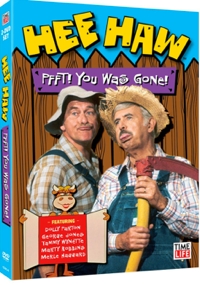
Hee Haw debuted in 1969 as the rural answer to Rowan & Martin’s Laugh-In, and while Laugh-In lasted two years longer on primetime network television, anyone who’s recently watched episodes from both shows knows that Hee Haw got the last laugh. Laugh-In’s gags were way too topical and tied to the news, or else they were silly catch-phrases that have long since lost their funniness. Either way, the show isn’t nearly as funny today, and you can bet your sweet bippy on it.

Hee Haw is another story. This show, hosted by country music stars Buck Owens and Roy Clark, was unapologetically devoted to cornball humor. Writers plumbed the depths of rural stereotypes for jokes that somehow managed to celebrate rural life while also poking fun of it. Like the Grand Ole Opry, the show had a group of talented regulars but also featured some of country music’s top stars and rising newcomers as weekly guests. It was a popular-enough series to last another 20 years in syndication, and it still plays pretty much the same now as it did then. Meaning, of course, that cornball humor never changes. The sketch comedy and rapid-fire jokes were corny then, and they’re corny now. How corny? You be the judge:

Doctor: I hate to tell you this, but your wife’s mind is gone.
Male patient: Well, that don’t surprise me. She’s been givin’ me a piece of it for the past 20 years.

More

Review of BEAUTY AND THE BEAST (2017) (Blu-ray combo)

Leave a comment

Grade: A/A-
Entire family: Yes
2017, 129 min., Color
Family musical fantasy
Disney
Rated PG for some action violence, peril and frightening images
Aspect ratio: 2.40:1
Featured audio: English DTS-HDMA 7.1
Bonus features: B-
Includes: Blu-ray, DVD, Digital HD
Trailer
Amazon link

We seem to have entered a new era of live-action Disney remakes of animated classics.

After a 2014 revisionist Sleeping Beauty story of Maleficent that divided critics, a trio of remakes—Cinderella (2015), The Jungle Book (2016), and Pete’s Dragon (2016)—fared nearly as well with reviewers as they did at the box office. More live-action remakes are in the works: The Sword and the Stone, Dumbo, Pinocchio, Alice and Maleficent sequels, Cruella (an attempt to improve on the 1996 101 Dalmatians flop), Winnie the Pooh, Mulan, Tink (a Peter Pan spinoff), Prince Charming (a Cinderella spinoff), Genies (an Aladdin prequel), and Night on Bald Mountain (a Fantasia adaptation). It other words, it’s getting real.

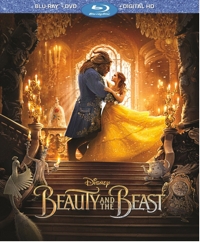
Predictably, not everyone is a fan. More audience members (83 percent) liked 2017’s Beauty and the Beast than critics (71 percent), but if you read between the lines you’ll see that the naysayers are mostly purists who think that nothing can compare to the 1991 film many consider to be the high point of Disney animation—one that, like The Lion King, inspired a Broadway version. Additional objections came from closet homophobes who took exception with the slightly flamboyant performance that Josh Gad (Olaf, in Frozen) gave of La Fou, sidekick to the film’s egotistical, intimidating villain. But hey, he’s a musical theater guy, this is musical theater, and children will see in his performance the same kind of second-fiddle comedy as his cartoon counterpart provided.

Our family watched Beauty and the Beast separately—my son, on his college campus; my wife and daughter, at a local theater; and me, when it finally came out on Blu-ray this week—but we all had the same reaction: We loved it.

Disney excels in creating movie worlds, and to create this one they decided against straight live-action and incorporated 1700 visual effects using both old and new technology. Watch a bonus feature and you’ll see Dan Stevens, who plays the beast, decked out in a full-body motion-capture suit, and you’ll see Emma Watson as Belle sitting at a table full of objects—the only actor in the room, because all of the other characters were CGI. But you’ll also see green screen work and matte backgrounds, and the combination of old and new techniques fashion a world that’s live-action but still altered reality—timeless, fantastic.

More

Older Entries Newer Entries