Home

AMAZING SPACE: AN AUDIO/VISUAL MEDITATION ON THE COSMOS (Blu-ray combo)

Leave a comment

AmazingSpacecoverGrade: B
Entire family: No, for meditation
2015, 52 min., Color
Not rated (would be G)
Aspect ratio: 1.78:1
Featured audio: Dolby Digital 5.1
Bonus features: B-/C+
Includes: Blu-ray, DVD, CD
Trailer
Amazon link

Amazing Space: An Audio/Visual Meditation on the Cosmos is as advertised: a slideshow of images from the Hubble telescope that fade in, fade out, and rotate slightly in a modified Ken Burns style, set to New Age music by composer-performer Kristin Hoffman.

Film Chest Media Group bills it as a “companion and guide to meditation, yoga, dance, dreaming or just relaxing.” That is, this one isn’t for family movie night. It’s for Mom or Dad, locked in a room alone and trying to unwind from the day’s stresses.

Those who find inspiration in music and images will discover that the first seven minutes or so, with its time-lapse photography of everyday life, is vaguely reminiscent of Koyaanisqatsi: Life Out of Balance—the 1982 documentary by Godfrey Reggio that featured striking cinematography by Ron Fricke and music from Philip Glass. The big difference is that in Koyaanisqatsi each new set of images was intended to provoke a reaction or insight. Here, the earthbound images are just a jumping-off point for a series of images that are designed to do just the opposite: to clear your mind.

AmazingSpacescreenHoffman’s compositions—featuring piano, synthesizers, drum programming, strings, percussion, sarod, marimba, chimes, and vocals—seem magical all on their own, the proof being that you can close your eyes and feel just as relaxed and transported, especially when Hoffman’s vocals take flight. The images of earth and space almost feel like a bonus, even though they served as inspiration for her eight compositions: “Root of All,” “Elixer Field,” “Starlight,” “The Galactic Beat,” “Universal Voice,” “Celestial Sight,” “Amazing Space,” and “Cosmic Consciousness.”

I do not meditate regularly, nor do I have a meditator’s mindset. Though I found the movements of Hoffman’s compositions to be nicely synchronized with the images and melodic enough to be relaxing, the minute that Amazing Space told me I was looking at the Milky Way, I found myself wondering throughout the rest of the 52-minute film what space phenomena I was witnessing.

I checked the bonus features, but none of the interviews told me in any detail what shots from the Hubble telescope I was watching. While I realize such an impulse makes me the anti-meditator, I do think that when you’re dealing with spectacular (yes, I’d use that word) images of space you’re going to have at least some people like me who, before or after trying to use the film as intended, would appreciate a few answers. I hope that future editions of this title incorporate a list of images and some information about them, or an option to watch with subtitles that identify what is being seen. Then it might actually do double duty: work to help Mom or Dad unwind, and also provide a teaching moment. Couple that with a show-and-tell piece of meteorite that you buy on the Internet (they’re plentiful) and it would be a great mini-lesson for home schoolers or families who enjoy learning together.

Amazing Space is a three-disc set that includes a Blu-ray, DVD, and CD soundtrack.
THE BEGINNERS BIBLE (Volumes 2, 3) (DVD)

Leave a comment

BeginnersBible2Grade: B+
Entire family: No (ages 6 and under only)
1995, 90 min. (3 stories), Color
Time Life/StarVista
Not rated (would be G)
Aspect ratio: 1.33:1 (full screen)
Featured audio: English mono
Bonus features: Spanish versions
Amazon link (Old Testament Stories)
Trailer

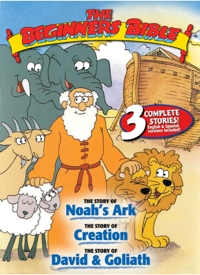
Time Life has taken over the distribution of The Beginners Bible, a DVD series from 1995 that should please parents who want to introduce their youngsters to Bible stories without exposing them to stilted language or the adult implications of those stories. It’s a really well made series of DVDs, each of which features three 25-30 minute animated stories geared for children age six and under. As of today, families can add two more volumes (sold separately) to their home video collections.

I reviewed the first installment—The Story of Easter, The Story of The Nativity, and The Story of Moses—in February, and on June 9 a second volume appeared featuring The Story of Noah’s Ark, The Story of Creation, and The Story of David and Goliath.

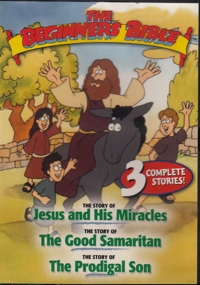
The third volume gets back to the New Testament with The Story of Jesus and His Miracles, The Story of the Good Samaritan, and The Story of the Prodigal Son. As with all the characters, Jesus is both humanized and contemporized. Though the dress is still tunic and sandals, the beard is fluffy and rounded and the speech is everyday. Jesus turns water into wine, walks on water, brings fish to his struggling fishermen-disciples, heals the sick and lame, and raises Lazerus from the dead. He is recognized as the Son of God. But at times the Son of Man also shows through—as when a woman asks him if he can help when the wedding runs out of wine, and he says it is not yet time for him to reveal himself. But she persists. Please? And like any good friend, he agrees.

All the animated entries in this series have a sunny palette and characters drawn with a lot of rounded curves rather than harsh angles. The eyes are big and round, which emphasizes the cartoon nature rather than an animated attempt at realism.

The other stories in this volume are parables that Jesus used to teach lessons. While the Bible emphasized that a man had been beaten and robbed and left in bad shape, the focus on this stranger in need is his location: Now the road is on a cliff, and the man is lying at the bottom. I’ve always wondered, though, why it wasn’t more emphasized that the Samaritan was actually someone outside of the tribes of Judah, while those who passed him by were considered of the same faith. The real moral of this story is helping people who are different from you, but of course children are led to the simple conclusion that helping people in need rather than passing them by is a good thing to do. Meanwhile, The Story of the Prodigal Son doesn’t dwell on the wickedness that the prodigal fell into when he left his family. Here it’s the story of someone who refuses to work the family farm and goes off to see the world and experience the temptations of the city. When he returns, the moral is framed thusly: His joyous welcome reminds us of God’s great love for everyone. The Bible, of course, emphasizes that those who have sinned and came back to the “path” are to be celebrated just as much if not more than those who have always stayed the course. But that gets a little heady for a preschooler, doesn’t it? Tweaks like these make this series something that little ones can absorb more readily.

BeginnersBible3The June 9 release offers stories that are more familiar and which will, in truth, hold more appeal for very small children. There’s more that they can relate to, with plenty of animals to fill out the screen. The Story of Noah’s Ark is well known: how God commanded Noah to build an ark and take on board all the animals, two by two, in order to survive a great flood that God would send to cleanse the earth of wickedness. The Story of Creation features the devil in serpent’s form tempting Eve and Adam to sample the only fruit God had forbidden. And David and Goliath is a story that resonates with any kid who’s come up against a bully or someone larger.

The picture quality is decent and the volumes are priced to sell: $9.95 SRP. The Noah’s Ark DVD is currently available at Amazon for $6.99, while the Jesus stories haven’t appeared yet.

THE HEE HAW COLLECTION (DVD)

Leave a comment

HeeHawcoverGrade: B/B-
Entire family: Yes
1969-71, 369 min. (5 episodes), Color
Not rated (would be G despite some innuendo)
Time Life
Aspect ratio: 1.33:1
Featured audio: Dolby Digital 2.0 Mono
Bonus features: B-
“Pfft You Was Gone” clip

The hay-day (sorry, bad pun) of rural comedy on American TV was between 1960, when The Andy Griffith Show debuted, and 1971, when all of them were put out to pasture. The novelty of The Beverly Hillbillies, Petticoat Junction, Gomer Pyle: USMC, Green Acres, and Mayberry R.F.D. had worn off, so it was no surprise that in 1971 CBS also cancelled Hee Haw—a country version of Rowan & Martin’s Laugh-In.

But like the Grand Ole Opry, this corny variety show, which debuted in 1969 and featured a group of talented regulars and some of the top country stars of the time, had a life of its own. It became an institution, going into syndication and lasting nearly another 20 years.

Hee Haw managed to have it both ways, featuring characters and jokes that celebrated rural life, but also poked fun of rural stereotypes. You’ll see nostalgic, folksy segments that lament the loss of cracker barrel philosophers, with Archie Campbell playing a barber and regaling customers with stories, Grandpa Jones and Junior Samples doing the same at Gordie’s General Store, or Stringbean reading a letter from home. Always it was a tall tale modernized or a long simmering lead-in to a corny punch line. Yet there were also recurring segments featuring not-too-bright farmer’s daughters in short-shorts or the country equivalent of mini-dresses, and a recurring sketch about barefooted moonshiners in overalls lying in the front yard next to a jug and a bloodhound. In fact, Junior Samples, with his slow-witted and deliberately speaking persona, was the anti-sophisticate, and darned proud of it. Put Junior in a Shakespeare sketch (as they often did) or making a used car commercial and it was instant laughs.

Hee_HawLaugh-In was hosted by a comic duo. Hee Haw’s hosts were musicians first and comedians second, which fit the corny concept just fine. Roy Clark, best known for his instrumental work on banjo, guitar, and mandolin, first appeared on the Grand Ole Opry at the age of 17. Buck Owens was a popular country singer and band leader whose best-known songs were “Act Naturally,” “Together Again,” and “Tiger by the Tail.” The pair appeared to have fun together and provided the perfect anchor for a boatload of sketches and musical numbers. Buck and Roy started each show with a rendition of “Hee Haw” and at some point did a vaudeville-style routine called “Pickin’ and Grinnin’” that strung jokes together with musical riffs. They also did at least one solo per episode.

Though the humor could be adult, the show was obviously intended for families because kids were included in some sketches and the show relied on animated farm animals to add to the laughs. One minute the audience could be enjoying some serious guitar-playing from Clark, and the next minute a chorus line of pigs would be dancing across the screen while he’s playing, lightening the mood.  More

CURIOUS GEORGE 3: BACK TO THE JUNGLE (DVD)

1 Comment

CuriousGeorge3coverGrade: B+/A-
Entire family: Yes, but ….
2015, 81 min., Color
Rated G
Universal
Aspect ratio: 1.78:1
Featured audio: Dolby Digital 5.1
Bonus feature: C-/D
Trailer
Amazon link

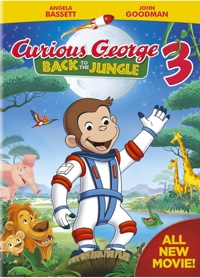
After a disappointing Curious George 2: Follow That Monkey and a relatively pedestrian Curious George Swings into Spring, executive producers Ron Howard and Brian Grazer have given this popular children’s book character the kind of animated adventure he deserves. Curious George 3: Back to the Jungle may be better than the original Curious George theatrical release, and that’s quite a compliment for a direct-to-DVD release.

This outing, George (voiced by animated voiceover genius Frank Welker) is recruited by a space program run by a man named Houston (John Goodman) to fly into space to link a gizmo to a satellite and then return to Earth with it so that the gizmo can be installed in Africa to prevent flooding. And yes, we do get the line, “Houston, we have a problem.” So while the previous two Curious George films were aimed directly at preschoolers and everyone else be gosh-darned, this time there are a few more embedded allusions to entertain the older siblings and parents who watch with them.    More

THE BLACK STALLION (Criterion) (Blu-ray)

Leave a comment

BlackStallioncoverGrade: B+
Entire family: Yes, but . . .
1979, 117 min., Color
Rated G
Criterion Collection
Aspect ratio: 1.85:1
Featured audio: DTS-HD MA 2.0 Surround
Includes: 17×11 color poster, five short films by Ballard
Bonus features:  B-/C+
Amazon link

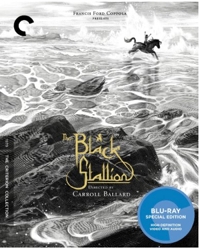
The Black Stallion—at least the 1979 adaptation that Francis Ford Coppola “presents”—is an interesting hybrid. It’s part family movie and part indie/art house film. Director Carroll Ballard takes the 1941 book for young readers and infuses the story of a boy and a wild horse who “save” each other with indie film sensibilities and art-house cinematography.

The result is a film that’s obviously made for adults but suitable for children. There are a few less warm fuzzies and sappy moments in this hybrid (a good thing!), though the pacing in the first act might seem a bit too leisurely for the youngest viewers. There’s not much you can do for them except to assure them that the action picks up, but older children who squirm can be shown the luxurious cinematography from Caleb Deschanel (Zooey Deschanel’s father), with breathlessly original shots and angles and the space for those shots to breathe and expand in our consciousness.

BlackStallionscreen1Ballard isn’t quite as lavish with his plotting and narrative. Some directors like to show rather than tell; Ballard likes to suggest rather than show. We see a young boy and his father on a steamer off the coast of North Africa, where Dad (Hoyt Axton) is gambling with dangerous-looking people, and the boy, Alec (Kelly Reno), has the run of the ship. The boy glimpses a wild black stallion roped and whipped by Arab trainers and forced into one of the ship’s holds. Feeling sorry for the horse, Alec returns with sugar cubes he swiped but is caught and treated almost as roughly by the Arab. Shortly thereafter, his father shares with him a trinket from his poker winnings: a small statuette of Alexander the Great’s horse. We hear the story of how the horse was so wild the king was going to put him down, but conceded that the boy Alexander could keep him if he could ride him. Of course, that tiny statuette and story become a controlling metaphor for the narrative of The Black Stallion, for soon afterwards a violent storm kicks up, the boy releases the horse so he won’t go down with the ship, and after watching him leap into the sea the boy is thrown overboard and calls for help.

So begins a relationship between the boy and the horse that develops on the island until he’s rescued by a group of men who also take the animal that Alec refuses to leave behind. And yet, what Alec does leave behind is any apparent feeling for his father. We really don’t know what happened to the man, nor did we see any emotional reaction in Alec after he awakens on the beach of a desert island. He’s as concerned about what happened to his father as he is about finding fresh drinking water (a detail that’s never addressed). We aren’t told, as readers of the book were, that the two of them had been visiting an uncle in India, so viewers really have no idea why the pair was on a ship so far from his home somewhere in the states where horses are raced. Even after Alec returns home to his mother (Terri Garr), we aren’t given much in the way of information.

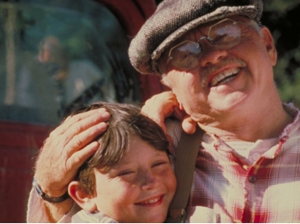
BlackStallionscreen2But this is an impressionistic film, one that is more image-driven and scene-driven than it is dependent on plot, especially in the early going. For a while, it’s like Cast Away, but with a horse instead of a volleyball. Then turns into National Velvet, but with a teenage boy instead of a teenage girl, and a thoroughbred horse race rather than steeplechase. Perhaps not coincidentally, just as actor Mickey Rooney played the role of the former jockey and mentor in National Velvet who helps young Velvet train for the steeplechase, he’s a former jockey and mentor here too, helping Alec to learn what it takes to harness all that wild energy and race Black, as he’s simply called.

The payoff will ultimately satisfy young viewers if they can make it through the slower parts. But frankly, it wouldn’t hurt today’s children to learn how to appreciate those slow-down moments in life—especially when they’re so beautifully filmed.

If you’re building a Blu-ray collection, by all means, add this title. But the master had a lot of grain that carries over onto the HD release, so this title would probably look just as good on DVD. As for the bonus features, they’re geared for adults—though older, curious young filmmakers-in-waiting might be drawn to several of the five short films by Ballard, especially one on the “Rodeo” and another in which Ballard interviewed centenarians talking about what L.A. was like a hundred years ago . . . juxtaposed against the chaos of images that flood 1971 Los Angeles. What he does will inspire young filmmakers, who will find a way to take the best of what he does and speed it up for the current time and generation.

Language: Clean as can be
Sex: Same here
Violence: That brief boat beat-down, a violent storm, and a cobra incident
Adult situations: Loss of the father
Takeaway: It IS possible to have it both ways, to craft a film that’s aesthetically pleasing out of a story intended for a young audience.

SCOOBY-DOO! 13 SPOOKY TALES: SURF’S UP SCOOBY-DOO! (DVD)

Leave a comment

ScoobyDooSurfsUpcoverGrade: B+
Entire family: Yes
1969-2015, 272 min. (13 cartoons), Color
Not rated (would be G, easily)
Warner Bros.
Aspect ratio: Varies (see below)
Featured audio: Dolby Digital 2.0
Bonus features: N/A
Trailer/Amazon link

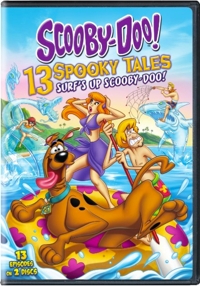
“Scooby-Doo! and the Beach Beastie” is a brand-new 22-minute cartoon and the sixth direct-to-DVD offering of its kind. But when you compare this latest effort with the “filler” added to flesh out the two-disc Scooby-Doo! 13 Spooky Tales: Surf’s Up, Scooby-Doo!, you almost wish that Warner Bros. had substituted a few more older episodes instead. “Beach Beastie” is by far the weakest, a going-through-the-motions affair that relies too much on Fred’s paranoia over nets and Scooby’s new love interest. It also offers too little in the way of mystery and phony monster moments—the two driving forces behind the popular franchise. What we get this time is a water monster that we’ve seen too many times before in other films.

Though a few voiceover actors and the style of drawing and animation changed over the years, the formula remains mostly the same: the Mystery, Inc. gang (timid Great Dane Scooby-Doo, always hungry Shaggy, bookish Velma, stylish Daphne, and All-American guy Fred) rambled onto the scene where a monster or ghost was terrifying people. Sometimes they were hired to get to the bottom of things, while other times they helped out a friend or simply “fell into” a mystery while trying to take a vacation—often to some exotic location. And always the unmasking revealed a phony monster with someone inside or with a remote control manipulating it for revenge or personal gain.

I don’t know if Warner Bros. deliberately chose “filler” episodes from a full range of Saturday-morning Scooby-Doo! cartoon shows, but to me that variety is the chief bonus. You really get a sense of the whole arc of this franchise. If only Warner Bros. had arranged the episodes in order, so viewers could better see how the characters and the series developed over 40 years. As is, the episodes are arranged either thematically (if you’re a glass half-full person) or randomly (if half-empty).  More

THE BEST OF THE ED SULLIVAN SHOW: 6-DVD COLLECTOR’S SET

Leave a comment

EdSullivancoverGrade: C+
Entire family: Yes, but….
1948-71, 444 min., B&W and Color
Not rated (would be G)
StarVista
Aspect ratio: 1.37:1
Featured audio: Dolby Digital 2.0
Bonus features: C+/B-
Amazon link

Baby Boomers grew up with The Ed Sullivan Show, the last great variety series that TV produced. From 1948 to 1971, families tuned in every Sunday night to watch Sullivan’s TV version of the old vaudeville shows: an odd and often surprising mixture of novelty acts, animal acts, musical acts, and comedy acts. But he also introduced cutting-edge rock ‘n’ roll, soul, and pop bands, and it was such an American tradition that The Ed Sullivan Show was immortalized in the Broadway play Bye Bye Birdie and ranked #15 on TV Guide’s list of 50 Greatest TV Shows of All Time.

Most people who buy this set will do so because of nostalgia. Like me, they grew up watching Sullivan and, like so many comedians, probably even tried their hand at imitating him. Many Americans first saw Elvis Presley and The Beatles on Sullivan’s show, and this 6-DVD Collector’s Set celebrates those milestones and others.

But there are two things that you should know about this set. First, five of the discs have been previously available as single DVDs. The Very Best of The Ed Sullivan Show, Vol. 1: Unforgettable Performances is the same disc we get here—a clip show hosted by Carol Burnett. Same with The Ed Sullivan Show: 50th Anniversary Special (a clip show hosted by The Smothers Brothers), The Ed Sullivan Show: The All-Star Comedy Special (another clip show hosted by Mary Tyler Moore), The Ed Sullivan Show: World’s Greatest Novelty Acts, and The Ed Sullivan Show: Amazing Animal Acts. The sixth disc of bonus interviews included in this set seems culled from the two main clip shows.

The other thing you should know is that there isn’t a single complete show included in this collection, and the clips are REALLY clipped. My family isn’t a fan of clip shows, because you don’t get the full context or, in this case, even the full performance most of the time. Everything is just a snippet here and a snippet there, and with so many different clip DVDs there’s a lot of repetition, too.

The only disc where you are really okay with the length of the clips is the Amazing Animal Acts disc. That’s because the idea of animals performing tricks is enough of a unifying theme that you don’t mind seeing only snippets . . . plus, the clips vary in length, with some of the performances longer than others, and some close to complete appearances. There are trained birds that count, a dog that counts, chimps that do acrobatic routines and walk on stilts, trained sea lions, elephants, a bear that grabs an ice cream cone right out of Sullivan’s mouth, and a historic moment when lion tamer Clyde Beatty assembled his act on a smaller-than-usual stage against his better judgment and lost control of a lion. Rather than focus on the problem on center stage, Sullivan walks into the audience to introduce celebrities. You can hear Beatty firing blanks in the background as he tries to scare the big cat back into submission. There are a number of moments like that on this five-disc clip compilation, but few that run as long or feel as complete. If you remove nostalgia from the equation, the “Amazing Animal Acts” disc is probably the only disc that my family enjoyed, and you can pick up the Amazing Animal Acts DVD separately for $14.95.

Don’t get me wrong. We liked seeing Bill Haley and the Comets, Elvis Presley, Sonny & Cher, The Byrds, Janis Joplin, and The Beatles, but with each of those acts we wanted more. The clips felt like a tease, and I frankly would have preferred a set that offered the two main clip shows plus discs that featured complete installments of The Ed Sullivan Show so that today’s families could really get a taste of what their counterparts 50 years ago watched. And it’s surprising how much of the comedy in that clip show seems dated or is no longer funny. Were they really the best of the show’s long run? It didn’t seem so to us.

Bottom line: The Ed Sullivan Show is an American classic, but chopping it into itty bitty pieces isn’t the best way to experience it.

THE BRADY BUNCH: COMPLETE SERIES (DVD)

1 Comment

BradyBunchcoverGrade: B
Entire family: Yes
1969-74, 2,980 min. (117 episodes), Color
Not rated (would be G)
CBS/Paramount
Aspect ratio: 1.33:1
Featured audio: Dolby Digital Mono
Includes: 20 discs in sturdy plastic case w/cardboard slipcase
Bonus features: C+
Amazon link

The Brady Bunch was one of the very last squeaky-clean family sitcoms in the old ’50s mold, airing as an anachronism of sorts during the Vietnam War years amid the chaos of Civil Rights, women’s rights, and anti-war protests. But in the Brady household, father Mike, a working architect, was still king of the castle with a den all his own, while his wife, Carol, was a stay-at-home mom who had the luxury of a servant. The children got into all sorts of minor conflicts and mischief, but none of the storylines tackled serious parental concerns of the day. Everything was sibling rivalry and innocent mix-ups.

There were conflicts over clubhouses, shared things and spaces, class elections, invented boyfriends, broken things that had to be replaced, and even talent shows. Drugs? Not here. Peer pressure to smoke? Only briefly. Teen pregnancy? Please! While other teens from the time were raiding their parents’ liquor cabinets, this group was content to raid the cookie jar. No one got into really serious trouble, and there was usually a lesson to be learned . . . from dad. When he wasn’t around, there was always mom or Alice, the housekeeper/cook (Ann B. Davis), to help them find their way.

First telecast on Sept 26, 1969, the show was a surprise hit, no doubt because it felt like comfort food to Americans who snuggled together during a turbulent era to watch and relive happier, more uncomplicated times. Divorce was becoming a widespread phenomenon for the first time, and the show about BradyBunchscreen1second-chance family life probably struck a chord with broken families. The range of the Brady children’s ages (7 through 14, when the show began) was broad enough for most youngsters to identify with. Airing on Friday nights, the show connected especially with children too young to have a social life, or, like the Bradys, too awkward and introverted. The Brady Bunch never finished in the Nielsen Top-30 and never won any Emmys, yet the show has become a cultural icon, lampooned in two feature films and held up as an example of one of the last wholesome family sitcoms to be telecast . . . before TV sitcom families would start spouting one-liners and zapping each other with zingers, before families (or rather, writers) got “hip.”   More

ISLAND OF LEMURS: MADAGASCAR (Blu-ray combo)

Leave a comment

IslandofLemurscoverGrade: B
Entire family: Yes
2014, 39 min., Color
Rated G
Warner Bros.
Aspect ratio: 1.78:1
Featured audio: English DTS-HD MA 7.1
Includes: Blu-ray, 3D Blu-ray version, DVD, Digital HD
Bonus features: B-
Trailer/Amazon link

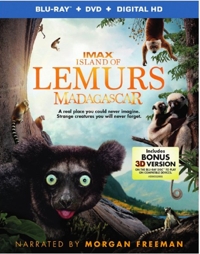
Island of Lemurs: Madagascar is a nature film made for IMAX theaters, not for a PBS viewership—meaning it’s geared for a popular audience rather than one looking to learn every detail they can about animals and their environment.

IMAX movies are typically experiences—movies shot in higher definition on 70mm film that can then be shown on screens way larger than anything you’d see in a standard movie theater, and with no loss of detail if you sit in the front rows. Shots have tended toward the dramatic—aerial panoramas, whales breeching, fires blazing out of control, and wilderness adventures—with early short films including The Eruption of Mount St. Helens!, Fires of Kuwait, and Alaska: Spirit of the Wild. So it’s somewhat of a deviation for a less naturally dramatic nature film like Island of Lemurs: Madagascar to get the IMAX treatment.

Featured primatologist Patricia Wright worked tirelessly to establish a 107,000-acre national park on the island of Madagascar to protect the 12 species of lemurs that live there. Maybe she has connections (or fans) in high places, because there isn’t a better way to raise awareness of a cause than with a 3D IMAX movie.

Wright and her work are showcased in Island of Lemurs, but the stars are, of course, the lemurs themselves. Lemurs tend to hop and jump a lot, using their strong hind legs, and there’s amazing footage of Sifakas, who naturally hop sideways so that it looks like they’re dancing, hopping across a beach. We also see Brown Mouse Lemurs, a little tinier and pudgier than the others, fearlessly flinging themselves from tree to tree. And we watch Indriids and their peculiar way they have of “singing.” You can look up information on these and find that their calls can be heard more than a mile away, but you won’t get that kind of specific information here. IMAX is a celebration of exotic places and phenomena, and the emphasis here is on these amazing creatures themselves.   More

THE ROAD TO HONG KONG (Blu-ray)

Leave a comment

RoadtoHongKongcoverGrade: B
Entire family: Yes, but young ones may not “bite”
1962, 91 min., black and white
Olive Films
Not Rated (would be G)
Aspect ratio: 1.66:1 widescreen
Featured audio: DTS-HD MA 2.0
Bonus features: None
Trailer

In May 1962, theatergoers saw two movies about the space race and secret organizations intent on world domination. One was the first James Bond film (Dr. No), and the other was The Road to Hong Kong, the last “Road picture” with Bing Crosby, Bob Hope, and Dorothy Lamour.

Ironically, Hong Kong, the first of the Road pics to make it onto Blu-ray, is also the weakest. My 17-year-old son watched this black-and-white comedy with me and was surprised to hear that. He gave it a solid B. “It had some stupid parts,” he said, pointing a finger at the ending, especially, “but it was also pretty funny.”

He’s right. While Road to Singapore (1940), Road to Zanzibar (1941), Road to Morocco (1942), Road to Utopia (1945), Road to Rio (1947), and Road to Bali (1952—the only one in color) are all better, The Road to Hong Kong is still entertaining.

Comedian Bob Hope and crooner Bing Crosby struck gold in the ‘40s playing a pair of vaudevillians slash con artists who somehow got involved in dangerous situations, with Crosby always duping Hope and the two of them always running into the singing siren Dorothy Lamour along the way. In each installment there were corny song-and-dance numbers, plenty of jokes and one-liners, at least one opportunity for Crosby to sing, and running gags about how Crosby always gets the girl and the best of his partner.

Hong Kong was the equivalent of a reunion show, and Crosby and Hope have clearly lost a little of their comic edge. In fact, a younger Peter Sellers doing a cameo as an Indian doctor reminds us that the two stars used to be much faster and glibber with their banter. Yet, they weren’t that old. Crosby and Hope were 59 at the time the movie was made, so it’s more likely that the 10-year-hiatus since they last worked together was responsible for the jokes not being as rapid-fire as usual. And while previous Road pictures were largely ad-libbed, this one felt mostly scripted.

Is that bad? No . . . unless you’re Dorothy Lamour, who was relegated to a cameo nightclub scene. Instead, then-hot Joan Collins was given the female lead. She does a decent job, but the chemistry just isn’t the same as it was when Lamour heated up the screen . . . and both of her co-stars.

RoadtoHongKongscreenIn Hong Kong, which spoofs ‘60s spy films before many of them had even been made, Hope and Crosby play a couple of cons selling “do-it-yourself interplanetary flight kits” that ends up giving Hope’s character amnesia. They go to a monastery for a cure, but along the way they end up mistakenly picking up a suitcase from a Third Echelon agent and are mistaken for the spies who are to give them a Russian rocket fuel formula. The plot thickens when Hope’s character receives a memory boost at the monastery and he can rattle off the entire formula from pages that his partner sticks in front of him as a test. The result is that they soon become entangled with a Third Echelon agent (Collins) and end up at the secret underwater base where the Third Echelon leader (Robert Morley) and his chief scientist Zorbb (Walter Gotell) are preparing to launch a rocket into space carrying chimps. But what better way to dispose of an “inconvenience” than by substituting them for the apes?

A space gag about forced feeding of the apes goes on a bit too long (which will make it the only funny part for very young viewers), and yes, if you don’t know the history of the Road pictures and how they break the fourth wall with almost every ending, the finale can seem hokey. But as a spy spoof and a Road reunion, The Road to Hong Kong does a pretty decent job.

And Olive Films, which has been producing a nice catalog of oldies on Blu-ray, did a very nice job on the transfer. They’ve quickly become a name you can trust for old movies on HD.

Older Entries Newer Entries