Home

Review of THE PAPER TIGERS (Blu-ray)

1 Comment

Grade:  B-
Action comedy-drama
Rated PG-13

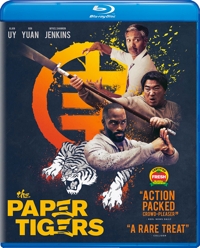
If your family loved Cobra Kai—or even The Karate Kid films that preceded the popular TV series—and you’re looking for another martial arts offering that balances medium-intensity action, drama, and humor, you might consider The Paper Tigers. Yuji Okumoto, who appeared in the second Karate Kid film and also Cobra Kai, was the film’s producer.

This English-language 2020 martial arts film from director Quoc Bao Tran is as much in the tradition of old-guys-proving-they’ve-still-got-it tradition of films like Space Cowboys (2000) and Old Dogs (2009) as it is the kung fu movies. But don’t fear, younger viewers, there’s young martial arts action too. It’s just that the focus is on three middle-aged men whose bodies have seen better days. In other words, this isn’t your typical Asian martial arts film, though it does have an almost obligatory memorable fight scene.

The Paper Tigers features three likable guys who are just that: guys. Too many martial arts films are all action with nothing but paper characters—kung fu wizards who do little more than kick, block, and punch their way through every scene. The heroes of this film are Everymen, real flesh-and-blood people who just happen to have bonded in the youth when they were “The Three Tigers,” as their master dubbed them. One of the characters happens to be African American and the other two Asian American, but all three are treated as people because “at the end of the day, we wanted to tell a fun, entertaining story that depicted our experience honestly,” Tran told the media.

More
Review of THE BRASS BOTTLE (Blu-ray)

Leave a comment

Grade:  C+/B-
Comedy
Not Rated (would be PG)

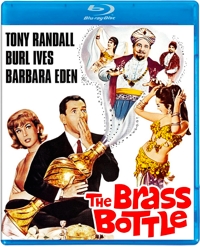
The mid-‘60s gave viewers two sitcoms featuring women with magical powers: Bewitched, an ABC-TV series about a witch married to a mortal, and I Dream of Jeannie, an NBC comedy about an astronaut who splashes down near a deserted island and finds a bottle containing a beautiful genie determined to serve (and exasperate) him.

As with “The Munsters” and “The Addams Family,” audiences were split over which show was better. It’s the fans of I Dream of Jeannie who are going to want to see The Brass Bottle, because it provided the inspiration for the TV show. After Bewitched became a smash hit when it debuted in October 1964, creator-producer Sidney Sheldon wanted to develop a similar property for NBC. Sheldon had seen The Brass Bottle, which opened in theaters in May of that year, and the concept seemed perfect. All he had to do was make a few changes, and the rest was television history.

The Brass Bottle was the third film inspired by the 1900 novel of the same name, and as it turns out, British writer Thomas Anstey Guthrie was probably born in the wrong century. The fantastic elements of The Brass Bottle drew praise from none other than George Orwell, and an earlier comic novel, Vice Versa, was about a father and son who change places because of magic. That novel was made into a 1981 British TV series and a 1988 American film. It also inspired modern retellings like Freaky Friday, Big, and Seventeen Again. In other words, the old Victorian writer would have made one heck of a good screenwriter.

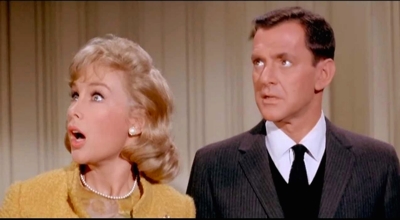
Though The Brass Bottle doesn’t have the madcap mayhem of slapstick or screwball comedy, the plot and dialogue are clever. The film might have played out like a fable, but there’s more complexity here and it’s fun to see how similar yet totally different The Brass Bottle is from I Dream of Jeannie. It’s equally fun to see the star of I Dream of Jeannie as a mortal in this fantasy.

More

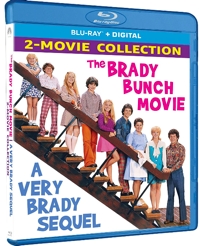
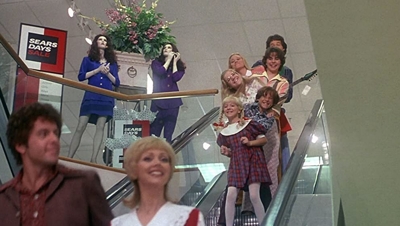
Review of THE BRADY BUNCH MOVIE (2-Movie Collection Blu-ray)

Leave a comment

Grade:  B-
Comedy
Rated PG-13

The Brady Bunch was one of the very last squeaky-clean family sitcoms in the old ’50s mold, airing as an anachronism of sorts during the Vietnam War years amid the chaos of Civil Rights, women’s rights, and anti-war protests. But in the Brady household, father Mike, a working architect, was still king of the castle with a den all his own, while his wife, Carol, was a stay-at-home mom who had the luxury of a servant. The children got into all sorts of minor conflicts and mischief, but none of the storylines tackled serious parental concerns of the day. Everything was sibling rivalry and innocent mix-ups. Drugs? Not here. Peer pressure to smoke? Only briefly. Teen pregnancy? Oh behave! And while other teens from the time were raiding their parents’ liquor cabinets, this group was content to raid the cookie jar. No one got into really serious trouble, and there was usually a lesson to be learned . . . from dad. When he wasn’t around, there was always mom or Alice, to help them find their way. The theme song explained the premise:

“Here’s the story . . . of a lovely lady
Who was bringing up three very lovely girls.
All of them had hair of gold, like their mother,
The youngest one in curls.

Here’s the story . . . of a many named Brady,
Who was busy . . . with three boys of his own.
They were four men, living all together,
Yet they were all alone.

Till the one day when the lady met this fellow,
And they knew that it was much more than a hunch
That this group would somehow form a family,
That’s the way we all became the Brady Bunch.”

First telecast on Sept 26, 1969, the show was a surprise hit, no doubt because it felt like comfort food to Americans who snuggled together during a turbulent era to watch and relive happier, more uncomplicated times. Divorce was becoming a widespread phenomenon for the first time, and the show about second-chance family life probably struck a chord with broken families. Plus, the range of the Brady children’s ages (7 through 14, when the show began) was broad enough for a wide range of youngsters to identify with. Airing on Friday nights, the show connected especially with children too young to have a social life, or, like the Bradys, too awkward and introverted.

More

Review of BRINGING UP BABY (Criterion) (Blu-ray)

Leave a comment

Grade:  A-/B+
Comedy
Would be PG

The dictionary says the noun “screwball” is a baseball pitch or “a crazy or eccentric person.” Baseball may be listed first, but when it comes to the adjective it’s all about film:  “crazy, absurd—relating to or denoting a style of fast-moving comedy film involving eccentric characters or ridiculous situations.”

The dictionary probably should have added, “See Bringing Up Baby,” because Howard Hawks’ 1938 comedy starring Katharine Hepburn, Cary Grant, a leopard and a dog is widely considered the quintessential screwball comedy.

Screwball comedies became popular as people could see the light at the end of the tunnel that had been the Great Depression. Often the films involved a romantic couple from different social classes, with one of them a screwball. Plots revolved around an unconventional “courtship” that began as annoyance and ended with attraction. In that respect they’re the quintessential “opposites attract” movies as well.

Screwball comedies are characterized by a flipped social script that featured women as the pursuer and men as passive or befuddled objects of desire. Basically, it was a comic twist on the femme fatale moviegoers saw in the film noir crime movies of the ‘20s and ‘30s. Fast talk and overlapping dialogue were also characteristics of the screwball comedy, as were farcical situations, mistaken identities and misunderstandings, physical comedy, witty and fast-paced plots, and “out-of-uniform” comic situations. What’s more, the “meet cute” that’s become a standard convention in romantic comedies was pioneered by screwball comedies.

This one stars Katharine Hepburn, for whom the screenplay was written. Cary Grant was cast at the suggestion of director Hawks’ friend, the reclusive billionaire Howard Hughes. Bringing Up Baby took four months to shoot, as production was frequently delayed because Grant and Hepburn kept cracking each other up. It was Hepburn’s first comedy, and when she struggled with the fast talk it made Grant laugh, and that made her laugh. They generate an off-the-rail runaway train energy that the best screwball comedies have, and their energy is contagious.

More

Review of MINARI (Blu-ray)

Leave a comment

Grade:  A-/B+
Drama
Rated PG-13

Minari, a film in Korean and English, earned a Best Supporting Actress Oscar for Youn Yuh-Jung and nominations for Best Picture, Best Actor, Best Director, and Best Original Score. Youn, a legendary actress in the Korean film industry, plays a grandma who travels from Korea to Arkansas at the request of her daughter, who is having a hard time adjusting to her family’s move from California.

In California, Monica (Han Ye-ri) and husband Jacob (Steven Yeun) were on track to pay off debt by “sexing chicks” and separating males from females. But Jacob wanted more for her and their children Anne (Noel Cho) and fragile young David (Alan S. Kim), so he moved the family to Arkansas to sex chicks for an outfit that also gave Jacob an opportunity to start his own farm specializing in Korean vegetables. 

Leisurely paced, lyrical, and stylistic kin to Terrence Malick’s The Tree of Life, this film hit close to home for the director. Lee Isaac Chung grew up as the young son of Korean immigrants who settled on a small farm in rural Arkansas, and there’s a truthfulness that quietly percolates beneath the surface of Minari—the name of a plant also known as Korean watercress or parsley that the grandma decides to plant on the banks of a nearby creek.

“Minari is truly the best. It grows anywhere, like weeds, so anyone can pick and eat it. Rich or poor, anyone can enjoy it and be healthy. Minari can be put in kimchi, put in stew, put in soup. It can be medicine if you are sick. Minari is wonderful, wonderful!” the grandma Soonja tells David.

Director Chung had said he initially wanted to make a film adaptation of My Antonia but found that avenue closed. He then decided to make a film about his own upbringing in rural Arkansas.

More

Review of FINDING FORRESTER (Blu-ray)

Leave a comment

Grade: B+/A-
Drama/Comedy
Rated PG-13

J.D. Salinger wrote three books, then disappeared into Howard Hughes-style oblivion and inspired at least two films.

In Field of Dreams, Kevin Costner’s character shakes a Salinger type (James Earl Jones) recluse out of his inertia, paranoia, and humanity-avoidance in order to satisfy the voices in his head that also told him to build a baseball field.

In Finding Forrester, aspiring 16-year-old writer Jamal Wallace ends up finding the all-time greatest mentor when on a dare he climbs through the window of a “ghost” who had been watching him and his friends play basketball and, scared off, leaves behind a backpack containing his writer’s notebook.

In a case of life imitating art, Rob Brown showed up for tryouts as an extra on this picture by Gus Van Sant (Good Will Hunting) hoping to earn enough money to pay his cell phone bill. But Van Sant liked what he saw and cast him as Jamal, who soon after that break-in finds his backpack tossed out on the street and his writer’s notebook marked up and critiqued by the older writer. On one page he sees a handwritten scrawl, “I want to support this writer.” And so begins a mentorship between Jamal and famed writer William Forrester that will benefit both parties.

It’s kind of refreshing to see African American youths in their lower-income neighborhoods playing basketball and going to school and hanging out without there being any hint of violence or gang activities—the kind of cinematic clichés that have befallen films having to do with residents of “the hood.” The only f-bomb in this PG-13 film comes from an old white man (Sean Connery as Forrester), and the worst behavior comes from uppity adults associated with the private school that recruits Jamal after his test scores expose him as a bit of a genius. It’s refreshing, too, that none of Jamal’s neighborhood friends resent him for transferring to a private school and, ultimately, playing for a championship that’s televised.

More

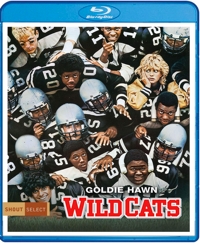
Review of WILDCATS (1986) (Blu-ray)

Leave a comment

Grade:  B/B-
Comedy
Rated R

One of my guilty pleasures recently came out on Blu-ray:  Wildcats, starring Goldie Hawn. You know, Kate Hudson’s mom?

Back in the day, Hawn was a huge star, and it didn’t take her long to get there. After a failed TV series (Good Morning World) and two minor roles in films, she landed a plum role opposite Walter Matthau in Cactus Flower and won an Oscar for Best Supporting Actress. Piece of cake, right? Except that after that she was cast in a succession of make-a-buck films that tried to capitalize on her popularity and personality in the ‘70s and ‘80s.

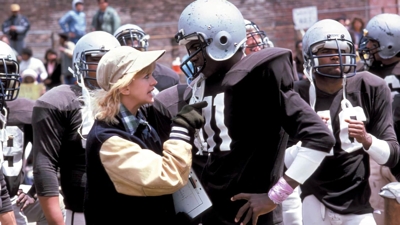
Along with Private Benjamin (1980), Seems Like Old Times  (1980), and Overboard (1987), Wildcats is one of the better formulaic light comedies that Hawn made. In it, she plays the daughter of high school football coach who finally gets the chance to realize her own dream of coaching football . . . at an inner city school.

Right . . . to use the catch-phrase of comedian Nipsey Russell, who plays the principal at that school.

Wildcats would be fun viewing for the entire family if it wasn’t rated R for language (F-bombs included), teen drinking and drunkenness, and brief nudity, because the whole high-school setting and fish-out-of-water, win-them-over storyline is meant to be as upbeat and warm-hearted as it is humorous. It’s hard not to root for Molly as she endures sexism in the workplace, resentment and disrespect from her players, and meddling/bullying from an ex-husband en route to trying to coach a bunch of losers into lovable winners.

More

Review of RAYA AND THE LAST DRAGON (Blu-ray combo)

Leave a comment

Grade:  A-/B+
Animation
Rated PG

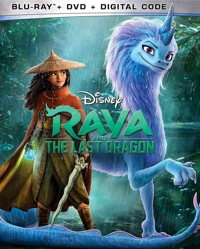
Some twelve weeks after its theatrical debut, Raya and the Last Dragon is the third highest grossing film in the U.S., behind Spiral and Wrath of Man. With a domestic box office of $49.3 million and another $60.6 million international box office revenue, it’s exceeding expectations, and I’d like to suggest one reason why:  Disney animators always seem to up their game, and they did so again with Raya.

The martial arts swordfights in this 59th full-length feature from Disney are the most accomplished I’ve seen so far in the world of animation—presented at a speed you’d normally encounter in the best Ip Man, Bruce Lee, and Jackie Chan movies. Combine that with gorgeous backgrounds and character animations, and Raya and the Last Dragon is another solid effort from the House of Mouse—though the plot itself can seem a bit familiar.

Set in a dystopian fantasy world, Raya and the Last Dragon begins with the backstory of a fictional land (Kumandra) where dragons and people once thrived together until evil spirits (that look a bit like the smoke monster on Lost)terrorized the land and turned dragons and people to stone—except for some people and one dragon, who focused the magic she and other dragons had on a single gem. But you do the math: one gem and five tribes? Of course they fight over it, and the pieces are eventually scattered among those tribes. Hundreds of years later, the Druun return and wreak havoc on the now-separate sections of what was once Kumandra. Raya is the daughter of Chief Benja of the Heart tribe, while her once friend and now rival, Namaari, is the princess of the Fang tribe. But like any fantasy, the story itself seems more complicated than the visual action. Relax and enjoy this simple quest story, as Raya tries to find the last dragon, recover the jewel pieces, and defeat the Druun once and for all. Unless Namaari beats her to it.

Give Disney credit, though, for creating strong female characters without drawing attention to it, without adding a Prince or love interest, and for not making a big deal out of adding two more princesses to the merchandising Pantheon. Give them credit, too, for giving Asians and Asian Americans feisty princesses that look like them—even if Disney took a little flak (what else is new?) for not featuring enough South Asian actors among the voice talents.

More

Review of THE MARKSMAN (Blu-ray)

Leave a comment

Grade:  B-/C+
Action thriller
Rated PG-13

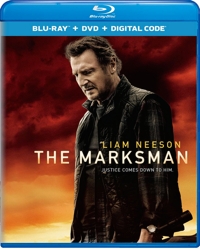
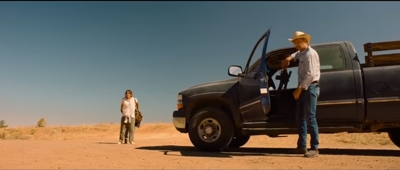
From the first scene where an aging Arizona rancher (Liam Neeson) stumbles onto a cartel “situation” and ends up with a bag full of money, to a scene that’s the equivalent of the Coen Brothers’ “coin toss scene,” The Marksman feels like a cheap knockoff of No Country for Old Men.  And with a little Hunt for the Wilderpeople added for good measure.

What cheapens it isn’t Neeson’s performance, but rather a formulaic approach to ticking off the boxes rather than concentrating on creating characters and relationships with any individuality or depth.

For one thing, first-time director Robert Lorenz spends too much time in the early going just establishing a few facts that could have been hinted at more subtly: 

—Jim Hanson was a Vietnam War veteran who earned a medal for marksmanship

—Jim Hanson is lost and lonely because his wife died of cancer

—Jim Hanson is going to lose his ranch unless he can come up with a lot of money to pay for back mortgage payments

The film is also marred by characters that push past stereotypes into caricature country.

Javier Bardem has nothing to fear from the cartel bad ass that Lorenz gives us here. Mauricio—called “Heffe” and played by Juan Pablo Raba—is too cartoonish to be chilling. He’s just a bad guy who sneers a lot and stares a lot in lingering close-ups. Oh we believe him when he says he’s going to kill the old rancher who drove away with the son of a Mexican woman he already killed at the border. And we believe he’s determined to recover the drug money that the boy’s (now deceased) uncle had taken from him and given to his (now deceased) mother. But Bardem as Anton Chigurh was a one-and-done, just as Heath Ledger’s lizard-tongued Joker was a one-time affair. Try to duplicate it and you’re doomed to fall short.  

More

Review of MAMBO MAN (DVD)

Leave a comment

Grade: B/B-
Drama
Not rated (would be PG)

Good art of any kind expands your world or your mind—often both. And films that show us a way of life, a way of perceiving life in another region or country can be more than fascinating. They can be instructional on a subliminal level. If you’re the kind of person who drives through a small town and looks in the windows of houses and shops wondering what it would be like to live there, the fictional Mambo Man is your kind of movie. And if you loved Buena Vista Social Club because it was awash with Cuban music, well, Mambo Man is your kind of movie too.

This 2020 Cuban film is full of fantastic images of life as it’s lived in in mostly rural Cuba, and the wonderful cinematography by Luis Alberto and Gonzalez Garcia is further enhanced by near-constant non-diegetic Cuban music that, along with several performances written into the screenplay, really capture the essence of life on this Caribbean island just 105 miles from Key West.

Edesio Alejandro and Mo Fini co-directed this film, which was shot mostly in the southeastern cities of Bayamo and Santiago de Cuba. Fini is the founding director of Tumi Music, which has produced more than 300 Latin CDs and videos, so it’s no wonder that music plays as much of a role in Mambo Man as the scenery and cinematography. Some scenes include live music performed by such legendary Cuban musicians as Candido Fabre, Maria Ochoa, Alma Latina, David Alvarez, and Arturo Jorge. The soundtrack features members of the Buena Vista Social Club—among them Grammy winner Eliades Ochoa, Juan de Marcos Gonzalez of the Afro-Cuban All Stars, Omara Portuondo, and many others that fill the screen with a rich tapestry of songs. More

Older Entries Newer Entries