Home

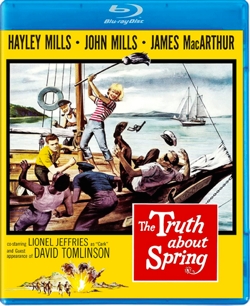
Review: The Truth About Spring (Blu-ray)

Leave a comment

Grade:  C+/B-

Family Adventure-Romance

Not rated (would be PG)

In the late ‘50s and early ‘60s, two young Disney stars were among the most popular on the planet: Mouseketeer Annette Funicello and British actress Hayley Mills, whose debut with Disney (Pollyanna, 1960) earned her the last special Juvenile Oscar awarded. A year later she starred as separated twins trying to reunite their divorced parents in The Parent Trap, and a song she performed, “Let’s Get Together,” reached No. 1 on the charts in the U.S.

For a decade, Hayley was big—even bigger than Annette. Stanley Kubrick offered her the title role in Lolita (which her father, Sir John Mills, turned down), and her performance in the 1961 British film Whistle Down the Wind (an adaptation of a novel written by her mother) earned her a BAFTA Best British Actress nomination. She also was voted the biggest star in Britain that year.

The Truth About Spring(1965) was the third film Mills made with her famous thespian father—fourth, if you count the elder Mills cameo as a golf caddy in The Parent Trap—and this star vehicle plays very much like an affectionate last daddy-daughter hurrah before the later leaves the nest, as Hayley would. Just a year later her father would direct her Sky West and Crooked and she would marry adirector 33 years her senior from The Family Way, in which John Mills had only a minor rle. So there’s something inherently poignant in the Mills pairing in The Truth About Spring.

If you don’t look at the credits, you’d swear that this film was made by Disney, with the familiar musical cues, structure, characters, tone, and direction—except that it’s not. Universal made this one and tried the Disney formula, with disappointing effects.
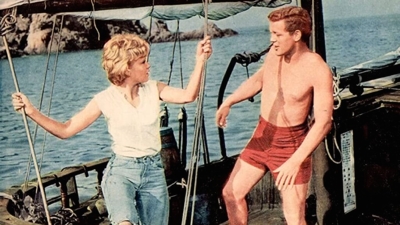
In his autobiography, John Mills wrote, “If the picture had turned out to be half as good as the food, the wine, the time and the laughs we had on that location it would have been a sensation—unfortunately it wasn’t.”

Though it’s also an adventure with some romance involving a young girl initially dressed as a boy, The Truth About Spring wasn’t nearly as successful as Disney’s Swiss Family Robinson (1960), in which the elder Mills played the father of a family marooned in the early 1800s on an island paradise. That film had real pirates and a lush tropical setting full of all sorts of animals and a cast of characters that provided plenty of side stories.

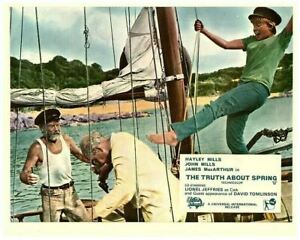
This adventure allegedly took place in the Caribbean. But the scenery was actually the barren rocky coast of southern Spain, and the pirates are contemporary—pirate in spirit and function, not dress.  There may be a treasure hunt, but it somehow seems nothing more than a plot device.

Other than two groups of “pirates,” The Truth About Spring also has only the two Mills and Swiss Family Robinson veteran James MacArthur (perhaps most famous for his role as Danno on TV’s Hawaii Five-O) for plot possibilities. For much of the film they’re aboard a small sailing vessel where the free-spirited con-artist Tommy Tyler (J. Mills) lives with his daughter, Spring. Into their lives comes William Ashton (MacArthur), a newly minted young lawyer who’s on his uncle’s yacht for a vacation before starting his job in Philadelphia.

Looking to work another con, Tommy invites him to jump ship to do a little fishing on their sailboat, and the next thing you know Ashton is accepting an invitation to spend a few weeks on their boat. Contrived? Certainly. But once you get past a hokey title sequence, there’s a wholesome charm to this coming-of-age film that remains all these years later.
Entire family:  Yes

Run time:  102 min. Color

Studio/Distributor:  Universal / Kino Lorber

Aspect ratio:  1.85:1 anamorphic widescreen

Featured audio:  DTS 2.0

Bonus features:  C+

Amazon link

Not rated (would be PG for some peril and social drinking)

Language: 1/10—I didn’t hear a single word, but I’m listing it as a 1 just in case . . .

Sex: 1/10—A first and second kiss, and a playboy uncle surrounded by cougars

Violence:  2/10—Guns are pulled, but no one is shot; there’s an explosion, but no one is hurt; and the fight against pirates involves punching, pushing, and whacking them with a mop

Adult situations: 1/10—Cocktails are held aboard the yacht, and Tommy channels his inner Popeye by smoking a pipe (and cigars)

Takeaway:  Hayley Mills still has a loyal following, and that fan base will be happy to have this seldom-broadcast film in their Blu-ray collections
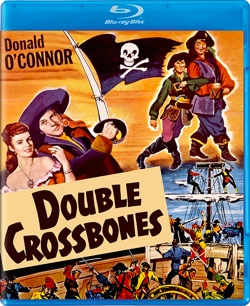
Review of DOUBLE CROSSBONES (Blu-ray)

Leave a comment

Grade:  B-/C+

Adventure Comedy

Not Rated (would be PG)

Today’s audiences know Donald O’Connor mostly as the third wheel in the 1952 Gene Kelly and Debbie Reynolds musical romance Singin’ in the Rain—you know, the “Make ‘Em Laugh” guy?

But O’Connor, a former vaudevillian, also had his share of top billings, starting with 1938’s Tom Sawyer, Detective and continuing with a series of romantic leads and Francis the Talking Mule pictures. Typecast as a mild-mannered nice guy / funny man, he became Universal’s version of Bob Hope. 

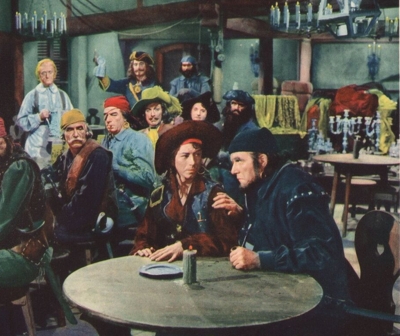
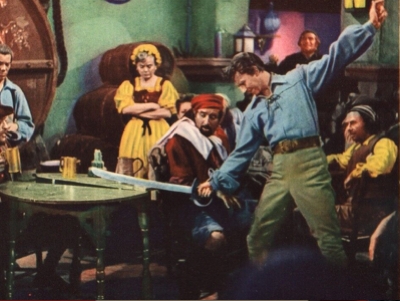
Hope made a Western comedy-musical in 1950 (Fancy Pants), and so did O’Connor (Curtain Call at Cactus Creek). Double Crossbones, which followed a year later,is Universal’s answer to the Hope comedy The Princess and the Pirate, in which a bumbling non-pirate finds himself at sea pretending to be one.

While the Hope film is a classic comedy that was frequently televised and released for home video, Double Crossbones got buried somehow—a forgotten little treasure that was recently dug up by Kino Lorber and released for the first time on Blu-ray for family home theaters. Like many films from the ‘50s, it’s a fun costumed romp that’s heavy on light entertainment, with a plot that’s just complicated enough to keep it interesting.

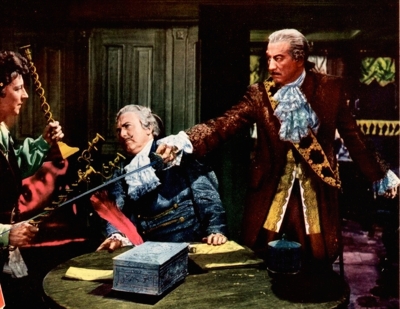
O’Connor is engaging as always, but surprisingly up to the task of shivering a few timbers and slitting a few gullets—far less cowardly than Hope’s characters. He plays shopkeeper’s apprentice Davy Crandall, whose boss turns out to have been selling stolen merchandise bought from pirates. When he’s wrongfully accused of being one of the pirates, Davy ironically takes to the high seas with his newfound sidekick (Will Geer) and bumbles his way across the Spanish Main to the top of the brotherhood (and sisterhood—pirate Anne Bonny makes an appearance).

Double Crossbones is directed by Charles Barton, who would later direct Disney’s The Shaggy Dog (1959), and in both films the comedy is mostly situational. Fans of classic TV will recognize Geer as the grandpa from The Waltons and Hayden Rorke as the suspicious Dr. Bellows from I Dream of Jeannie. And if the actor playing Captain Kidd looks familiar, it’s because Alan Napier would go on to play Bruce Wayne’s butler, Alfred, in the campy sixties Batman series.

There’s action, but the violence is minimal compared to films today.

There’s comedy, but the jokes aren’t as clever or in-your-face as in films today.

There’s drama, but not the melodrama of most films of the era or the anxiety-driven films of today.

As I said, Double Crossbones is light entertainment, but fun and watchable light entertainment that manages to sneak in a comic dance routine from O’Connor . . . who indeed makes his cutlass-and-pistol-wielding audience laugh.

Will he have the same effect on audiences today? Probably not. Hope’s The Princess and the Pirate (1944) is still the better movie of the two, and The Crimson Pirate, Treasure Island, and Against All Flags are the best of the pirate movies that Hollywood made in the fifties. Everything else falls somewhere in the 2-2 ½ star range out of 4, and Double Crossbones lands near the higher end of those colorful genre films. It’s guilty pleasure pirate booty that still makes for an entertaining family movie . . . perhaps as the warm-up for one of Disney’s Pirates of the Caribbean movies?

Entire family:  Yes

Run time:  76 minutes Color

Studio/Distributor:  Universal / Kino Lorber

Aspect ratio:  1.37:1

Featured audio:  DTS 2.0

Bonus features:  C

Amazon link

Trailer

Not rated (would be PG for some violence)

Language:  1/10—Squeaky clean, but I might have missed something

Sex:  0/10—Tepid, not torrid, love interest, with an occasional embrace

Violence:  3/10—There are swordfights (uh, “Pirate!”) and brawls, but nothing cringeworthy

Adult situations:  2/10—Pirates hang out in pubs in Tortuga, and so there’s drinking and smoking in such scenes

Takeaway:  Disney’s Treasure Island sparked several dozen pirate movies in the fifties, more than were made in the previous decades, and Double Cross is an artifact of that era

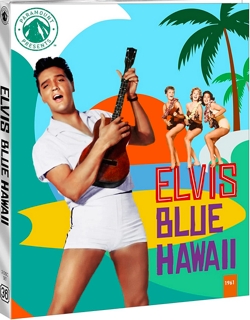
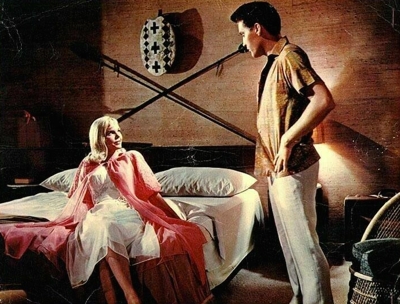
Review of BLUE HAWAII (4K) (1961)

Leave a comment

Grade:  B-
Musical comedy
Rated PG

How do you explain the Elvis Presley phenomenon?  You start with the music. Until Elvis, rock and roll was an evolving synthesis of blues, gospel, jazz, boogie woogie, and western swing. As a type of music that was deliberately dance-oriented, it hooked America’s youths. But Elvis and his “rockabilly” variation made the new music sexy, with hip-swiveling gyrations that caused girls to scream and faint. In no time at all, he became the biggest rock-and-roll star of them all and is still recognized by Guinness as the best-selling solo musical artist of all time, with more than 500 million records sold worldwide.

If you saw Baz Luhrmann’s Elvis you learned that Col. Tom Parker, Elvis’s manager, was exploitive as a promoter. The big money was in movies, so he pushed Elvis away from giving concerts (some of which were banned or caused riots) and instead pointed him in the direction of Hollywood. From 1956-69, Elvis starred in 30 films. Since Elvis wasn’t doing concerts anymore, his movies were the only way fans could actually seehim perform, and they turned out in droves. As a result, Hal Wallis remarked, “A Presley picture is the only sure thing in Hollywood.”

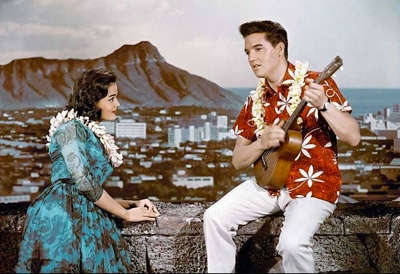
Variety called Blue Hawaii a “handsome, picture-postcard production,” and that’s what it was. With Hawaii becoming the 50th state on August 21, 1959, Americans wanted to see and learn more, and location filming added to the film’s interest—along with a tagline that promised “Ecstatic romance…Exotic dances…Exciting music in the World’s Lushest Paradise of Song.”

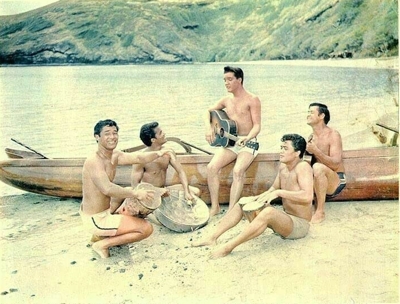
Elvis plays Chad Gates, the son of a wealthy pineapple plantation owner (Roland Winters) and a doting, suffocating mother (Angela Lansbury). Chad dreads seeing his parents after returning from military service and instead goes straight to his beach house to hang with his girlfriend (Joan Blackman as Maile) and local musicians. The premise was genius, since Elvis himself had only recently returned stateside after a stint in the Army. Blue Hawaii was his third post-service film, following Flaming Star and Wild in the Country. Not wanting to work at the family business, Chad instead proposes to start a tourist guide business with Maile. But their first client proves that Chad’s charm is both an asset and a liability as he is tasked with showing a schoolteacher and her four teenage charges a good time.

On a four-star scale, all Elvis movies fall in the 2-to-3 star range, but Blue Hawaii makes everyone’s Elvis Top 10 movie list because of the music. Some of the movies skimped on songs, but this one has 15 of them, including “Can’t Help Falling in Love,” which sold a million copies as a single release. The soundtrack album spent 20 weeks at the top of the Billboard Pop Albums chart. Some of the songs are throwaways, but there are some solid ones here too, like “Almost Always True” (though it’s a bit mind-boggling that Maile would smile and groove along with him as he fudges, in song, the question of whether he was faithful to her). Other upbeat songs that work as something more than soundtrack music include “Rock-a-Hula Baby,” “Beach Boy Blues,” and possibly “Slicin’ Sand,” while Elvis’s renditions of “Hawaiian Wedding Song,” “Aloha Oe,” and “Blue Hawaii” are serviceable enough.

Blue Hawaii finished as the 10th top-grossing film of 1961—so successful that it would provide the formula for many of the Elvis films that followed. The image that these films cultivated was an Elvis meant to be everything to women. A nice guy and a perfect gentleman yet handy with his fists if need be, he also had a slight bad boy or rebellious streak. He was also good with kids and respectful of elders—the kind of guy that, despite the attitude, you could still bring home to meet Mom and Dad. The formula called for Elvis to have at least two women interested in him, at least one cutesy scene with children, one scene with elders, and one scene where he comes to the defense of a woman. And as much as the formula Elvis movie is ridiculed—Top Secret! offers a pretty wicked spoof!—it was still what fans seemed to want. Year after year.

Do the Elvis films still work? Probably not, unless you’re wanting to put yourself in the mindset of young people from the time period, or unless you’re an Elvis fan. If you are, this still ranks in the top third of his films.

This Paramount release contains a superior 4K feature and a Blu-ray version with special features that’s a little grainier.

Entire family:  Yes (pretty wholesome, overall)
Run time:  101 min. Color
Studio/Distributor:  Paramount
Aspect ratio:  2.35:1 widescreen
Featured audio:  Dolby TrueHD 5.1
Bonus features:  C
Includes: 4K Blu-ray, Blu-ray, Digital Copy
Amazon link
Trailer
Rated PG for mild sensuality

Language:  1/10—I didn’t catch anything

Sex:  3/10—Women come on to Elvis, and a girl who’s supposed to be 17 throws herself at him and flirts with others; a woman loses her top in the ocean but nothing is shown and nothing is sexualized

Violence:  2/10—Just a brief restaurant-bar fight

Adult situations:  3/10—One young woman acts up and ostensibly tries to drown herself and is subsequently “spanked” in a rather outdated sequence; flirting and suspicions of cheating

Takeaway:  It’s dizzying reading all of the movies, studio recordings, benefits, and other things that Elvis did, and you can’t help but wonder if he wasn’t so overworked if his personal outcome might have been different

Review of AINBO: SPIRIT OF THE AMAZON (DVD)

Leave a comment

Grade: B/C+
Animation
Not rated (would be PG)

Ainbo: Spirit of the Amazon follows the path of save-the-rainforest themed films like The Emerald Forest (1985, R-rated live action), Ferngully: The Last Rainforest (1992, G-rated animation), and James Cameron’s Avatar (2009). Its footsteps are more indigenous, though, which is a positive.

But having two 13-year-old girls who talk the way adult writers think 13-year-old girls talk, along with some seen-it-before characters and plot points, could narrow the audience. I’ll tell you this, though:  I’ve watched more than my share of animated features from small or start-up animation companies, and this one is far more interesting than any of them—though it too seems aimed at children first and families second.

Rather than spending their budget on big-name voice actors to try to attract an audience, the filmmakers trusted their narration and animation to do the job. It’s beautifully animated, with strong characters and plot.

Directed by José Zelada and Richard Claus, Ainbo is based on a story by Zelada, whose family spent the 1980s living in the Amazon basin, where Zelada heard stories his mother told him that he tried to incorporate into his screenplay. That’s as big of a plus as the film’s environmental and female empowerment themes.

Fittingly, this film about global concerns was an international production, with Tunche Films, Zelda’s Peruvian animation house, handling the bulk of the work in partnership with the Netherlands-based studio Cool Beans and the Dutch animation house Katuni. Produced. Distributed internationally (via TV and DVD) by Cinema Management Group, Ainbo became CMG’s biggest pre-sold animated feature since 2005’s Hoodwinked: The True Story of Little Red Riding Hood.

The dialogue isn’t quite as wink-wink smart as Hoodwinked, and the recognizable elements from other films don’t make any statements about the genre. Adults may or may not find it fun that Zelada decided to channel Disney’s Timon & Pumba in creating his own wild animal characters: a fast-talking armadillo named Dillo and his “spirit animal” pal Vaca, a tapir that, like Disney’s warthog, looks a bit like a big pig. In addition, the warrior-medicine man Atok has a build, features, and personality similar to the antagonist in the animated Road to El Dorado. Meanwhile, family members who have sat through any number of films for children will see two main characters that also seem familiar: the 13-year-old Ainbo, who dreams of becoming a great warrior-hero but is still a klutz, and her 13-year-old “bestie” Zumi, who happens to be the daughter of the chief that also raised Ainbo after her mother passed away. If it wasn’t happening in the Amazon, there would probably be a whole lot more giggling and hugging.

Ainbo is a member of a tribe named after the Candámo River in Peru, near the headwaters of the Amazon. Ainbo and Zumi are a bit more curvaceous than most 13-year-old girls, yet somehow not sexualized. The emphasis is on their friendship and their naiveté. Zumi doesn’t know how to be a king, though her ailing/aging father just passed the responsibility on to her, and Ainbo doesn’t know how to be a warrior.

More

Review of DC LEAGUE OF SUPER-PETS (Blu-ray combo)

Leave a comment

Grade:  B-/B
Animation
Rated PG

You know how you have to make up a list of positives and negatives when you’re undecided about something? That’s what I had to do in order to review DC League of Super-Pets.

Right about now, any children or fans of the DC Universe who are reading this are shaking their heads and muttering Loser or something to that effect. And I get it. My take might go against the grain, because this 2022 Warner Bros. picture earned a 73 percent “fresh” rating at Rotten Tomatoes and an 88 percent favorable audience rating.

Don’t get me wrong. This is an entertaining film—one that I think puts it in the low-to-mid B range. But it took the ledger method for me to reach that conclusion.

I felt conflicted from the very beginning, when a somewhat sappy scene featuring a giggling baby and his perky puppy set against a minimalist background seemed designed to go straight for the heart. All films manipulate viewers’ emotions, but this was a little too obvious and clichéd for me. But very quickly it’s revealed that the baby is Kal-El, and as his conflicted parents put him in a mini-spaceship and wave goodbye, the baby beckons . . . and the puppy obliges, sliding under the closing door as slick and in a nick of time as Indiana Jones. And I thought, How clever!

Throughout the film, I found myself similarly conflicted, but the positives far outweigh the negatives, so let’s start there.

+ It makes sense that if Superman has powers on Earth, so does his dog, Krypto. But the writers did a good job coming up with a logical explanation for how and why the pets in a shelter come to Toy Story life with powers of their own:  Orange Kryptonite. It causes a tough-looking, gruff dog named Ace to become so super strong he can shield others from all sorts of weapons and explosions. Meanwhile, a potbelly pig nicknamed PB can balloon to various gigantic sizes, while an elderly poor-sighted turtle named Merton (a playful allusion to Dr. Seuss?) of course becomes suddenly super fast, and a squirrel named Chip (take that, Dale), whose eyes already look plugged-in, turns into someone that can channel electrical charges. And how clever is it to turn the idea of shelter animals on its head—to have those creatures normally rescued by humans doing the rescuing . . . of super-humans?

More

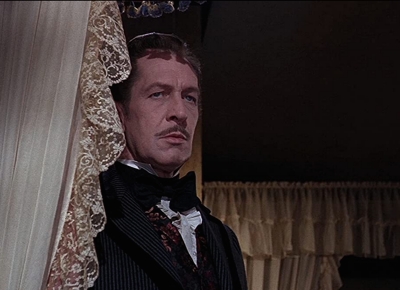
Review of THE BAT (1959) (Special Edition Blu-ray)

Leave a comment

Grade:  B-/C+
Mystery-Thriller
Not rated (would be PG)

Another release timed for Halloween is The Bat (1959), which is in the public domain and widely available for free . . . in blurred versions that are no better than VHS tapes (remember those?). The way to watch, if you’re a fan, is on hi-def Blu-ray from The Film Detective, which becomes available on October 25. Transfer purists might wince at a few compression artifacts, but this print is still plenty sharp and a major improvement over the free stuff.

Don’t let the title, tagline (“When it flies . . . Someone Dies”) or star fool you. The Bat isn’t a horror film. With Vincent Price onboard and cover art reminiscent of The Pit and the Pendulum, you’d certainly think as much, but when I watched this film for the first time a single thought kept popping into my head:  the old “Shadow” radio serials.

With a radio mystery feel to it, The Bat has more in common with Edgar Allan Poe’s detective stories than it does his tales of the macabre. And while Price gets top billing, Agnes Moorehead (Samantha’s mom on the old Bewitched TV series) has the most screen time and is also more engaging. She plays a mystery writer who rents a mansion that has a sketchy past and rumors of hauntings and crazy people, just so she can get ideas for her next book.

Men in Plaid

Sleeping in a haunted house all alone except for a terrified female assistant (Lanita Lane)? No problem. Cornelia van Gorder is more like her sleuth heroes than the typical writer immersed in a real-life adventure that we encounter in movies. Nothing seems to faze her, this creation of Mary Roberts Rinehart, who in 1920 based her three-act play The Bat on her 1908 novel, The Circular Staircase, and lived long enough to see two Hollywood adaptations. She died a year before this faithful adaptation was released on a B-movie twin bill with the 1959 Hammer version of The Mummy. But based on a play, it feels like a play.

More

Review of ISLAND OF THE BLUE DOLPHINS (1964) (Blu-ray)

Leave a comment

Grade:  B-
Drama
Not Rated (would be PG)

Island of the Blue Dolphins was released just four years after the 1960 Newbery Award-winning book on which it was based. If you’re a fan and haven’t seen this film by James B. Clark (A Dog of Flanders, Misty), you’ll be glad to know that the writers and director steered as close to Scott O’Dell’s book as anyone could. And both the book and the film have been used in classrooms to broach discussions of feminism and the mistreatment and resilience of indigenous people.

Parents should be cautioned that this children’s book was written originally for adults, which means that there are some adult things here. Island of the Blue Dolphins has more in common with a novella like John Steinbeck’s The Pearl than it does your typical Newbery Medal recipient. Though there isn’t much blood, many people die in a brief battle, a main character is killed off-screen, and a beloved animal dies onscreen. Through it all, what’s emphasized is the strength and fortitude of a female character that is 12 years old when the story begins.

Black-and-white promo (film is in color)

Celia Kaye, part Cherokee, won a Golden Globe for Best Newcomer as Karana, who must learn how to fend for herself in Robinson Crusoe fashion after her people decide to leave their Channel Island off the coast of southern California following a battle with Russian fur traders and their Aleut trapper allies. Karana is in the evacuation boat when she realizes that her six-year-old brother (Larry Domasin) is still on the island. Rather than leave him, she dives into the water, which is indeed populated by dolphins. That split-second decision will lead to many years of relative solitude and self-sufficiency.

The book and film are set in 1835, and Karana must learn how to do things that were forbidden for her to learn because she was not male—things like how to string a bow and shoot arrows to protect herself from the feral dogs on the island, and how to feather arrows and make nets. When the film was first released, a New York Times reviewer pronounced it a film for children. Maybe that’s because the script calls for the characters to speak in simple language with no contractions to suggest an earlier time period; maybe it’s because the plot itself is as simple as a fable, but with a less obvious lesson; or maybe it’s because the reviewer was conditioned to think of it as a children’s story since it had been published as a children’s book. But for a 1964 production, Island of the Blue Dolphins doesn’t seem all that dated because of these things. And it’s not nearly as slow as the film version of Robinson Crusoe due to the constant presence of a threat on the island.

More

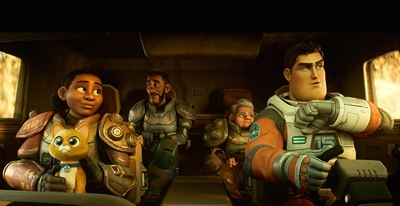
Review of LIGHTYEAR (Blu-ray combo)

Leave a comment

Grade:  B+
Animation
Rated PG

Sometimes you can’t help but hear the buzz about certain films, and I heard two main complaints about Lightyear (2022): that the character wasn’ta toy at all or acting very Buzz-like, and that Disney made a lesbian movie (gasp). And that kind of response slowed down this film at the box office.

Come on, people.  In Toy Story, Buzz Lightyear was an action figure programmed to speak a limited number of sentences, like the old Chatty Cathy dolls. That it came to life when people weren’t around was pure fantasy, and the toy Buzz, upon learning he’s not the real space ranger Buzz Lightyear, spent the rest of the moving dealing with a Pinocchio complex (“I wanna be a real boy”). Meanwhile, Lightyear states its basic premise on a pre-title sequence card that’s onscreen long enough for even slow readers to process:  “In 1995, a boy named Andy got a toy from his favorite movie. This is that movie.”

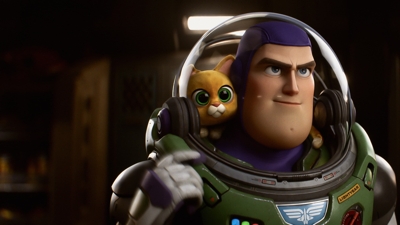
In other words, this animated Buzz is the living human film character that inspired the action figure seen in the Toy Story movies. People complained, Why isn’t Tim Allen the voice? Uh, because Tim Allen voiced a toy; the real Buzz is a different character, voiced here by Chris Evans—who knows a thing or two about playing a superhero. Later critics who gave Disney credit for the cleverness of the idea complained that Disney settled for making a typical origin story, but that also kind of misses the point. To inspire action figures and all sorts of merch, it takes a by-the-numbers blockbuster, and that’s what we get in Lightyear.

As for the lesbianism, I’m guessing that the people who are now losing their minds over a black mermaid are the same ones who bashed this film because it “exposed” children to gay characters. If you haven’t seen the film, you should know that the sexual orientation of Buzz’s best friend and fellow Space Ranger Alisha Hawthorne (voiced by Uzo Aduba) is introduced in innocent, matter-of-fact fashion. When she tells Buzz she got engaged, Buzz responds with the delight of any best friend and tells her how wonderful it is, adding, “Who is she?” Meaning, he’s already known about her orientation and accepts it as another fact of life, like hair color or temperament. So should moviegoers. And it’s treated so subtly here that many children won’t even notice. There are brief touchstone visuals and references to the married couple later parenting a child, and yes, there’s a kiss—but it’s the same kiss of greeting children receive from relatives of all genders. Same-sex marriage is such a blip on the screen that it’s a shame so many people are talking about that instead of the film.

If people have to rip on something (and finding fault with Disney pictures seems to be a national pastime, like Wordle or Sudoku), I’m surprised they haven’t attacked the logic behind the film’s main situational premise.

Buzz, best friend Alisha, and a rookie (Bill Hader) carry out an exploration mission on the planet T’Kani Prime. Quickly they (and we) learn the planet is populated by tentacled life forms, and after their ship is destroyed Buzz declares that they’re marooned. But fast-forward a year later and there’s a full-blown space colony with all kinds of people and the capacity to engineer, build, and operate high-tech buildings and vehicles. And they’re still trying to figure out how to repair or replace the hyperspace fuel crystal that will allow them to return home? Meanwhile, the commander and the rest of the colony (where’d they come from?) decide they want to stay on the planet, so they construct a biodome to protect them from hostile indigenous life forms.

Even small children may wonder about the effectiveness of a dome when the tentacled creatures seem to come from underground, but logic and action movies don’t exactly go hand in hand. And Lightyear is an action movie—a slam-bang ride that abandons warp speed only a handful of times so everyone can catch their breaths and also process poignant Up-style montages that explain why Buzz’s new right-hand ranger has to be Alisha’s space-phobic granddaughter, Izzy (Keke Palmer). Lightyear also alludes to and ramps up elements found in previous slower-paced space films as 2001: A Space Odyssey (instead of H.A.L. we get I.V.A.N.) and Interstellar (a fearful space glide especially stands out). Adults have all the allusions, and the kids will hone in on the action (when the bugs start getting zapped, older youths might have Starship Troopers flashbacks) and the characters—young Izzy, especially.

In Disney movies, animal friends aren’t just foils for characters or a source of comic relief. They’re minor characters who have the potential to steal scenes, and that certainly happens with Sox (Peter Sohn), a robotic cat assigned to be Buzz’s “personal companion robot” to ease his emotional transition after he had been on a long solo mission to retrieve a crystal. Also engaging are the ranger trainees that Buzz ends up with after his return:  Izzy, Mo (Taika Waititi), and the gravel-voiced Darby (Dale Soules), who all find themselves facing and fighting a robot invasion coordinated by . . . yep, Zurg (James Brolin), who is shot at times to make viewers think of that late, great space villain Darth Vader.

Viewers are either going to love all the Star Wars references and consider them clever allusions, or they’re going to hate them and think they’re lazy or unimaginative rip-offs. But they’re present in force, and you’ve been warned. I personally think they add a referential element that feeds into the whole idea of a space blockbuster and shows that director Angus MacLane and his cast and crew were trying to have some fun with this film. Ultimately, that’s what it is:  a fun animated film that’s nota prequel, not a sequel, and not an origin film. It’s a related film that helps to add depth and breadth to the Toy Story universe. Just don’t expect Woody or any of the other toys to show up.

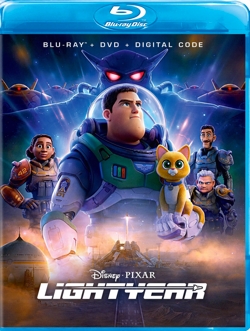
Lightyear is streaming now on Disney+, but decent bonus features on the Blu-ray and repeat-play potential also make this worth adding to your Disney-Pixar home movie collection so you can play it even after it disappears from the online menus. And you know it will. Disney has that habit of returning titles rather quickly to the “vault.” The 7.1 DTS-HDMA soundtrack also has a commanding presence, and I’m not sure that’s the case with the streamed version.

Entire family:  Yes
Run time:  105 min. Color
Aspect ratio:  2.39:1 widescreen
Featured audio:  DTS-HDMA 7.1
Bonus features:  C+
Includes:  Blu-ray, DVD, Digital Code
Amazon link
Trailer
Rated PG for action and peril

Language:  1/10—Aside from a few euphemistic versions of swearwords that I can’t even recall, this is one squeaky clean galaxy

Sex:  0/10—Nothing at all, unless the mere mention of progeny somehow offends you

Violence:  4/10—Mostly it’s peril, because the violence itself is pretty tame, with the tentacled creatures losing a few here and there; when Zurg’s robot army appears, children who’ve been on the Buzz Lightyear theme park ride will get the same shooting gallery sensation watching this film, even down to the sounds

Adult situations:  2/10—A character has to deal with feelings of loss and displacement

Takeaway:  Disney-Pixar still has a friend in me, as long as they keep producing high-quality films like this one that continue to reflect the studio’s commitment to creativity and excellence

Review of TWICE TOLD TALES (1963) (Blu-ray)

Leave a comment

Grade:  B-/C+
Drama/Horror
Not Rated (would be PG)

Rewatching Twice Told Tales on the new Kino Lorber Blu-ray, I found myself wondering about the ideal audience for this film adaptation of Nathaniel Hawthorne stories featuring screen legend Vincent Price.

Children old enough to have read the stories in school might be curious to see how the 1963 film treatment was handled, but I’m not sure that they will appreciate a tone that tends toward the melodramatic. Director Sidney Salkow took a break from directing popular TV series like Death Valley Days to churn out seven B-movie genre films: four westerns, a mystery, and two fantasies—one of them being this anthology of Hawthorne tales.

Whether by design or coincidence, the three stories are presented in descending order of appeal. The strongest tale, “Dr. Heidegger’s Experiment,” is a short story that plumbs the depths of human desire for a fountain of youth or immortality. Like the frequently anthologized Edgar Allan Poe story “The Cask of Amontillado,” it involves a friendship that’s solid on the surface but bubbling beneath with hidden emotions. Sebastian Cabot—whose voice children may recognize as the narrator of Disney’s Winnie the Pooh films and the character Bagheera in Disney’s animated Jungle Book—plays Carl Heidegger, who celebrates his 79th birthday with best friend Alex (Price), his only companion since his beloved fiancée Sylvia (Mari Blanchard) died the night before they were to be married 38 years ago. But a “dark and stormy night” causes the door to a crypt in the backyard where her coffin is housed (yep, we’re talking Gothic romance) to open. Carl feels compelled to check on her, and both men are shocked to see that her body appears as it did when she was alive. The rest of the tale follows Dr. Heidegger’s drive to discover what preserved her and maybe even bring her back to life.

The type of horror included in these Price Told Tales is the same sort one would find in a Jaycee’s haunted house: skeletons, dead bodies, creatures dying instantly as if from witchcraft, blood oozing from strange places, etc.—minus the jump scares. It’s pretty tame but still somehow memorable . . . because of the images or concepts, or because of their pairing with old-time melodrama?

More

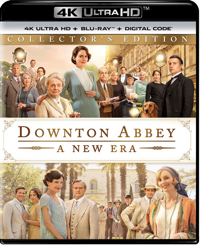
Review of DOWNTON ABBEY: A NEW ERA (4K UltraHD, Blu-ray)

1 Comment

Grade:  B+
Drama
Rated PG

It’s almost a cliché that in Hollywood (and presumably everywhere else films are made) there are two main plots:  something comes into the heroes’ world, or the heroes leave their world. Either way, they encounter the sort of challenges, adventures, or drama that come from a disruption of routine.

The first Downton Abbey movie (2019) was about something coming into the world of the Crawley family and their servants. It revolved around a visit to Downton from King George V and Queen Mary, and the only exit was one of the staff, who went to New York to visit parents and got arrested at an underground gay nightclub. Downton Abbey: A New Era (2022) seems more richly plotted because there is a balance between the coming and going, with heftier plotlines that are equally intricate and dramatic. 

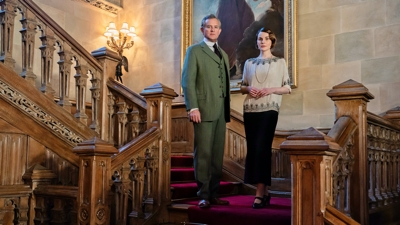
Robert and Mary

On the home front, a film company requests permission to shoot a silent film at Downton, and Robert Crawley (Hugh Bonneville) is opposed . . . until oldest daughter Lady Mary (Michelle Dockery) convinces him that the income would pay for the new roof they so desperately need. She assures her father that she will supervise the affair and keep a close watch. Naturally, the staff gets as excited about a movie being made at Downton as they did when the King and Queen visited—except, of course, for the ever-so-grumpy Mr. Carson (Jim Carter)—but their excitement is tempered by a less-than-congenial leading lady (Laura Haddock) and the disappointing announcement that funding for the movie is being pulled because only “talking pictures” are making money. Of course, shades of Singin’ in the Rain, they decide to improvise in order to make a film with sound, and even the staff gets into the act. Literally.

More

Older Entries Newer Entries