

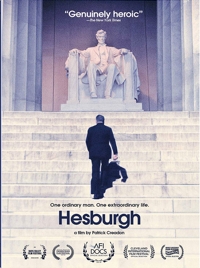
 Grade: B+
Entire family: No
2018, 106 min., B&W and Color
Documentary
Not rated (would be PG for Kent State footage)
Music Box Films
Aspect ratio: 1.85:1
Featured audio: Dolby Digital 5.1
Trailer
Amazon link
Pres. Dwight D. Eisenhower asked him to serve on the National Science Board and later the U.S. Civil Rights Commission, and he was the one who brought Democrats and Republicans together on the latter, then brokered the approval of 11 civil rights recommendations. Later “Ike” asked him to help bridge the gap between Russia and the U.S., and he became good friends with the Soviet Union’s delegate to the U.N. in order to relax tensions.
Dr. Martin Luther King, Jr. asked him to be by his side for a crucial civil rights rally at Chicago’s Soldier Field on June 21, 1964, and there he linked arms with Dr. King and sang “We Shall Overcome.” Eleven days later the Civil Rights Act was signed, and years later King’s widow, Coretta Scott King, would call him “One of the giants of the civil rights movement.”
Pres. Richard M. Nixon called on him to stop anti-war protesters at Notre Dame, and he cracked down on them . . . but after Kent State, had a change of heart and publicly attacked Nixon and the Vietnam War. He’s prominently mentioned on the Nixon tapes as a “problem.”
 Who knew that the life of a college president could be so influential . . . and fascinating?
Rev. Theodore Hesburgh was president of the University of Notre Dame from 1952-87, and this 2018 biography begins with a voiceover recording of him saying “Since the age of six, I wanted to be a priest,” and ends with his funeral procession and thousands of Notre Dame students lining the route to the cemetery. But it’s as much a documentary about history as it is a man who devoted his life to the service of others, and there are some incredible stories here.
Who knew that the president of Notre Dame had such power?
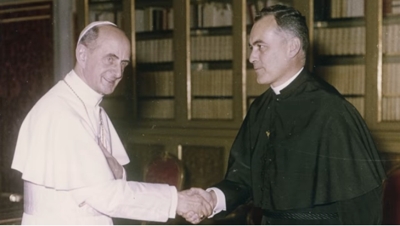
One of the stories Hesburgh tells is about a Cardinalship that he turned down. “I came to know all of the popes throughout my life,” Hesburgh says, “but the only one I considered a true friend was Giovanni Montini, who would take on the name Pope Paul VI.” The Pope gave him the enormous emerald ring he wore as a cardinal, saying, “Now it’s yours,” but hoping he would accept his offer. “I said, ‘Thank you for the ring, Your Holiness,’ and I put it in my pocket. . . . [but] I can do a lot more as a university president.”
Who knew that a fishing trip was behind the success of civil rights reform in the U.S.? More



 I
I



 Family Home Theater